The 12-Week Guided Recovery Program
You can remember the lies. The humiliation. The nights you cried yourself to sleep.
You can explain exactly why the relationship was unhealthy.
You can even swear you’ll never go back.
But when they text you, your heart still races.
When they disappear, you panic.
When they show you the smallest bit of affection, you start questioning everything you promised yourself.
And when you try to move on, you find yourself missing the very person who caused so much of your pain.
The hardest part isn’t knowing you need to let go. It’s getting through the moments when every part of you wants to hold on.
That’s exactly what Trauma Bond Detox is designed to help you work through.
A structured 12-week recovery program combining live weekly coaching, 84 days of guided support, practical exercises, and a private community.
So you can stop facing the same emotional cycle without a plan and start building the skills, boundaries, and confidence to move forward.

Enrollment: $397
Limited group enrollment. Three monthly payments of $149 also available.
Secure checkout · PayPal · Credit Card · Debit Card · Google Pay · Apple Pay


Before you check the time.
Before you get out of bed.
Before your day has even started.
Their name is already in your head.
You wonder what they’re doing. Who they’re talking to. Whether they’ve forgotten you.
You haven’t even had breakfast, and you’re already emotionally exhausted.
You tell yourself you’re not waiting for their message.
But every notification makes you look.
Every unfamiliar number makes you wonder.
You check their social media even though you know it will hurt.
And when you see something you don’t like, your entire day changes.
You remember how they looked at you in the beginning.
How intensely they pursued you.
The promises.
The affection.
The person you believed they were.
Then you start wondering:
“What if that person is still in there?”
“What if I gave up too soon?”
“What if this time they really change?”
And suddenly the relationship you desperately wanted to escape begins looking like something you might want back.
What did they mean by that?
Why did they say they loved you and then disappear?
Did you overreact?
Could you have handled things differently?
Were you asking for too much?
You replay the same conversations looking for an answer that finally makes everything make sense.
But the more you think, the more confused you feel.
You lasted three days.
Or three weeks.
Maybe even three months.
Then one lonely evening, one unexpected message, or one painful memory changed everything.
You replied.
You checked their profile.
You called.
Or you went back.
And afterward, you promised yourself it would never happen again.
But you’ve made that promise before.
People think you’re moving on.
You go to work.
You answer messages.
You smile when you’re supposed to.
But nobody sees the hours you spend fighting the urge to contact them.
Nobody sees the tears after midnight.
Nobody knows how much of your day is still organized around someone who isn’t even there.
And sometimes you wonder:
“How can someone who hurt me this much still have this much power over my emotions?”
You may recognize yourself in several of these stages.
You remember the person they were at the beginning.
The affection felt real.
The connection felt different.
You keep hoping that version of the relationship will return.
Something happens again.
A lie.
A betrayal.
An insult.
A disappearing act.
Another argument that somehow becomes your fault.
You tell yourself you’ve had enough.
You pull away.
You block them.
You stop responding.
You decide to focus on yourself.
For a moment, you feel stronger.
Then the loneliness arrives.
The memories become louder.
You start remembering what you miss instead of why you left.
You wonder whether they miss you too.
Sometimes they reach out.
Sometimes you do.
A message becomes a conversation.
A conversation becomes hope.
And hope makes it easier to overlook what happened before.
The familiar problems return.
You feel disappointed, ashamed, and exhausted.
You promise yourself this was the last time.
Then the cycle begins again.
Not everyone experiences every stage in the same order. But if this pattern feels painfully familiar, you know how difficult it can be to interrupt.
The goal of Trauma Bond Detox is to help you recognize your personal cycle and develop practical ways to respond differently before the next return.

You already know the relationship hurt you.
You may have spent months researching narcissistic behavior, emotional manipulation, love bombing, gaslighting, and trauma bonds.
You understand the warning signs.
You can recognize the excuses.
You know the apologies don’t erase the harm.
So why do you still struggle to leave them behind?
Because understanding a relationship and changing your emotional responses to it are two different tasks.
When affection and rejection repeatedly alternate, unpredictable moments of relief can become especially compelling.
Over time, familiar emotional patterns can be difficult to interrupt, even when you recognize that the relationship is harmful.
Knowing that doesn’t automatically tell you what to do when the urge to reconnect feels overwhelming.
Or when grief makes you question your decision.
Or when you feel guilty for setting a boundary.
Or when they return with the exact words you’ve wanted to hear.
You need more than an explanation of the cycle. You need practical ways to respond when it starts happening again.
That’s the work we’ll focus on together.
This isn’t about frightening you into a decision.
It’s about recognizing what the current pattern is already costing you.
You keep checking whether they’ve messaged.
You keep wondering whether they’ve changed.
Your mood still depends on something they do or don’t do.
You question your memories.
You revisit decisions you’ve already made.
You struggle to trust your judgment because every lonely moment makes you reconsider.
Your attention is divided.
Your sleep may suffer.
You find it difficult to concentrate on work, friendships, family, or things you used to enjoy.
You postpone plans.
You hesitate to meet new people.
You spend energy trying to understand someone else’s behavior instead of deciding what you want for yourself.
“This time I won’t reply.”
“This time I won’t check.”
“This time I’m really done.”
And when those promises become difficult to keep, the shame grows.
The cost isn’t simply missing someone.
It’s how much of your time, attention, and emotional energy the pattern continues to occupy.
Of course, no program can guarantee that you’ll never struggle again.
But you can decide to stop relying on willpower alone and begin developing a more structured way to respond.
Not because you’ve magically stopped caring.
But because you’re practicing different responses, building support, and working through the attachment one step at a time.
That’s the direction Trauma Bond Detox is designed to support.

Trauma Bond Detox is a structured group coaching program for people who understand their relationship was harmful but continue struggling with emotional attachment, repeated contact, obsessive thinking, and difficulty moving forward.
Over 12 weeks, we’ll focus on three major areas:
Recognize your triggers, work through intense urges, and build practical strategies for difficult moments.
Explore self-blame, grief, emotional needs, automatic responses, and relationship expectations.
Develop boundaries, reconnect with your identity, and prepare a plan for setbacks and future contact.
You’ll have weekly live coaching, daily guidance, structured exercises, and a private community to support your participation.
This is not a promise that every painful feeling will disappear in 12 weeks.
It’s a commitment to give you a clear process, practical tools, and consistent guidance as you work toward recovery.
Weeks 1–4: From Constant Emotional Reactivity To Having A Plan

Understand Your Personal Trauma Bond
We’ll explore how the relationship developed, identify the patterns that kept you attached, and begin mapping your personal cycle.
Survive The Urge To Reach Out
Learn practical strategies for moments of longing, intrusive thoughts, anxiety, and the temptation to reconnect.
Create an emergency response plan you can use when the urge becomes intense.
Separate The Memories From The Full Reality
Explore idealization, conflicting memories, and the difference between what you hoped the relationship would become and what you experienced.
Work Through Shame And Self-Blame
Examine the guilt associated with staying, returning, or struggling to leave.
Practice responding to setbacks without turning them into reasons to give up.
By the end of Phase One, you’ll have worked on identifying your triggers and creating practical responses for difficult moments.
Weeks 5–8: From Repeating Old Responses To Practicing New Ones

Interrupt Automatic Thought And Behavior Patterns
Identify the thoughts, routines, and emotional triggers that repeatedly pull you toward contact.
Practice alternative responses.
Explore The Emotional Needs Beneath The Attachment
Examine fear of abandonment, approval seeking, attachment expectations, and recurring relationship patterns.
Build Emotional Regulation Skills
Practice grounding techniques, calming exercises, and strategies for responding to distress.
Process Grief And The Future You Imagined
Work through the loss of the relationship, unmet expectations, anger, sadness, and the life you thought you were building together.
By the end of Phase Two, you’ll have practiced new ways of responding to difficult feelings and recurring patterns.
Weeks 9–12: From Living Around The Relationship To Reclaiming Your Direction

Reconnect With Your Identity
Explore your interests, priorities, personal values, and sense of self beyond the relationship.
Build Boundaries And Relationship Standards
Practice communicating boundaries, recognizing unhealthy patterns, and identifying what you need from future relationships.
Prepare For Hoovering And Setbacks
Create a practical plan for unexpected contact, renewed promises, and moments when old patterns return.
Create Your Personal Recovery Roadmap
Review what you’ve learned, identify areas that still need attention, and create a plan for continuing your progress.
By the end of Phase Three, you’ll have a personal roadmap to continue working on your recovery after the program ends.

One 60-minute group coaching session every week.
Bring your questions.
Discuss challenges you’re experiencing.
Learn how to apply the week’s material to real situations.
Review your progress and identify what to work on next.
The benefit: You have opportunities for guidance throughout the 12 weeks instead of being left to interpret everything independently.
Receive one structured email every day for 12 weeks.
Each email helps you focus on a specific concept, reflection, or exercise.
Some days will focus on understanding patterns.
Others will focus on managing urges, boundaries, grief, confidence, or rebuilding your identity.
The benefit: You have a consistent next step to work on, even between live sessions.
Structured exercises, reflection questions, journal prompts, and planning tools aligned with the weekly sessions.
The benefit: You can turn what you’re learning into written plans and exercises you can revisit.
The program includes resources for situations such as:
The benefit: You’ll have practical starting points for common challenges instead of having to invent a response while overwhelmed.
Grounding, reflection, calming, and self-compassion practices to support the work you’re doing throughout the program.
The benefit: Additional ways to practice responding to difficult emotions.
A private space to connect with other people working through similar relationship experiences.
Share progress.
Discuss challenges.
Ask questions.
Find encouragement from people who understand why moving forward can be complicated.
The benefit: You don’t have to explain your entire experience from the beginning every time you need peer support.
Miss a live call?
Review the session recording and return to the material when you need it.
The benefit: You can continue following the program even when your schedule gets complicated.
The goal isn’t to make you hate them.
It isn’t to erase every memory.
It isn’t to pretend the relationship never mattered.
It’s to help you build a life where your next decision isn’t automatically controlled by the urge to reconnect.
Here’s what that can look like in everyday life.
Instead of immediately acting on the urge, you have a specific response plan and exercises to try.
Instead of remembering only the affection, you practice examining the complete relationship.
Instead of deciding in the middle of an emotional moment, you have boundaries and a contact plan to consider.
Instead of treating guilt as proof you made the wrong decision, you learn to examine the feeling more carefully.
Instead of deciding that all your progress has disappeared, you have a way to reflect, adjust, and continue.
Instead of organizing every plan around whether they’ll return, you begin reconnecting with what matters to you.
These are the kinds of practical changes we’ll work toward throughout the program.

Verified Client

“I Was Stuck For 19 Years. This Program Changed Everything.”
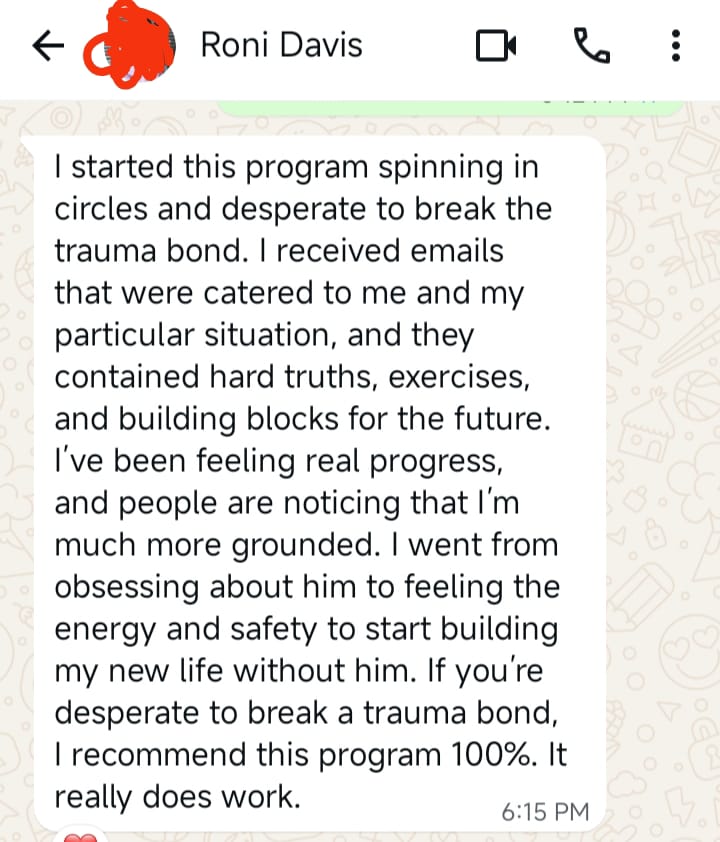
“I started this program spinning in circles and desperate to break the trauma bond. I received emails that were catered to me and my particular situation, and they contained hard truths, exercises, and building blocks for the future.
I’ve been feeling real progress, and people are noticing that I’m much more grounded.
I went from obsessing about him to feeling the energy and safety to start building my new life without him.
If you’re desperate to break a trauma bond, I recommend this program 100%. It really does work.”
Individual participant experience. Results vary.
Real words from people working through the same cycle.
“I finally have a plan for the hard moments.”
Before this program I understood everything about trauma bonds and still went back. The weekly structure changed that. When the urge hits now, I know exactly which exercise to use instead of texting him.
“The daily emails kept me going.”
Some mornings the email was the only thing standing between me and breaking no contact. It always seemed to arrive talking about exactly what I was struggling with that day.
“I stopped blaming myself.”
Week 4 alone was worth the enrollment. I carried shame for years for staying and for going back. This program helped me put that down and actually start rebuilding my life.
“When he came back, I was ready.”
He hoovered in week 9, right on schedule. Because we had prepared for it, I didn’t decide in the middle of the emotion. I followed my plan. First time in six years I didn’t go back.
“The community understood without me explaining.”
Everywhere else I had to justify why leaving was hard. Here, people just got it. That alone made the lonely evenings so much easier to get through.
“I wake up and think about my own life now.”
He used to be my first thought every single morning. By week 12 my first thought was my own plans. I didn’t think that shift was possible for me. It is.
Individual participant experiences. Results vary.
For over seven years, my work has focused on helping people understand narcissistic abuse, toxic relationships, emotional manipulation, and the challenges of moving forward.
One of the most difficult experiences people describe is understanding exactly how much a relationship hurt them while still feeling intensely attached.
They know the red flags.
They know the repeated patterns.
They know why they wanted to leave.
But when the loneliness, memories, or unexpected messages arrive, knowing those things doesn’t always make the next decision easier.
I created Trauma Bond Detox to give people a more structured way to work through those moments.
Not just understanding.
Not just encouragement.
A 12-week process combining education, practical exercises, live coaching, and consistent guidance.
Because the work of moving forward often happens in ordinary moments:
When you’re alone with your phone.
When a memory catches you off guard.
When you’re tempted to answer a message.
When you’re trying to rebuild your confidence after another setback.
That’s where I want this program to be useful.

You don’t have to be completely over the relationship to join.
You just need to be willing to begin working on the patterns that keep pulling you back.
Think about the last three months.
How many times did you check their profile?
How many nights did you lose sleep replaying conversations?
How many times did you promise yourself you wouldn’t reply?
How many hours did you spend wondering whether they missed you?
How many decisions were influenced by the hope that things might finally change?
Now imagine the next 90 days.
You could continue trying to manage everything without a structured plan.
Or you could spend those weeks learning, practicing, asking questions, and building strategies for the moments you find most difficult.
You cannot change the last 90 days. But you can choose how to approach the next 90.
And you don’t have to wait until you’re completely exhausted to begin.
Your enrollment includes:
Both options include the same core program access.
Every enrollment goes through secure checkout. Choose whichever payment option works best for you:
Your first two weeks are covered by the Refund Promise. Attend the first two live sessions, complete the exercises, and if the program isn’t a good fit, request a refund under the program’s terms.
Your payment is encrypted and processed securely by trusted payment providers. Your card details go to them — never through this page.
Your enrollment stays private. What you choose to share inside the program is covered by the program’s participation guidelines.
You’re not left on your own after checkout — 12 live coaching calls, 84 days of guidance emails, and a private participant community are all included.
I want you to experience the structure and guidance before deciding whether the program is right for you.
Attend the first two live sessions.
Complete the assigned exercises.
Participate in the program.
If you don’t feel the program is a good fit after those first two weeks, contact us within the published refund window to request a refund under the program’s terms.
You can evaluate the experience instead of relying on promises alone.
That’s one of the patterns this program addresses. You’ll work on recognizing triggers, managing urges, understanding repeated returns, and preparing for setbacks.
You don’t need to stop missing them before joining. The program is designed for people who are struggling with attachment and want to work on responding to it differently.
Some participants have children, work responsibilities, or other reasons they must remain in contact. The program includes material on boundaries and managing necessary communication.
You can participate in the learning and exercises without disclosing every private detail to the group. Live coaching and community participation are subject to the program’s participation guidelines.
Recordings are included so you can review the session afterward.
No. Trauma Bond Detox is an educational group coaching program, not psychotherapy, diagnosis, or medical treatment. It can complement appropriate professional care.
No program can guarantee a particular recovery timeline. The goal is to help you build practical skills, greater awareness, healthier responses, and a plan you can continue using.
The confirmed start date and weekly session schedule will be provided before you complete enrollment.
Waiting for an apology.
Waiting for an explanation.
Waiting for the person you remember to return.
Waiting for the feelings to disappear.
Waiting until you feel strong enough to move forward.
But your next chapter doesn’t have to depend on what they do next.
You can begin working on your own responses.
Your own boundaries.
Your own confidence.
Your own plans.
Your own life.
Not through another promise to yourself that tomorrow will be different.
Through a structured process, consistent practice, and support over the next 12 weeks.
12 Weeks. 12 Live Calls. 84 Days Of Guidance.
$397 — One-Time Enrollment
Or choose three monthly payments of $149.
Secure checkout · PayPal · Visa · Mastercard · Amex · Discover · Credit Card · Debit Card · Google Pay · Apple Pay

You don’t have to stop missing them before you start choosing yourself.