

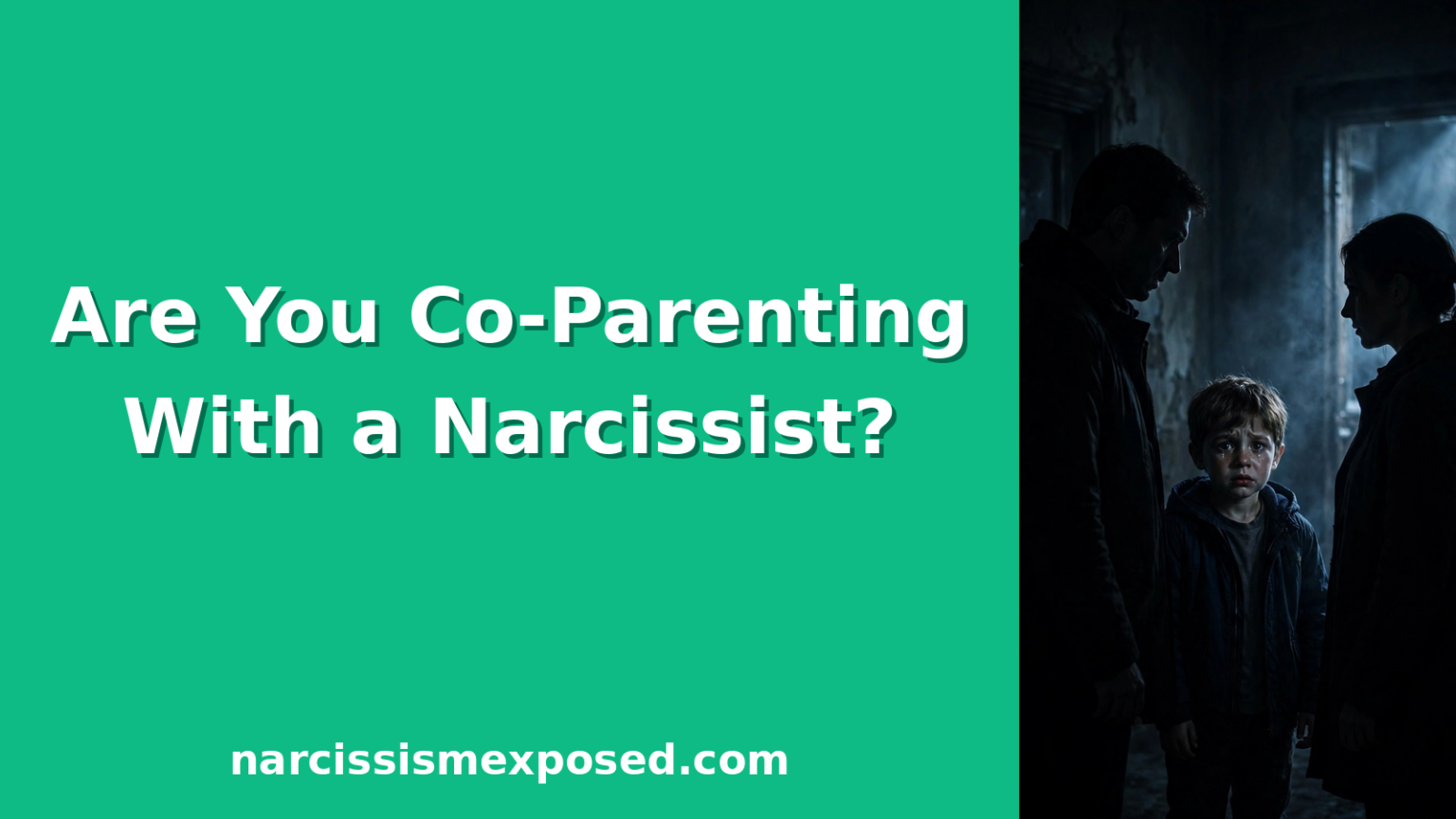
You left the relationship thinking the worst was over. The arguments, the control, the walking on eggshells: all of that was supposed to end the day you walked away. Instead, you got a new war, fought over pickup times, school decisions, and bedtime routines. If you are googling the signs you are co parenting with a narcissist at 2 AM while your ex sends angry texts about a schedule change, this article is for you.
- The Short Answer to the Signs You Are Co Parenting With a Narcissist
- Sign #1: The Custody Schedule Is a Suggestion, Not an Agreement
- Sign #2: Your Child Has Become the Messenger
- Sign #3: They Badmouth You to Your Own Children
- Sign #4: Every Handoff Turns Into a War Zone
- Sign #5: They Play the Fun Parent While You Play the Villain
- Sign #6: They Interrogate the Kids About Your Life
- Sign #7: They Recruit Allies and Run Smear Campaigns
- Sign #8: Agreements Get Rewritten Overnight
- Sign #9: Your Boundaries Are Invisible to Them
- Sign #10: They Weaponize Money and Legal Threats
- Sign #11: They Withhold School and Medical Information
- Sign #12: The Kids Come Home Different
- Sign #13: They Parent for the Audience, Not for the Kids
- Stop Co-Parenting. Start Parallel Parenting.
- Protecting Your Children While You Parallel Parent
- You Cannot Change Them, But You Can Protect Everything That Matters
- Frequently Asked Questions
Here is the truth nobody tells you during the divorce: co-parenting requires two adults who put their children first, and a narcissist cannot do that. Narcissistic personality disorder is defined by grandiosity, a constant need for admiration, and a profound lack of empathy, which means your children will not be protected from the pattern. They will become part of it. Your ex will not co-parent with you. They will parent AT you, using the kids as the battlefield and the weapon at the same time.
But here is the other truth: you do not need their cooperation to protect your children. You need a different playbook. The thirteen signs below will confirm what your gut already knows, and the parallel parenting strategies after them will show you exactly how to survive this without losing your mind or your kids.
The Short Answer to the Signs You Are Co Parenting With a Narcissist
If your ex treats custody agreements as optional, uses your children as messengers and spies, badmouths you to the kids, turns every handoff into a confrontation, and treats boundaries like invitations, you are not co-parenting. You are dealing with a narcissistic co-parent, and traditional co-parenting advice will not work.
The solution is not better communication. It is LESS communication, structured differently. Psychologists call it parallel parenting: each parent parents independently during their own time, with minimal contact, written-only communication, and ironclad boundaries. As one clinical guide to co-parenting with a narcissist puts it, parallel parenting limits the interaction between the parents and lets each parent adhere to their own decisions, activities, and parenting style.
If more than a few of the signs below match your life, stop trying to co-parent and start parallel parenting.
Sign #1: The Custody Schedule Is a Suggestion, Not an Agreement
A healthy co-parent treats the parenting schedule like a contract. A narcissistic co-parent treats it like a starting bid. They arrive late without warning, return the kids early or late on a whim, book vacations during your time, and rewrite the rules at will. Object, and you are suddenly “inflexible” and “impossible to work with.”
This is not forgetfulness. It is control: the schedule is one of the few levers they still have over your life, and pulling it keeps you reactive and anxious. Refusing to respect agreed-upon parenting schedules and boundaries is one of the hallmark signs of a narcissistic co-parent, because the agreement itself offends their sense of entitlement.
Sign #2: Your Child Has Become the Messenger
“TELL your mother that if she is late again, I am keeping you for the whole weekend.” “Ask your father when he is sending the money he owes me.”
If your child delivers messages between two adults, you are witnessing one of the clearest signs you are co parenting with a narcissist. Every message puts them in the middle of a conflict they did not create and cannot resolve. Using a child as a messenger between separated parents is a classic form of parent-child triangulation, linked by research to poorer psychological adjustment in adolescents pulled into hostile interparental conflict.
Your child did not volunteer for this job. The fix is non-negotiable: all adult communication goes through a co-parenting app or email, in writing, between the adults. Tell your child, gently and firmly, that they never have to carry messages between adults.
Sign #3: They Badmouth You to Your Own Children
“Mommy does not really care about you. If she did, she would not have left.” “Your father is a liar. Do not believe anything he tells you.”
A narcissistic co-parent does not just disagree with you privately. They campaign against you inside your own child’s mind: criticizing your parenting, mocking your rules, rewriting the breakup so you are the villain and they are the victim. Criticizing the other parent in front of the children is especially damaging, because it discredits your ability to parent in the one place that matters most.
A narcissist experiences children as extensions of themselves, not as separate people, so winning a child’s loyalty feels like winning. In its sustained form, this is parental alienation, and courts take it seriously, so document it. Save the screenshots. Keep a dated log.
Sign #4: Every Handoff Turns Into a War Zone
Pickup should take ninety seconds: child, bag, goodbye. With a narcissistic ex, it becomes forty-five minutes of interrogation, insults, and theater. They arrive early to catch you off guard or late to make you wait, start arguments in front of the kids, and drop comments designed to provoke you (“Nice to see you finally acting like a parent”), then play innocent when you react.
This is deliberate. Conflict is their comfort zone, and your emotional reaction is the prize. A narcissist’s backhanded comments and character attacks are designed to elicit an emotional response, so they can then accuse you of being out of control. Expect the nastiness so it stops blindsiding you, then refuse to give them the reaction. Confirm the time, collect your child, and leave.
Sign #5: They Play the Fun Parent While You Play the Villain
At their house, there are no bedtimes, no homework rules, no vegetables, and endless gifts. At your house, there is structure, and suddenly you are the boring one, the strict one, the mean one. Your child comes home asking, “Dad lets me stay up as late as I want. Why do you not love me enough to do that?”
The Disney parent routine is not generosity. It is strategy: narcissistic co-parents prioritize their own need for admiration, playing the fun parent while casting the other as strict or unreasonable.
Do not compete. Your child does not need a second fun house. They need one safe, predictable home where rules do not change with someone’s mood. Children remember consistency, not presents.
Sign #6: They Interrogate the Kids About Your Life
“Who was that man in the kitchen?” “Take a picture of your dad’s apartment and send it to me.”
A narcissistic co-parent treats their time with the children as an intelligence operation, pumping them for details about your dating life, finances, and home, then using that information to start fights or file complaints. Some even tell children to record or photograph the other parent’s home to file unfounded claims.
This puts your child in an impossible position: spy on the parent they love, or face the other parent’s cold fury. Tell your children they never have to report on your household, and that your home is their safe space.
Sign #7: They Recruit Allies and Run Smear Campaigns
The smear campaign did not end with the divorce. It just got new recruits: mutual friends, in-laws, the other parents at school, the soccer coach. A narcissistic co-parent needs an audience, so they tell anyone who will listen that you are unstable, neglectful, or dangerous. Triangulation is one of the narcissist’s favorite tools: aligning the kids, and everyone else, against you so you end up cast as the bad guy.
It is infuriating, and your instinct will be to defend yourself to every person they poisoned. Do not. You cannot out-argue a smear campaign, because the narcissist is not playing by truth rules. Stay calm, stay consistent, and let the people who matter watch your actual parenting over time. Document the pattern, because documented false reports are exactly what family courts need to see.
Sign #8: Agreements Get Rewritten Overnight
“We never agreed to that.” “I said I would think about it, not that I would do it.” “That was before things changed.”
Agreements you both made, sometimes in front of a mediator, get denied or reinterpreted the moment they become inconvenient. This is gaslighting applied to logistics, designed to exhaust you into giving up.
This is exactly why verbal agreements with a narcissist are worthless. Everything must be in writing: email, a co-parenting app, or the court order itself. When they rewrite history, you do not argue about what was said. You forward the message. Blame-shifting and denial of responsibility are core signs of a narcissistic co-parent, and the only antidote is a paper trail so complete that reality cannot be debated.
Sign #9: Your Boundaries Are Invisible to Them
You asked for written-only communication. They call twelve times. You set a pickup time. They arrive an hour early and wait in your driveway. You said no joint holidays. They show up at the school concert anyway. Insisting on celebrating holidays together despite the other parent’s refusal, and showing up even when told no, is textbook narcissistic co-parent behavior.
Boundaries are not requests to a narcissist. They are challenges, and every one you set will be tested. So make your boundaries structural, not conversational: app-only communication instead of “please do not call,” neutral exchange locations instead of “please do not come to my house,” court-ordered specifics instead of “please be reasonable.” You do not need them to respect your boundaries. You need systems that do not require their respect.
If you are still in the thick of this and barely holding it together, whether you are living with a narcissist you cannot leave yet or freshly out and drowning in the chaos, you need more than articles. You need a plan. The Survival Workbook gives you step by step strategies to protect your mind, set boundaries that actually hold, and stay sane while you navigate the hardest season. And if you have left but the pull of the old dynamic keeps dragging you back into their games, the 30-Day Trauma Bond Recovery Workbook walks you day by day through breaking the attachment that makes their chaos feel like home.
Sign #10: They Weaponize Money and Legal Threats
“I will take the kids away from you.” “I will make sure you never see them again.”
Custody threats are the narcissist’s favorite blunt instrument: the children are your greatest vulnerability, so they aim every threat there. They withhold child support to punish you, then call you money-obsessed when you ask for it. They file frivolous motions and use the court system as harassment, a pattern therapists call litigation abuse.
Never respond to legal threats in the moment. Document the threat, forward it to your attorney, and say nothing to your ex. The calm, factual, child-focused parent is the one the court trusts.
Sign #11: They Withhold School and Medical Information
They “forget” to tell you about the parent-teacher conference. They take the child to the doctor and never share what was said. They enroll the kid in activities during your time without consulting you. Information is power, and a narcissistic co-parent hoards it to keep you in the dark.
The fix: go directly to the sources. Contact the school and ask to be added to all communications and portals. Introduce yourself to the pediatrician and request duplicate records. Keep your own calendar of activities. You do not need your ex’s permission to be an informed parent.
Sign #12: The Kids Come Home Different
After time with your ex, your child is anxious, withdrawn, defiant, or oddly cold toward you. They repeat phrases no child would invent. They act out for a day or two after every transition, a pattern so common it has a name: transition behavior.
Pay attention to this sign, because it matters most. Everything else on this list is about how they treat you. This one is about what it is doing to your children. Children caught between high-conflict parents often feel confused, responsible for adult emotions, afraid to upset either parent, and pressured to choose sides. You cannot control the other household, but you can make your home the place where they decompress: predictable routines, open conversations, and the constant reassurance that they are allowed to love both parents.
Sign #13: They Parent for the Audience, Not for the Kids
Watch your ex when people are watching versus when they are not. At the school play, they are the most devoted parent in the room, camera out. At home, they are on their phone while the kids raise themselves. On social media, they post tributes to their “babies.” In private, they forget pickup and hand the kids a tablet for six hours.
Narcissistic supply does not distinguish between a romantic partner and a child. Your kids are props in a performance of wonderful parenthood, trotted out for applause and shelved when the audience leaves. Excessive boasting and the need to be seen as the more capable parent are classic narcissistic co-parent signs, and the performance is always for someone else’s benefit.
You do not need an audience. Be the boring, consistent, present parent when nobody is watching. Your children will eventually see the difference between performance and presence.
Stop Co-Parenting. Start Parallel Parenting.
If you recognized your life in the signs above, here is the shift that changes everything: stop trying to co-parent. Co-parenting assumes goodwill, flexibility, and shared priorities, and no effort on your part will create those in someone else. Parallel parenting is the alternative: a structured, low-contact model where each parent parents independently during their own time, and interaction drops to the bare logistical minimum.
Here is how to build it:
Switch to written-only communication. No calls, no voice notes, no face-to-face “quick chats” at pickup. Use email or a co-parenting app like OurFamilyWizard or TalkingParents: timestamped, unalterable records that protect you and expose manipulation.
Use the BIFF method for every message. BIFF stands for Brief, Informative, Friendly, and Firm, a framework from Bill Eddy of the High Conflict Institute built for exactly this. Every response is a few sentences: the facts, a neutral tone, a clear endpoint. “Thank you for your message. Pickup is confirmed for 5:00 PM Friday at the school parking lot, per the parenting plan. No changes are needed.” No rebuttals, no defenses, no engagement with the insults. When you reply only to the practical part and let the jabs go unanswered, you starve the conflict.
Go grey rock. Become the most boring person your ex has ever met: no emotional reactions, no justifications, no explanations beyond the strictly necessary. You do not JADE: Justify, Argue, Defend, or Explain. “Confirmed.” “Noted, I will follow the schedule.” “This does not require a response.” Give them nothing to work with.
Document everything. Every late pickup, rewritten agreement, threat, and badmouthing incident your child reports. Dates, times, screenshots, saved messages. A parallel parenting log is not paranoia. It is the evidence that protects your custody rights if things escalate.
Make exchanges contactless. School-based handoffs are ideal: one parent drops off, the other picks up, and you never see each other. Otherwise, use a neutral public location with exact times in the parenting plan. Vague plans are a narcissist’s playground.
Protecting Your Children While You Parallel Parent
The strategies above protect you. These protect your kids:
Validate without badmouthing. When your child says, “Dad says you do not love me,” do not attack back. Say, “That must have felt really confusing to hear. I want you to know I love you completely, and nothing will ever change that.” Tell the truth about your love without telling lies about their other parent.
Give them language for what they feel. Teach them simple truths: “It is okay to love both of us.” “Grown-up disagreements are never your fault.” “You never have to choose sides.” “You can always tell me how you feel.”
Keep your home boring in the best way. Predictable bedtimes, consistent rules, regular meals, calm mornings. Structure is the antidote to chaos. When the other household is unpredictable, your consistency becomes your child’s anchor.
Watch for the quiet damage. Anxiety, people-pleasing, sudden aggression, regression, fear of disappointing a parent: these are the fingerprints of a child under pressure. If they persist, get your child a therapist who understands high-conflict divorce.
Take care of the parent, too. Co-parenting with a narcissist keeps your nervous system in survival mode for years. Therapy, survivor support groups, and ten quiet minutes a day are not luxuries. They are maintenance for the most important job you have.
You Cannot Change Them, But You Can Protect Everything That Matters
Let us be honest. Your ex is not going to wake up one day, realize the damage, and become a cooperative co-parent. Narcissistic personality disorder is a long-term pattern that rarely shifts without years of committed therapy, and people with NPD rarely seek treatment on their own. Waiting for them to change is waiting for a season that never comes.
But here is what you CAN control, starting today: how much access they have to your emotions, how clean your paper trail is, how boring your responses are, and how safe your home feels. Parallel parenting is not giving up. It is the smartest, most protective strategy available to you: the chaos shrinks, the kids stabilize, and peace becomes possible again.
If you are tired of guessing which battles to fight, which messages to answer, and how to protect your kids without losing yourself in the process, you do not have to figure out your next move alone. A personalized Clarity Report maps your exact situation step by step: what you are actually dealing with, why every strategy so far has failed, and the concrete moves that fit your custody reality, your risks, and your timeline. No more generic advice. Just clarity about your situation, and a path forward that protects what matters most: your children, and you.
Frequently Asked Questions
Can you co-parent with a narcissist?
Honestly, no. Real co-parenting requires cooperation, flexibility, and empathy, which are precisely the capacities narcissism impairs. What works is parallel parenting: a low-contact model where each parent operates independently and communication stays limited to written logistics. Most family therapists consider it the safest option with a narcissistic or high-conflict ex.
How do you deal with a narcissistic co-parent?
You deal with them through structure, not persuasion: written-only communication through a co-parenting app, BIFF on every message, grey rock with zero emotional reactions, documentation of every violation, contactless exchanges. Never try to reason with them. Your goal is less contact, cleaner boundaries, and a paper trail.
What is parallel parenting with a narcissist?
Parallel parenting is a co-parenting alternative for high-conflict situations. Instead of cooperating, each parent parents independently during their own time with minimal direct interaction. Communication stays written, logistical, and infrequent. Decisions follow the court order rather than negotiation, and exchanges happen at neutral locations or through school.
How does a narcissist use children against you?
Narcissists use children as messengers, spies, and weapons. Common tactics include pumping kids for information about your life, badmouthing you to turn the child’s loyalty, playing the fun parent while painting you as the villain, using custody threats to control you, and forcing the child to choose sides. The child becomes both the battlefield and the prize. Documentation and parallel parenting structures are the primary defenses.
What should you never do when co-parenting with a narcissist?
Never badmouth your ex to the children: it hands them ammunition and hurts the kids. Never argue, justify, or explain yourself (do not JADE), because every emotional reaction feeds the cycle. Never make verbal agreements, since they will be rewritten. Never use your child as a messenger or spy. And never threaten things you will not follow through on, especially about custody. Stay calm, stay written, stay boring, and let the record speak.
How do you protect your child from a narcissistic parent?
You protect them by being their safe, stable base. Validate their feelings without criticizing the other parent. Give them explicit permission to love both parents, and tell them the adult conflict is never their fault. Keep your home predictable. Teach them they never have to carry messages or report on your household. Watch for anxiety or parentification, and get them a therapist experienced in high-conflict divorce if the pressure persists.
What is the BIFF method for communicating with a narcissistic ex?
BIFF stands for Brief, Informative, Friendly, and Firm, a framework developed by Bill Eddy of the High Conflict Institute for high-conflict interactions. Every message holds a few sentences of necessary facts in a neutral tone, with a clear endpoint that leaves no opening for back-and-forth. For example: “Thank you for your message. Pickup is confirmed for 5:00 PM Friday per the parenting plan. No changes are needed.” It denies the narcissist the emotional reaction they seek while creating a clean written record.