What Narcissistic Fathers Do to Their Sons, 7 Wounds
You got the promotion. You called to tell him first, and within two minutes you were defending your career choice to a man who had never asked what you wanted. If that sounds familiar, you already understand what narcissistic fathers do to their sons, even if you have never put it into words.
- 1. He Makes You Chase Approval You Will Never Catch
- 2. He Competes With His Own Son
- 3. He Shames Vulnerability and Punishes Feelings
- 4. He Rules With Rigidity and Absolute Control
- 5. He Brags About You to Friends and Tears You Down at Home
- 6. He Gets Jealous of Your Bond With Your Mother, and Later Your Partner
- 7. He Punishes You for Outgrowing Him
- How Sons of Narcissistic Fathers Heal
- Frequently Asked Questions
What narcissistic fathers do to their sons is rarely loud abuse that leaves visible marks. It is quieter and harder to name: a pattern of competition, criticism, and conditional approval that teaches a boy he is never quite enough, then follows him into every adult relationship he has. A narcissistic father treats his son as an extension of himself, not a separate person, which means the son’s victories belong to the father and the son’s failures are public embarrassments. This article names the 7 wounds this pattern leaves, and shows you exactly how each one shapes a son’s adult life, so you can start unwinding them.
1. He Makes You Chase Approval You Will Never Catch
The signature move of a narcissistic father is conditional love. The son learns early that approval has a price tag: perfect grades, the right career, the right wife, the right hobbies, everything the father decided a worthy son should be. Meet the conditions and you get a brief nod. Miss one and the warmth vanishes.
What makes this wound so deep is that the conditions keep moving. The boy who got straight A’s was supposed to be a better athlete. The son who became a doctor should have been a surgeon. Sons of narcissistic fathers grow into adults who achieve constantly yet feel empty after every win, because the finish line was never real. If you recognise this hunger for a nod that never comes, you are not broken. You were trained.
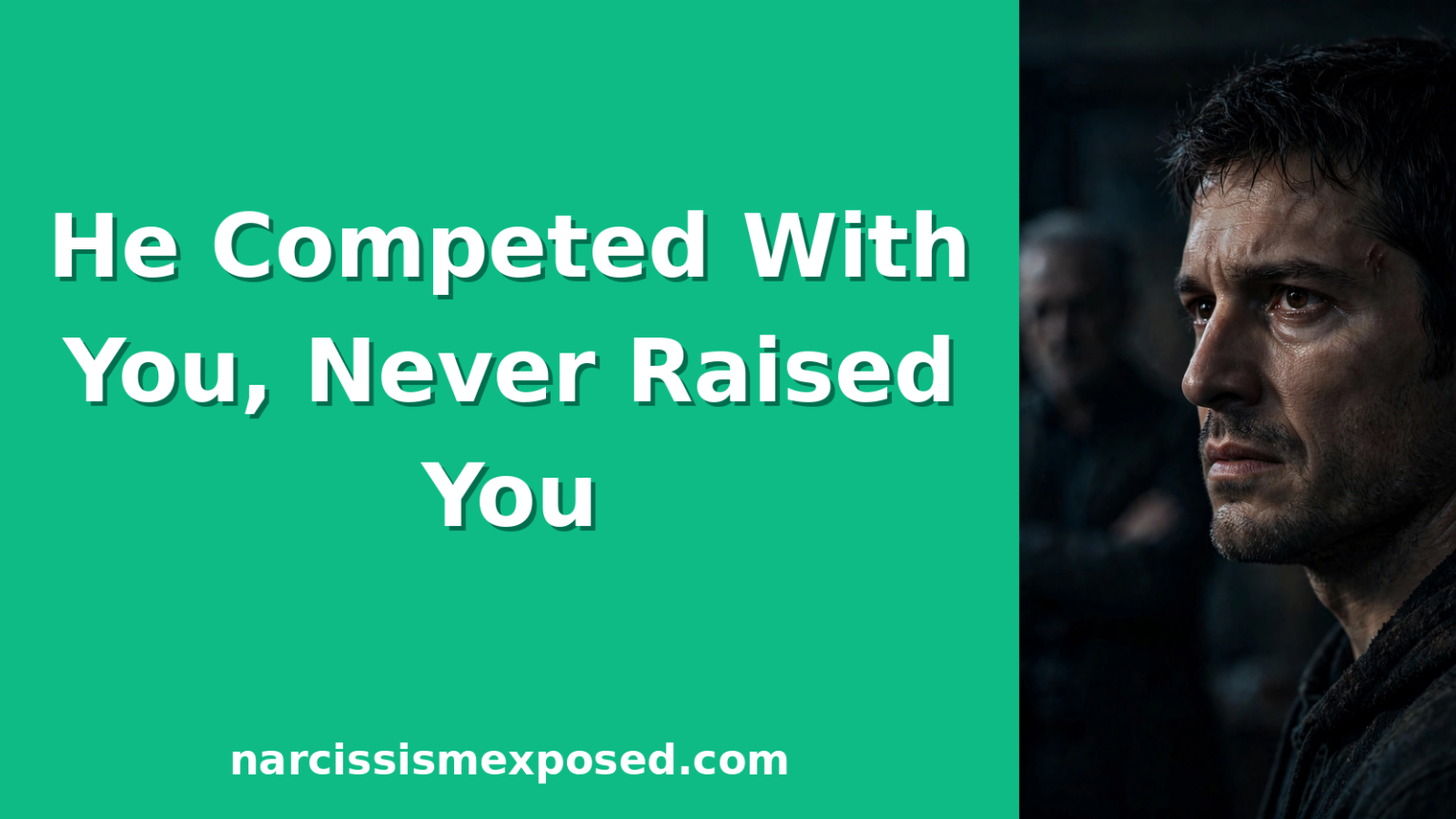
2. He Competes With His Own Son
Most fathers celebrate their sons outpacing them. A narcissistic father takes it as an insult. Psychologists who study narcissistic families describe fathers who ruthlessly compete with their own sons, even when the boy is a far less capable child, turning games, grades, and eventually careers into contests the father must win.
This looks like the dad who played basketball against his 12-year-old like it was the finals, who belittled the son’s achievements while boasting inflated versions of his own, who told friends the son’s success was really his own doing. The son absorbs one message: do not shine too brightly, or you will be punished for it. As adults, these sons often dim their own success, pick fights with authority figures, or sabotage promotions, still playing a childhood game they never agreed to join.
3. He Shames Vulnerability and Punishes Feelings
A narcissistic father has no room for a son’s emotions. Sadness is weakness. Fear is dramatic. Anger is disrespect. The son learns that feelings are either ignored completely or punished with contempt, so he does the only logical thing: he locks them away.
This emotional invalidation follows the son for decades. He becomes the man who cannot name what he feels, who goes numb in conflict, who picked partners that mirror the same cold distance because it feels like home. Clinicians note that children raised with chronic emotional invalidation are at higher risk for anxiety, depression, and difficulty forming secure attachments as adults. The numbness was a survival strategy. It stopped being useful the day he left the house.
4. He Rules With Rigidity and Absolute Control
Narcissistic fathers are authoritarian in the clinical sense: rigid about how things should be done, certain their opinions are the only correct ones, and furious when challenged. His rules are delivered with an undertone of anger and total condemnation, and, cruelly, the rules rarely apply to him.
For the son, this creates a specific adult wound: a terror of making mistakes paired with a hatred of being controlled. He either becomes hyper-compliant, scanning every room for the rules before he relaxes, or he rebels against all authority, including the healthy kind. Both are reactions to the same childhood, where one wrong move could detonate the dinner table. Learning the difference between healthy structure and control is part of the healing, and it starts with noticing which one your body expects.
5. He Brags About You to Friends and Tears You Down at Home
This is the wound that confuses sons the most. The same father who mocked his son’s weight, his voice, his grades, or his girlfriend in private would brag about him to neighbours, colleagues, and family friends, presenting a proud-father act that made the son feel crazy for resenting him.
That split is intentional, even if the father never planned it. The public praise feeds the father’s image; the private tearing-down feeds his need for control. The son grows up believing two things at once: I am impressive, and I am worthless. Adult sons of narcissistic fathers often carry imposter syndrome alongside grandiosity, swinging between overconfidence and self-loathing, because they inherited their father’s two faces and turned both inward.
If you want to see the full checklist of these behaviours, the 7 signs of a narcissistic father lays them out one by one so you can spot the pattern clearly.
6. He Gets Jealous of Your Bond With Your Mother, and Later Your Partner
A healthy father is glad his son is loved. A narcissistic father reads other people’s love for his son as competition. Psychologists describe narcissistic fathers who compete with their sons for the wife’s attention, and later insert themselves between the grown son and his girlfriend or wife, with flirting, undermining comments, or outright attempts to turn the partner against him.
The son learns that closeness is dangerous because it triggers the father’s sabotage. As an adult he may keep partners at arm’s length, pick fights before milestones like weddings, or feel guilty for being happy in a relationship, as if joy were a betrayal. It was never about you or your partner. It was about a man who needed to be the most important person in every room, including rooms he was not invited into.
If these patterns echo in your own childhood or the life of someone you love, the Narcissistic Abuse Survival Workbook ($27.99) gives you daily exercises to protect your mind, rebuild your confidence, and plan your next move with clarity. Get it here: https://narcissismexposed.com/survival-workbook/
7. He Punishes You for Outgrowing Him
The final wound lands when the son refuses to stay small. When the son sets a boundary, limits contact, or simply builds a life the father cannot control, the narcissistic father retaliates. He launches a smear campaign, telling siblings, relatives, and anyone who will listen that the son is ungrateful, unstable, the source of every family problem.
This is the part that breaks sons open a second time, because the smear often works. Family members take the father’s side. Holidays become battlegrounds. The son fights not just for success in the world but to be seen accurately by his own family. Understanding this dynamic is crucial, because the smear is not evidence that you are the problem. It is evidence that you stopped playing the role he assigned you. Many sons find that when the scapegoat fights back, the family system reveals exactly who was holding it together all along.
How Sons of Narcissistic Fathers Heal
Healing starts with naming the pattern, which you have just done. The next steps are practical. First, stop chasing the approval: write down the moving finish lines you have been running toward and ask which ones were ever yours. Second, grieve the father you needed, not the one you got; the grief is real even if he is still alive. Third, build a chosen family of people who celebrate your wins without competing with them. And fourth, consider working with a therapist who understands narcissistic family systems, because these wounds were installed by an expert and they deserve expert removal.
The Mayo Clinic notes that personality disorders involve long-term patterns of behaviour that differ markedly from cultural expectations, and that professional support is the recommended path when these patterns cause serious problems. The WebMD clinical team similarly describes how growing up with a narcissistic parent can shape adult self-esteem and relationship patterns, which is why recovery focuses on rebuilding the self-trust that was systematically taken apart.
You do not have to keep playing a game you never agreed to join. Learning how to deal with narcissistic family members gives you the boundary scripts and distance strategies that protect the adult you are becoming, and listening to the things narcissistic fathers say will confirm that the phrases still echoing in your head came from the pattern, not from the truth about you.
If you recognise these patterns in your own family and want clarity about your next step, the Narcissistic Abuse Clarity Report ($67) maps your exact situation with a personalised breakdown and a clear action plan, so you stop guessing and start acting. Get your report here: https://narcissismexposed.com/sp/clarity-landing-page/
Frequently Asked Questions
How does a narcissistic father affect his son?
A narcissistic father leaves his son with chronic self-doubt, a terror of disappointing authority, and difficulty trusting his own emotions. The son learns that love is conditional on performance, that vulnerability gets punished, and that outshining the father brings retaliation. As an adult he may struggle with imposter syndrome, people-pleasing, numbness in conflict, and choosing partners who repeat the cold dynamic.
Can a son recover from a narcissistic father?
Yes. Recovery starts with naming the pattern, which breaks the spell that it was your fault. Practical steps include grieving the father you needed, setting boundaries or limiting contact, building supportive relationships outside the family, and working with a therapist who understands narcissistic family systems. Many adult sons report that their confidence and relationships transform once they stop chasing the father’s approval.
Why does a narcissistic father compete with his son?
A narcissistic father sees his son as an extension of himself, not a separate person, so the son’s success feels like a threat to the father’s superiority rather than a shared victory. The competition is driven by the father’s fragile self-esteem and need to remain the most important person in every room. It is about the father’s insecurity, never about the son’s worth.
Do narcissistic fathers love their sons?
A narcissistic father is capable of attachment, but his love is conditional and self-serving: it flows when the son reflects well on him and vanishes when the son asserts independence. What the son experiences as love is usually approval tied to performance. True parental love accepts the child as a separate person; narcissistic love treats the child as an audience or a trophy.
Should a son go no contact with a narcissistic father?
There is no single right answer. Some sons go fully no contact to protect their mental health, others choose low contact with strict boundaries, and some maintain contact while doing deep therapeutic work. The deciding factor is your wellbeing: if every interaction leaves you destabilised for days, distance is a health decision, not cruelty. A therapist experienced in narcissistic family dynamics can help you choose the level that fits your situation.
Why do narcissistic fathers treat sons differently than daughters?
Narcissistic fathers often treat sons as rivals and daughters as extensions to control, though the pattern varies. Sons tend to receive more direct competition, physical intimidation, and challenges to their masculinity, while daughters more often receive control over appearance, relationships, and life choices. Both children absorb conditional love; the delivery differs because the father projects different insecurities onto each child.
How do you set boundaries with a narcissistic father as an adult?
State boundaries once, calmly, and enforce them with consequences rather than debates. For example: “If you criticise my wife at dinner, we will leave.” Then leave when it happens. Do not explain, defend, or negotiate, because negotiation is the opening the pattern needs. Keep visits short, have your own transport, and decide your exit lines before you arrive. Boundaries work through consistent action, not through convincing him.