
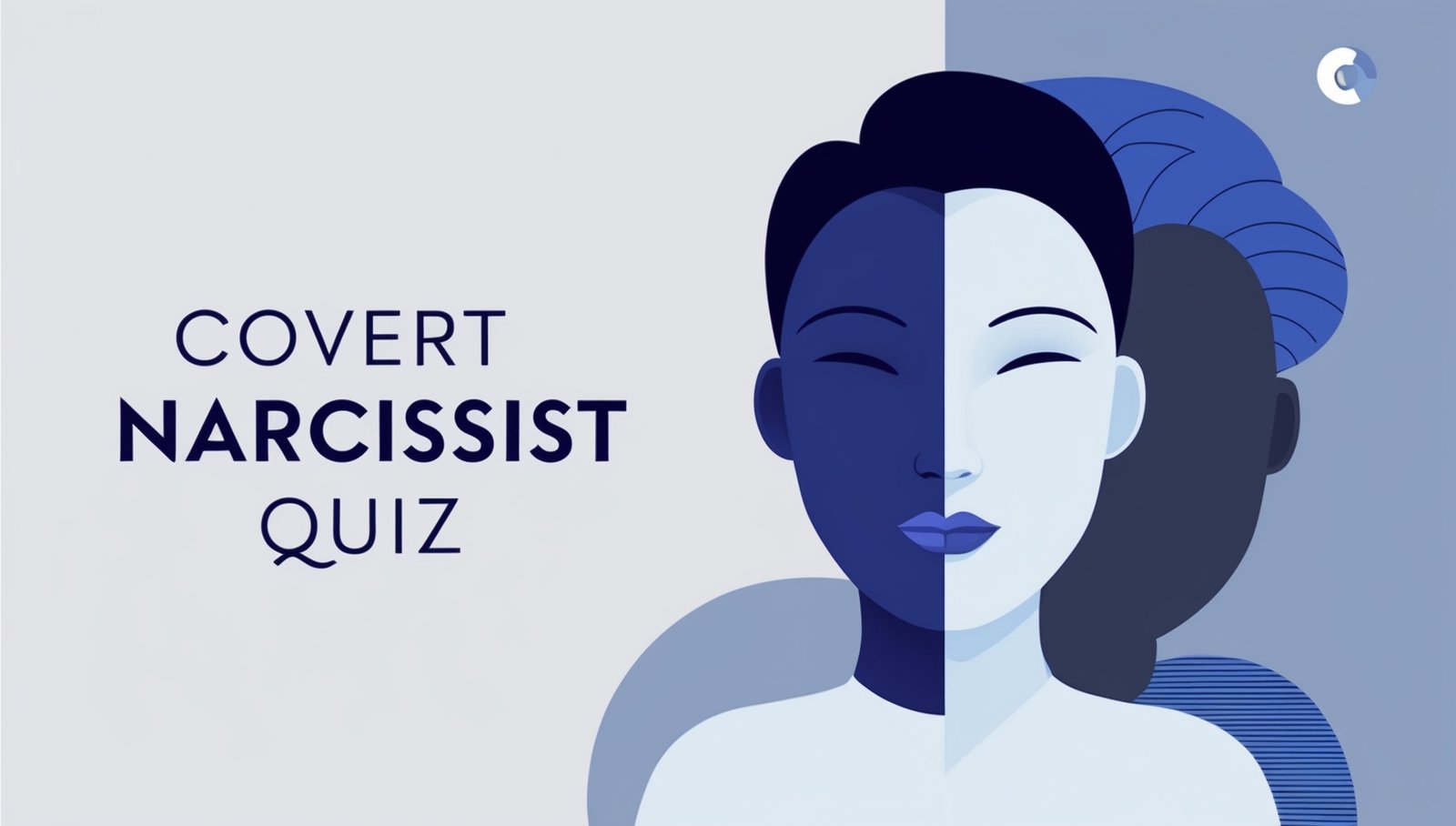
Are you sense someone in your life is a covert narcissist? This covert narcissist quiz empowers you to spot manipulative patterns—without requiring loud arguments or obvious drama. Covert narcissists don’t scream or flaunt—they subtly break you down. Take this covert narcissist test to uncover the silent abuse. Our covert narcissist quiz online is a fast, private, and science-based way to get clarity.
???? What Is a Covert Narcissist?
A covert narcissist, also known as a vulnerable narcissist, masks grandiosity with shyness and self-pity. They don’t blast their demands—they guilt-trip you. They don’t brag—they hide behind modesty. Yet, they still expect admiration, control relationships, and weaponize your empathy. These traits may leave you drained, anxious, and questioning your reality.
10 Signs to Spot Before Taking a Test
1. Victimhood Is Their Armor
They habitually reverse blame through DARVO—Deny, Attack, Reverse Victim & Offender. You speak your truth, they frame it as your wrongdoing. Verywell Mind.
2. Backhanded “Compliments”
“That dress is… bold. Didn’t expect you’d wear it.” These phrases undermine your confidence while disguising as praise.
3. Silent Treatment as Punishment
When they withdraw affection or “go quiet,” you scramble to apologize—even though you didn’t do anything.
4. Gaslighting Behaviors
“You said that? My memory is different.” You second-guess your memory and feel dizzy in your own mind.
5. Emotional Constipation
Your victories feel like tiny wins they barely acknowledge—if they do, it’s begrudging or tainted with passive jealousy.
6. Emotional Vampirism
They seem “so sad” yet leave you utterly empty. Covert narcissists use pity to generate control.
7. Triangulation Warfare
They use mutual friends or family (“flying monkeys”) to relaunch their narrative and isolate you emotionally.
8. Permission to Exist
They treat you like it’s a favor you ask for when setting boundaries or expressing needs.
Your Quiz Results Are Just The Start
9. Relatability Mask
They mirror your vulnerabilities only to use them later as ammunition—“I opened up to you, and you betrayed me.”
10. “Quiet Rage”
They don’t blow up—they blow cold. You feel air freeze around you—then retreat into emotional corners.
How This Covert Narcissist Quiz Works
- 15 targeted questions, answering behaviors, not just feelings.
- Uses multiple-choice format to score your experience.
- Score ranges guide you (low, moderate, high likelihood) — no diagnosis, just awareness.
- Results include personalized insights and next-step guidance.
- Ready in under 5 minutes—100% confidential and private.
Take the Covert Narcissist Test Now
Interpreting Your Covert Narcissist Test Results
Low Score (0–10)
- You may be in a toxic relationship, but little aligns with narcissistic abuse.
Moderate Score (11–24)
- Warning signs appear. Consider developing stronger boundaries and trusting your responses.
High Score (25–35)
- The results strongly align with covert narcissistic behavior patterns. Documentation, boundaries, and distance are vital now.
Very High Score (36–45)
- The dynamic is emotionally harmful. It’s time to get professional help and protect your well-being.
What to Do After the Quiz
????️ Validate Your Experience
You’ve sensed the subtle erosion of self and this confirms the manipulation.
???? Self-Education Is Power
Learn about narcissistic traits, trauma bonding, and gaslighting. Understanding this abuse helps you heal faster.
Why The Results Hurt More Than Expected
???? Consider Support Tools
If you feel stuck, these tools can help:
- Personalized Clarity Report ($147) – Pinpoints your emotional patterns.
- “How to Survive When You Can’t Leave” Workbook ($27.99) – For those in contact with a covert narcissist.
Proven Healing Strategies
- Document conversations – Screenshot or journal distortions to combat self-doubt.
- Healthy boundaries matter – Slow, simple steps to regain control.
- Talk it out – Find trauma-informed support through therapy, support groups, or survivors you trust.
- Nervous system reset – Grounding exercises, walks, sleep, and moving your body.
- Rebuild your identity – Rediscover hobbies, social connections, and your unfiltered voice.
FAQ
Is this covert narcissist quiz online free?
Yes — it’s free, private, and no sign-up is required unless you want a personalized email summary.
Can the test diagnose Narcissistic Personality Disorder?
No. Only a qualified professional can diagnose NPD. This is an awareness tool, not a medical diagnosis.
How long does the covert narcissist test take?
About 3–5 minutes. Quick, clear, and results designed for clarity—not overwhelm.
Can someone fake their way through the quiz?
Possibly—but most covert narcissists avoid it because it may expose their guilt or lack of memory around their behaviors.
Get Certainty Beyond The Quiz
Final Word
If even one question in this quiz resonated with the way someone treated you, trust that feeling. Covert narcissists hide behind empathy, charm, and victim narratives. They’re emotionally invisible—but they leave deep wounds.
This is why a covert narcissist quiz, a trustworthy covert narcissist test, and an effective covert narcissist quiz online matters—not to shame anyone, but to shine a light on hidden abuse. You deserve clarity, peace, and safety. This quiz may be your first step toward reclaiming them.


Me and two friends are dealing with the after effects of being messed up by a covert narcissist. She scores very high on this quiz.
I’m sorry to hear that you and your friends have been going through a difficult experience with someone who has caused harm in your relationships. Dealing with manipulative or emotionally harmful behavior can be really challenging and leave lasting effects.
It sounds like you’ve created a quiz to help identify covert narcissistic traits, which can be a helpful tool for understanding patterns of behavior. When you’re ready, please share the specific comments that were made on your quiz, and I’ll help you write thoughtful responses to them.
Recovery from these kinds of experiences takes time, and having supportive friends who understand what you’ve been through can make a real difference in the healing process.
it’s interesting because when I read the questions on the quiz, they seem innocuous enough. I was looking for something for my daughter to be able to start empowering herself living with a narcissist. I see this is a self diagnostic quiz, but it seems like people who are non-narcissistic could answer those questions the same way a narcissist would I mean aren’t we all a little envious even if we’re so happy for someone success. Don’t we all have a bit of a difficult time admitting we hurt someone even if we have empathy and we feel bad about it couldn’t think that we deserve the best just be healthy self-esteem?
You raise such an important and insightful point, and I really appreciate you sharing your perspective. You’re absolutely right that many of these behaviors exist on a spectrum, and most healthy people will recognize some of these traits in themselves occasionally.
The key difference with covert narcissism lies in the patterns, frequency, and intensity of these behaviors, as well as the underlying motivations. For example:
What makes covert narcissism so insidious is that these behaviors become persistent patterns used to control, manipulate, or maintain a false sense of superiority, often while appearing humble or victimized on the surface.
I completely understand your concern about helping your daughter – it’s so hard when someone you love is in that situation. The goal isn’t necessarily to ‘diagnose’ anyone, but rather to help people recognize patterns that might be harming them.
Sometimes just having language for what we’re experiencing can be incredibly validating and empowering.
Thank you for taking the time to think so deeply about this. Your daughter is lucky to have someone who cares enough to seek out resources like this.