
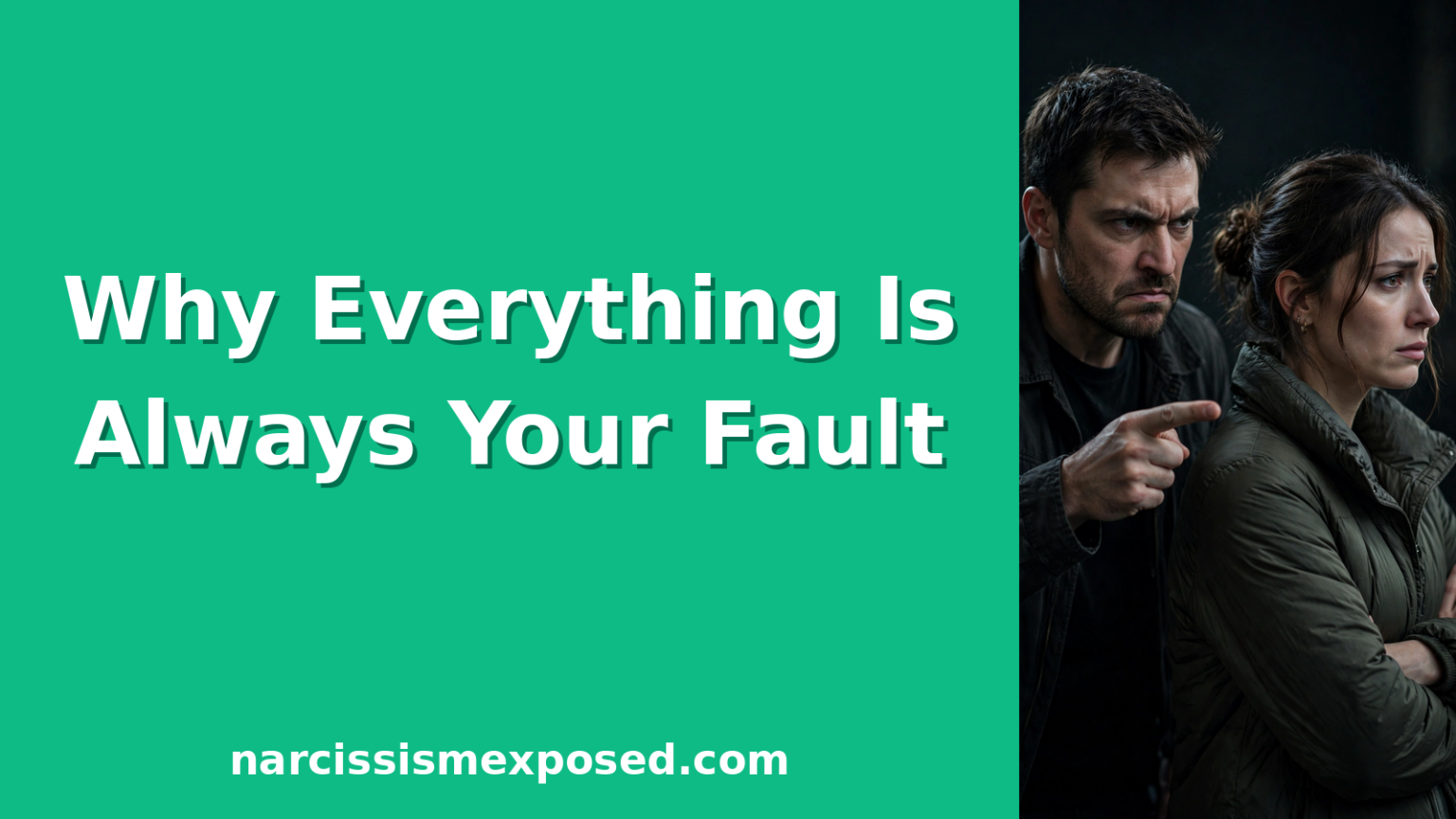
Blame shifting is the reason you walked into that conversation with one small complaint and walked out apologizing for something you did not do. It is 2 in the morning and you are lying awake replaying the argument, and somehow the version in your head has you as the villain again. You started the conversation because he lied. You ended it apologizing for “not trusting him enough.” You raised it because she forgot your birthday. You ended it apologizing for “making her feel guilty.” If this keeps happening to you, you are not confused, you are not too sensitive, and you are definitely not the problem. You are dealing with blame shifting, and once you learn to see it, you can never unsee it.
- What Is Blame Shifting?
- Why Do Narcissists Shift Blame?
- 10 Signs a Narcissist Is Shifting Blame Onto You
- Blame Shifting vs Gaslighting: What Is the Difference?
- How to Respond When a Narcissist Shifts Blame Onto You
- What Blame Shifting Does to You Over Time
- When Blame Shifting Becomes Emotional Abuse
- Frequently Asked Questions About Blame Shifting
Here is the truth no one has told you: every argument that ends with you apologizing was not a resolution. It was a transfer. They handed you their guilt and walked away clean. This article shows you the 10 signs, why narcissists do it, and the exact words to say when they try it next.
What Is Blame Shifting?
The blame shifting definition is simple: it is a manipulation tactic where a person avoids taking responsibility for their own behavior by redirecting the fault onto someone else. Instead of owning what they did, the blame shifter twists the conversation until the other person feels responsible for the problem.
In plain terms, blame shifting means this: they did it, but somehow it is your fault. They lied, but you “made” them lie. They hurt you, but you “provoked” them. They broke the promise, but you “expected too much.” The facts never change. Only the target of the blame moves, from them to you, every single time.
In psychology, blame shifting is a defensive strategy tied to an inability to tolerate shame. Admitting fault feels like annihilation to some personalities, so the mind protects itself by finding another person to carry the blame. In narcissistic relationships, blame shifting is not an occasional bad habit. It is the operating system: the relationship cannot function without someone to absorb the blame, and that someone is always you.
Why Do Narcissists Shift Blame?
This is the question that keeps you up at night: why can they never just say “I was wrong”? It is not that they do not know what they did. Admitting it would crack something inside them they cannot afford to have cracked.
Shame avoidance.
Beneath the grandiose mask sits a fragile sense of self. The Mayo Clinic describes narcissistic personality disorder as an inflated sense of self-importance paired with a deep need for admiration, and that pattern hides an ego that cannot tolerate being wrong. Accountability feels like a threat to their entire identity, so the blame has to go somewhere. It goes to the nearest safe target: you. For many narcissists this is automatic, learned in childhood homes where blame was passed around like a hot potato. They do not decide to shift blame. They breathe it.
Control.
Blame shifting keeps them in charge of the relationship’s story. As long as you are the one apologizing, you are the one trying to fix things, which means you are the one who can be managed. A person who believes they are at fault does not leave, set boundaries, or fight back. They comply.
The blame game is self serving.
Psychologists call this the self serving bias: taking credit for the good, denying responsibility for the bad. In most people it is mild. In a narcissist it is absolute. Nothing is ever their fault, and everything good is because of them. It is a one way valve, and you are on the wrong end of it.
Here is your reframe: they are not confused about what happened. They are committed to never carrying it.
10 Signs a Narcissist Is Shifting Blame Onto You
Read these slowly. Count how many live in your house. If 7 or more of these sound like your last month, you are not dealing with bad communication. You are dealing with a pattern, and patterns have names for a reason.
Sign 1: Every Argument Ends With You Apologizing
The scene. You caught him texting his ex and calmly said you needed honesty. Twenty minutes later, you were crying: “I am sorry I went through your phone.” He never once apologized for texting her.
The twist. It does not matter what the argument was about. The endpoint is always the same: you apologizing. By the end, the original offense has been quietly filed away, and you are the one on trial.
Your reframe: If every fight ends with you apologizing, you are not in a relationship, you are in a courtroom where you are always the defendant.
Sign 2: They Attack How You Said It Instead of What You Said
The scene. You said, “It hurt when you canceled our plans again.” She replied, “So now I am not allowed to have a life? The way you said that was so aggressive.” Now you are defending your tone instead of discussing her cancellations.
The twist. This is arguing the argument: the moment you raise an issue, they put your delivery on trial. Wrong tone, wrong words, wrong time. There is never a right way to raise a problem with a narcissist, because the “how” is just a shield to avoid the “what.”
Your reframe: A person who cares about the issue discusses the issue. A person who attacks your tone is protecting themselves from it.
Sign 3: Your Past Gets Dragged Into Their Present Mistake
The scene. You asked why he came home three hours late without a word. “Remember two years ago when YOU disappeared for a whole evening and I said nothing? But I do it once and it is a federal case.” That thing from two years ago had nothing to do with tonight. Suddenly it is all anyone is discussing.
The twist. Digging up your old mistakes changes the math: two offenses on the table instead of one, his fresh one diluted by your ancient one. It does not matter that you already apologized, or that the situations are nothing alike. The spotlight moved off him and onto you, which is the only outcome he was ever negotiating for.
Your reframe: Your past is not a hall pass for their present.
Sign 4: They Play the Victim the Second You Ask for Accountability (Classic Blame Shifting)
The scene. “You promised you would call, and you did not. I was worried.” Her eyes filled with tears. “Nothing I do is ever good enough for you. I cannot do anything right. Maybe you would be happier with someone else.” Now you are comforting her for hurting you.
The twist. This hijacks your empathy. The instant accountability appears, they transform into the wounded one, and your compassion does the rest of the work for them. You drop the complaint, reassure them, and end up feeling guilty for having needs at all. Playing the victim is blame shifting in its most effective costume, because who confronts a person who is crying?
Your reframe: Tears that appear exactly when accountability arrives are not grief. They are a defense strategy.
Sign 5: “You Are Too Sensitive” Replaces Any Real Answer
The scene. You told him his joke about your weight in front of his friends embarrassed you. He laughed. “God, you are so sensitive. It was just a joke. Everyone else thought it was funny.” You went quiet, and later wondered if you had overreacted.
The twist. “You are too sensitive” is the Swiss army knife of blame shifting phrases. It dismisses your feeling, relabels his behavior as harmless, and makes your reaction the actual problem. He never addresses the joke. The conversation becomes a referendum on your emotional stability instead of his cruelty. After enough rounds of this, you stop raising issues at all, which is the entire point. If you want to understand how this fits into the bigger picture, read our breakdown of the real narcissist meaning and the traits that drive this behavior.
Your reframe: You are not too sensitive. You are being managed.
Sign 6: They Accuse You of Exactly What They Are Doing
The scene. She has been distant for weeks, barely speaking. When you finally ask what is wrong, she snaps, “You are the one who has been distant. You never talk to me anymore. You have checked out of this relationship.” She just described her own behavior, word for word, and pinned it on you.
The twist. Psychologists call this projection. They take the thing they are guilty of and hand it to you like a gift you never asked for: the cheater accuses you of cheating, the liar calls you dishonest, the one giving the silent treatment says you are shutting them out. It works because it is so brazen your brain short circuits. Nobody would accuse someone of the exact thing they are doing. A narcissist would. Every time.
Your reframe: When they accuse you out of nowhere, listen closely. They are often confessing.
Sign 7: The Apology Comes With a “But” That Erases It
The scene. After a huge fight he finally said it: “I am sorry.” Your chest loosened for three seconds. Then: “I am sorry, BUT you know how you get. If you had not pushed my buttons, I would not have yelled.” The apology had a self destruct button, and it just went off.
The twist. A real apology has three parts: I did it, it was wrong, I will change. The narcissist’s version has a fourth part that cancels the first three: “but you.” “I am sorry, but you made me do it.” It gives you just enough of what you asked for to end the fight, while quietly reinstalling the same dynamic: their behavior, your fault. The word “but” in an apology is where accountability goes to die.
Your reframe: An apology with a “but” is not an apology. It is a verdict with your name on it.
Sign 8: They Rewrite What Happened Until You Doubt Your Memory
The scene. “Last night you told me I was worthless.” Total calm: “I never said that. I said you were acting worthless, which is completely different. You always twist my words.” You remember the exact sentence. You can hear his voice. But his certainty is so complete that a crack opens in your memory.
The twist. This is where blame shifting crosses into gaslighting, and it does the most long term damage. Rewriting the event erases their responsibility and makes you doubt the one instrument that could hold them accountable: your own mind. Stop trusting your memory and you stop trusting your judgment, until you accept anyone’s version of reality, especially the one where you are always to blame.
Your reframe: Your memory is not the problem. Their version of events is a legal defense, not the truth.
Sign 9: They Recruit Other People to Their Version of Events
The scene. After the fight he called his mother and best friend with his version: how you “freaked out over nothing” and “always start drama.” By Sunday dinner, his mother was giving you looks and his friend “jokingly” told you to take it easy on him. You walked into a room where the verdict was delivered and you were never invited to the trial.
The twist. A narcissist who cannot win the argument with you takes it to an audience that will. They get ahead of the story, frame themselves as the reasonable one dealing with your “episodes,” and collect allies who pressure you to back down. This is also how smear campaigns start. If this is happening to you, our article on when a narcissist turns everyone against you breaks down exactly how this recruitment works and how to protect yourself. And when the recruited people start carrying messages back to you, you are dealing with flying monkeys, which is blame shifting with a supporting cast.
Your reframe: If they need an audience to prove they are right, they already know they are wrong.
Sign 10: They Shrug and Say “So What?”
The scene. You laid it all out: the lying, the broken promises, the nights you cry yourself to sleep. He looked at his phone: “Okay. So what do you want me to do about it?” Flat. Bored. Like you had read him a grocery list.
The twist. The “so what” does not redirect blame. It denies blame exists at all. Your pain becomes an overreaction to nothing, their indifference framed as rationality, designed to make you feel foolish for caring and exhausted for trying. When someone can look at your pain and shrug, the message is not “I disagree.” It is “you do not matter enough to be accountable to.” This cold indifference is one of the clearest markers on the road through the 7 stages of trauma bonding, where attachment deepens even as cruelty becomes open.
Your reframe: Indifference is not the absence of an answer. It is the cruelest answer there is.
If 7 or more of these sound like your last month, stop calling it a communication problem. Communication problems improve when both people try. This only changes when one person stops absorbing blame that was never theirs, and that person is you.
Blame Shifting vs Gaslighting: What Is the Difference?
People mix these up constantly, and narcissists count on that confusion. Here is the clean distinction.
Blame shifting is about responsibility. It answers the question “whose fault is this?” with “yours,” no matter what the facts say. The event itself is not denied. He admits he came home late. She admits she said the cruel thing. What changes is who carries the fault for it. Blame shifting moves the blame.
Gaslighting is about reality. It answers the question “did this even happen?” with “no, you are imagining it.” The event itself is denied, rewritten, or reframed until you doubt your own perception. Gaslighting moves your sanity.
In practice, narcissists use them as a one-two punch. First they gaslight: “I never said that.” If you hold firm, they switch to blame shifting: “Okay, I said it, but you made me say it.” Reality denial first, responsibility denial second. That is why they feel so similar from the inside: you end up doubting both what happened and whose fault it was, with nothing solid to stand on.
Remember it this way: gaslighting attacks your memory, blame shifting attacks your conscience. One makes you feel crazy, the other makes you feel guilty, and together they keep you exactly where a narcissist needs you.
How to Respond When a Narcissist Shifts Blame Onto You
Knowing the signs is half the battle. The other half is what comes out of your mouth next time. Here is the playbook.
Stop Defending Yourself Against False Accusations
The single most important rule: do not JADE. Do not Justify, Argue, Defend, or Explain yourself against a false accusation. The moment you start defending yourself, you have accepted the premise that you are on trial, and a trial you did not agree to is one you cannot win.
When he says “you always overreact,” your instinct is to prove you do not. When she says “you made me do it,” your instinct is to list every way you did not. Both instincts feed the dynamic. Defending yourself legitimizes the false accusation and tells the narcissist their framing is worth engaging with. It is not.
Instead, name what is happening in one calm sentence and stop. “That is not what we are discussing.” “I am not going to defend myself against that.” Then silence. Silence is not weakness here. Silence is you refusing to play a rigged game.
Use These Exact Lines Instead
Memorize these. Short, calm, and impossible to twist. Pick the one that fits and say it once.
1. When they rewrite what happened: “I remember what happened, and I am not going to debate my own memory with you.” Then stop talking. Do not provide evidence. Evidence invites a trial over the evidence.
2. When they say you made them do it: “You are an adult. Your choices are your responsibility, not mine.” This one sentence dismantles the entire blame shifting premise. Say it flat, without heat.
3. When they attack your tone: “We can talk about how I said it after we address what I said.” This puts the original issue back on the table where it belongs. If they refuse, you have your answer about their intentions.
4. When they play the victim: “I hear that you are upset. My concern still stands.” You acknowledge without surrendering. You do not comfort them out of your own complaint. You hold your ground inside your compassion.
5. When they shrug with “so what”: “I needed you to hear that. What you do with it is your choice.” Then walk away. Chasing a response from someone committed to indifference will only drain you.
The pattern in all five: short, no justification, no counterattack, full stop. You are not trying to win the argument. You are refusing to lose yourself in it.
Document Everything in Writing
Blame shifting thrives in the fog of verbal arguments, where words evaporate and versions multiply. Writing is sunlight. Keep a dated log: what happened, what was said, how the blame moved. Save texts and emails. Screenshot the important ones.
This is not about building a court case, though it can help if things ever go legal. It is about building an anchor for your own mind. On the days when Sign 8 has you doubting your memory, your own written record will tell you the truth. Narcissists rewrite history. Paper does not.
If you are thinking about leaving a narcissist down the road, this documentation becomes even more important. It reminds you why you are leaving on the days your heart tries to rewrite the story.
Set One Boundary and Enforce It
Do not fix the whole dynamic at once. Pick one boundary, the smallest one that matters, and enforce it every time. Example: “I will not continue a conversation where I am blamed for your behavior. If it happens, I leave the room.”
Then do it. The first time. The fifth time. The twentieth time. The boundary only works if the consequence is boring and predictable. The moment you enforce it inconsistently, the narcissist learns that your boundaries are suggestions.
Expect escalation at first. When blame shifting stops working, many narcissists try harder before they try something else. That escalation is not proof your boundary failed. It is proof it is working.
Know When to Walk Away From the Conversation
Some conversations cannot be won, because the other person is not trying to resolve anything. They are trying to transfer blame, and every minute you stay is another minute they get to work on you. Walking away is not losing. It is refusing to participate.
Say it once: “This conversation is not productive anymore. I am done for now.” Then leave. Do not announce it three times or wait for permission. You can return to the issue later, in writing, on your terms. You cannot think clearly while someone is actively shifting blame onto you in real time.
If walking away from a conversation eventually becomes walking away from the relationship, our guide on how to go no contact with a narcissist walks you through doing it safely, step by step.
What Blame Shifting Does to You Over Time
Nobody walks away from years of blame shifting unchanged. The damage is quiet, cumulative, and easy to mistake for your own flaws. Here is what it looks like.
You stop trusting your judgment.
After enough rounds of being told your reactions are wrong and your memory is faulty, you start outsourcing your reality to other people. You ask friends “Am I overreacting?” about things you once knew with certainty. That hesitation is not humility. It is the residue of blame shifting.
You walk on eggshells.
You edit yourself before you speak, rehearsing conversations, calculating which words will not set them off. You become a diplomat in your own home, and diplomacy is exhausting. The tragedy: no amount of careful wording works, because the problem was never your delivery.
You apologize for existing.
“Sorry” becomes your most used word. You apologize for having needs, for taking up space, for crying, for being upset about being hurt. Your feelings start to feel like an inconvenience to the people who claim to love you.
Your identity erodes.
This is the deepest cut. When every conflict ends with you as the problem, you begin to believe you ARE the problem. Not in this argument, but as a person. You forget what it felt like to be sure of yourself, to be someone before this relationship taught you to doubt everything.
None of this means you are broken. You have been carrying weight that was never yours, and it changed your posture. Put it down, and you will be surprised how quickly you stand straight again.
When Blame Shifting Becomes Emotional Abuse
Blame shifting in small doses shows up in any stressed relationship. But there is a line where it becomes emotional abuse, and you need to know where it is.
It is abuse when it is constant, not occasional: every disagreement, every mistake, every bad day ends with you carrying the fault. It is abuse when it is paired with fear, when you are afraid to raise issues because of the rage or icy silence that follows. It is abuse when it isolates you, when they have turned people against your version of events or you have stopped telling friends what is happening.
It is abuse when you no longer recognize yourself. If you have become anxious, hypervigilant, and hollow in a way you never were before this relationship, that is not a communication issue. That is the impact of sustained psychological manipulation.
If this is where you are, hear this: you do not have to figure this out alone, and you do not have to stay to prove you are strong. WebMD’s overview of narcissistic traits is a solid starting point for the clinical side, but talk to a therapist who specializes in narcissistic abuse, not a general couples counselor. If you ever feel unsafe, reach out to a domestic violence helpline in your country. Leaving is not failure. It is the first decision in a long time that is actually yours.
Frequently Asked Questions About Blame Shifting
In psychology, blame shifting is defined as a defensive strategy in which a person avoids accountability for their own actions by redirecting responsibility onto someone else. It is closely associated with narcissistic personality traits, where the inability to tolerate shame makes admitting fault feel psychologically unbearable, so the blame must be assigned to another person.
In a relationship, blame shifting means that one partner consistently makes the other partner feel responsible for problems they did not cause. You raise a legitimate concern, and somehow the conversation ends with you apologizing. Over time, this dynamic trains you to suppress your needs and accept fault automatically, even when you have done nothing wrong.
They are related but distinct. Blame shifting is about responsibility: “it is your fault.” Gaslighting is about reality: “that never happened.” Narcissists frequently use both together. They may first gaslight you into doubting the event, then shift blame onto you for your reaction to it. You can read the full breakdown in the Blame Shifting vs Gaslighting section above.
Because accountability threatens the grandiose false self they have constructed. Admitting fault would mean facing the shame and inadequacy buried underneath, which feels like psychological annihilation to them. Shifting blame onto you is not a choice they weigh carefully. It is an automatic defense mechanism that protects their fragile ego, and it happens almost every time.
DARVO stands for Deny, Attack, and Reverse Victim and Offender. It is a manipulation pattern where the wrongdoer first denies the behavior, then attacks the person confronting them, then reverses the roles so they become the victim and the actual victim becomes the offender. Blame shifting is the engine inside DARVO: the “reverse victim and offender” step is blame shifting in its purest form.
Do not JADE: do not justify, argue, defend, or explain yourself against false accusations. Name what is happening in one calm sentence (“I am not going to defend myself against that”), use a short scripted line, and disengage if they escalate. Document incidents in writing, set one clear boundary with a consistent consequence, and walk away from conversations that are only designed to transfer blame onto you.
Common examples include: “You made me cheat by never being there,” “I would not have yelled if you had not pushed my buttons,” “You are too sensitive, it was just a joke,” “I am sorry, but you started it,” and “Remember when YOU did the same thing two years ago?” The pattern is always the same: their behavior, your fault.
Because in their internal story, they cannot be the villain. Your partner likely has a fragile ego structure where admitting fault triggers overwhelming shame, so their mind automatically reroutes blame to the safest nearby target: you. This is not about what you did. It is about what they cannot face in themselves.
It becomes emotional abuse when it is persistent, intentional, and paired with control, fear, or isolation. Occasional defensiveness in a stressed partner is a human flaw. A systematic pattern of making you feel responsible for everything wrong, to the point where you doubt yourself and fear speaking up, is psychological abuse.
Living under constant blame shifting can cause serious psychological harm, including anxiety, depression, and symptoms consistent with complex PTSD (C-PTSD): hypervigilance, emotional numbness, difficulty trusting yourself, and intrusive replaying of arguments. If you are experiencing these symptoms, please speak with a trauma informed mental health professional. You deserve support, not just survival.
Use short, calm, closed statements that do not invite debate: “I remember what happened, and I am not going to debate my memory.” “Your choices are your responsibility.” “We can discuss how I said it after we address what I said.” Say it once, without heat, and stop. The goal is not to win the argument. It is to refuse to absorb blame that is not yours.
Because someone has been training you to feel that way. When every conversation ends with you apologizing, your brain starts skipping the trial and going straight to the verdict: it must be me. That feeling is not evidence of your guilt. It is evidence of how long the blame shifting has been working on you.
You are not too sensitive. You are not crazy. You are not the problem in every argument. You have been carrying blame that was never yours, for so long you forgot what it feels like to stand up straight.
Now you know the 10 signs and you have the words. The next time blame starts moving toward you, you will see it in real time, and seeing it is the beginning of stopping it.