
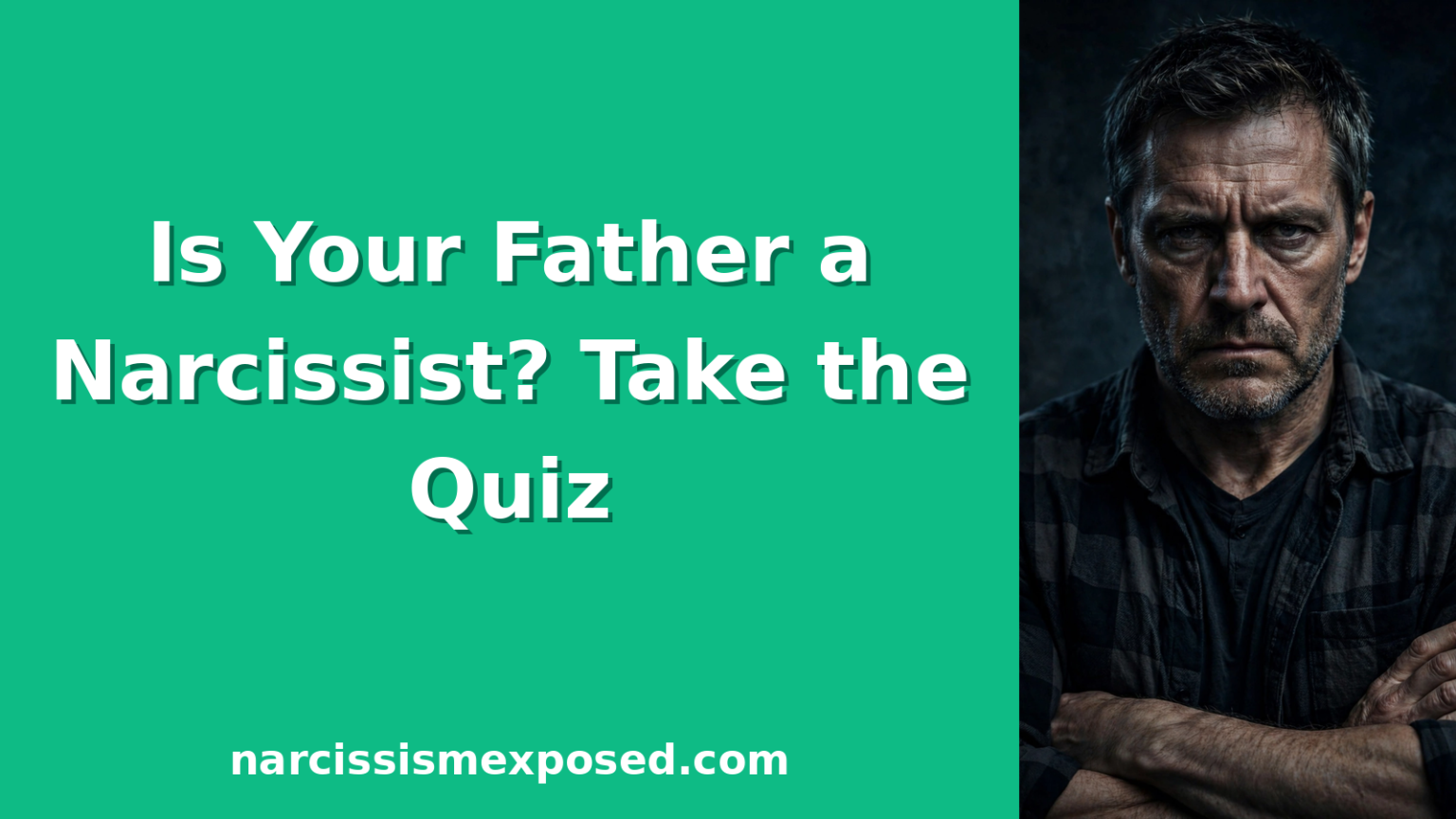
If you landed on this is my father a narcissist quiz, something about your childhood never quite sat right. Maybe you spent years chasing his approval and never caught it. Maybe criticism came easily and warmth never did. Maybe his rules, his moods, and his reputation mattered more than how you felt.
You are not ungrateful for wondering. A father who demands respect without giving it, who treats love as a reward for obedience, shapes a child in lasting ways: perfectionism, people-pleasing, hypervigilance, and the constant feeling that you are never quite enough. This quiz gives you something solid to stand on: a clear-eyed look at the patterns you have been carrying, perhaps for decades.
What This Quiz Measures
This quiz looks at 10 specific, observable behaviors tied to narcissistic traits: taking credit for your achievements, mocking your emotions, demanding respect without giving it, anger at disagreement, refusing accountability, image obsession, conditional affection, gaslighting, competition and triangulation, and keeping you indebted. These are the same patterns mental health professionals watch for when narcissistic personality disorder is discussed, because the disorder is diagnosed from a consistent pattern of behavior, not from one bad argument.
Each question asks how often you see the behavior: Never, Rarely, Sometimes, or Often. Your answers produce a score out of 30, which places your situation in one of three bands: low likelihood, concerning patterns, or strong narcissistic patterns. The point is clarity, not a label. You will finish the quiz knowing what you were actually raised in, which changes everything about how you make sense of it.
Frequency matters more than any single incident, because narcissistic behavior is defined by repetition. A father who loses his temper once during a hard year is human. A father who criticizes, controls, or withdraws love every single week for years is showing you a pattern. That is why each answer carries points instead of a simple yes or no. Ten questions, each scored 0 to 3, give you a total out of 30. The higher the number, the more often these behaviors show up in your life, and the clearer the picture becomes. If you want to understand the quieter, harder-to-spot version of these traits, our covert narcissist quiz breaks down the hidden patterns many adult children miss for years.
When His Approval Was the Whole Prize
10 Signs of a Narcissistic Father to Check
The questions in this quiz are built from the behaviors adult children of narcissistic fathers report most often. Read through them slowly and notice how many feel familiar. One or two occasional signs do not mean much on their own. It is the cluster, repeated over years, that tells the real story.
- Love had conditions. Approval came when you performed, obeyed, or reflected well on him. The real you was never quite enough.
- His temper ruled the house. Everyone learned to read his mood at the door, because one wrong word could detonate the evening.
- Criticism as a parenting style. Nothing you did was right the first time. Feedback always came with contempt attached.
- He competed with his own children. Your successes were threats to be minimized, not milestones to celebrate.
- Emotions were weakness. Tears, fear, or hurt got mocked or punished. You learned to feel nothing where he could see it.
- Control disguised as authority. Rules changed without warning, and questioning them was treated as disrespect.
- He rewrote history. That never happened, you are too sensitive, I did my best and you are ungrateful. Your childhood gets edited in real time.
- Your mother was his shield or his target. He either turned her against you or made you watch him diminish her.
- Apologies never came. He was never wrong. If you were hurt, it was your fault for being hurt.
- Respect flowed one way. He demanded total respect and offered little in return, even to his own children.
If several of these hit home, you are not being disloyal. You are recognizing a pattern, and naming it is the first step. If you are now a parent yourself and share custody with a difficult ex, these signs you are co-parenting with a narcissist will feel painfully familiar too, because the same tactics you grew up with can resurface in adult relationships.
A Note Before You Start
This quiz is an educational self-assessment, not a medical diagnosis. Only a qualified mental health professional can diagnose narcissistic personality disorder, and this quiz does not replace professional advice. What it can do is help you trust what you have known for years but were told not to feel. Many adult children second-guess themselves because calling it what it is feels disloyal. A clear pattern on paper can be the first step toward trusting yourself again.
Answer based on the long-term pattern, not the worst year or the best one. Think about your childhood and adult relationship as a whole, and answer for his typical behavior, not the version of him you wish existed. The more honest your answers, the more useful your result will be. Nobody sees your individual answers. Your result is yours alone, and if you share your email at the start, your score summary is sent only to you.
Take the Quiz
Answer honestly, based on what you have actually seen over the years, not one bad week. It takes about three minutes.
0
Interpreting Your Results: What Your Score Means
When you finish, you will see a score out of 30. Here is exactly what that number tells you. Each question was worth 0 to 3 points, so your total reflects how often narcissistic behaviors show up in your relationship, not how bad one single incident was.
0 to 10: low likelihood. The behaviors you checked are occasional, not a pattern. Your father may be difficult in specific ways, but the results do not point to narcissistic traits running the relationship. If something still feels off, trust that feeling and keep learning, but you probably do not need to overhaul the relationship.
11 to 20: concerning patterns worth watching. Several narcissistic behaviors show up regularly. This is the range where most adult children feel the most confused, because the good times make them doubt the bad ones. Your result is telling you the confusion itself is a signal. This is the right time to learn boundary skills before the dynamic hardens further.
21 to 30: strong narcissistic patterns. The behaviors are frequent and consistent. This does not diagnose your father, but it does confirm that what you have been experiencing has a name and a well-documented pattern. Many people in this range describe feeling relief mixed with grief. Relief that they were not imagining it, grief for the relationship they deserved and did not get. Both feelings are normal, and both deserve support.
Whatever band you land in, remember what the number cannot do. It cannot tell you whether to cut contact, confront him, or keep things as they are. Those decisions depend on your safety, your values, and your capacity. What the score gives you is a clear starting point, so the next steps you take are based on reality instead of self-doubt.
Stop Chasing Approval You Were Never Meant to Earn
Get a Personal Map of Your Exact Situation
What to Do With Your Result
Whatever your score, the healthiest next step is the same: stop chasing the approval he was never going to give, and start building the life you actually want. That means clear boundaries, calm and consistent responses, and support from people who understand what growing up like that does to you. If your result shows strong patterns, do not try to win him over. Focus on what you can control: your access, your energy, and the adult relationship you choose to have with him now.
Many adult children find that once they name the pattern, the guilt lifts. You are not ungrateful for seeing what is in front of you. You are an honest one.
Ready for a personal plan? Get your Narcissistic Abuse Clarity Report, a personalized report that maps your exact situation and shows you the steps that work for dynamics like yours. Get your Clarity Report here.
And if your score landed in the higher bands, do not try to win insight from him. The most healing move is usually the least dramatic one: steady boundaries, limited emotional access, and support from people who understand. The Clarity Report exists for exactly this moment, a personalized map of your parent’s patterns and the steps that actually work for dynamics like yours.
Frequently Asked Questions
Can a quiz really tell me if my father is a narcissist?
No quiz can diagnose anyone. This quiz measures how often specific narcissistic behaviors appear in your relationship, based on patterns mental health professionals recognize. Think of it as a structured mirror, not a medical verdict. If your score is high and you want certainty, a licensed therapist experienced in personality disorders is the right next step.
What if my score is low but I still feel hurt?
Then the hurt is still real. A low score means narcissistic traits are not the main driver, but it does not invalidate your pain. Harsh, critical, or emotionally absent parenting wounds people even without narcissism. Your feelings deserve attention regardless of the label.
Should I show my result to my father?
In most cases, no. Confronting a narcissistic father with a quiz result usually triggers denial, rage, or a new round of guilt-tripping, not insight. Use your result for your own clarity and your own boundaries, not as evidence in an argument you cannot win.
Why does the quiz ask for my name and email?
So your result summary can be sent to you privately. Many people want to sit with their score, reread it later, or share it with a therapist. Your details are only used to deliver your result and the updates you explicitly sign up for.
What should I do if my score is in the highest band?
Start with education and boundaries, not confrontation. Learn the common tactics so you stop being blindsided, decide what access he gets to your life, and consider support, whether that is a workbook, a therapist, or a personalized Clarity Report that maps your exact situation.