
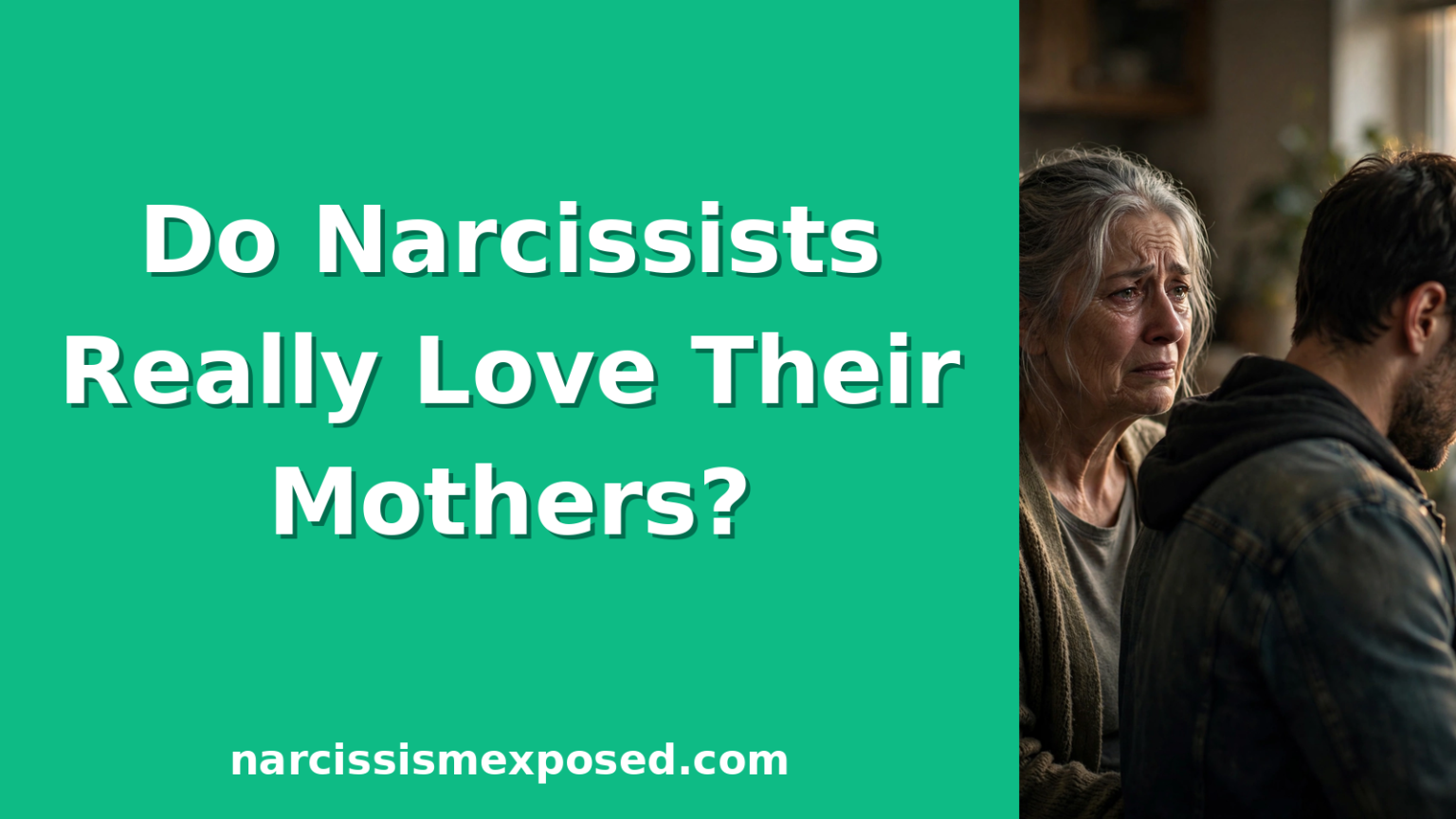
He called his mother three times yesterday, each call a long complaint about his boss. On her birthday today, he forgot to call at all. If you have watched this exact pattern play out in your family, you are probably asking the question this article answers: do narcissists love their mothers?
- The Short, Honest Answer: It Is Attachment, Not Empathy
- 7 Ways A Narcissist’s Love For His Mother Shows Up
- Why The Mother Bond Runs So Deep
- Do Narcissists Love Their Mothers More Than Anyone Else?
- If You Are The Mother Of A Narcissist, Read This
- If Your Partner Is The Narcissist, Here Is The Hard Part
- The Bottom Line
- Frequently Asked Questions
Psychologists who study narcissistic personality disorder (NPD) say yes, but with a painful asterisk. A narcissist can feel a powerful attachment to his mother while lacking the empathy that turns attachment into real love. What looks like love from the outside is usually something else: need, loyalty, obligation, and a hunger for approval that never quite goes away. Below are the 7 painful truths about how narcissists actually relate to their mothers, drawn from clinical psychology and the patterns therapists see every day.
The Short, Honest Answer: It Is Attachment, Not Empathy
Attachment and empathy are not the same thing, and this distinction is the whole answer. A narcissist can be fiercely attached to his mother, protective of her in public, furious when anyone criticizes her, and still treat her like an object that exists to meet his needs. Attachment is the glue. Empathy is the caring. He has the first and struggles deeply with the second.
This is not an insult. It is clinical. The Mayo Clinic lists a lack of empathy, an unwillingness to recognize the needs and feelings of others, as one of the defining features of narcissistic personality disorder. You can read the full clinical picture on the Mayo Clinic’s overview of narcissistic personality disorder. Researchers have also found structural differences in the brain regions associated with emotional empathy in people with NPD. In plain language, the hardware for feeling what another person feels does not work the way it does in most people.
So when a narcissist says “I love my mother,” he is not lying. He means it, in the only way he can mean it. His love is conditional, transactional, and built around what she gives him: admiration, comfort, status, proof that he is a good son. The moment those supplies run dry, the warmth runs dry with them.
7 Ways A Narcissist’s Love For His Mother Shows Up
1. Public Devotion, Private Coldness
The birthday tribute post is glowing. The actual birthday call never happens. This is the first and most visible truth. Narcissists often perform love for an audience, because a devoted son is excellent for the image, while offering little real warmth behind closed doors. If you are the mother, you live with a strange contradiction: the world thinks your child adores you, and you feel lonelier than anyone knows. Therapists notice this pattern constantly, and Psychology Today notes that narcissistic behavior is fundamentally driven by a fragile self esteem that needs constant external proof. The public display is for the proof, not for you.
2. Warmth That Tracks Praise
Watch a narcissist with his mother for a week and you will see the thermostat. When she praises him, defends him, or tells him how successful he is, he is warm, charming, attentive. When she criticizes him, sets a boundary, or gives her attention to someone else, the temperature drops to ice. She learns, often without realizing it, that her value in the relationship is directly tied to how well she feeds his ego. This is conditional love in its purest form: affection that arrives as a reward for compliance and disappears as punishment for independence.
3. She Is Treated As An Extension Of Him
One of the strangest truths about narcissistic love is that the other person is never fully real to the narcissist. She is experienced as an extension of him, like a limb or a mirror. That is why a narcissist can be genuinely distressed when his mother is upset, not because he feels her pain, but because her pain disturbs his world. He may dictate how she dresses, who she sees, and what she says about him, because in his mind she is a supporting character in his story. A mother who tries to live as her own person with her own opinions will be treated as if she has broken a contract she never signed.
4. Affection Used As Leverage
“I did so much for you” is the national anthem of the narcissist’s relationship with his mother, and sometimes it plays in reverse. A narcissist may shower his mother with gifts and help when he needs something from her, emotional support, money, a babysitter, a place to stay, and then remind her of his generosity when she hesitates to comply. Or the mother may hear a lifetime ledger of sacrifices recited back to her every time she says no. In both directions, affection is a currency, not a gift. Real love gives without keeping score. Narcissistic love keeps the scorecard on the refrigerator.
5. Rage When She Displeases Him
The flip side of conditional affection is conditional cruelty. A narcissist who is warm when praised can turn cold, contemptuous, or explosive when his mother disappoints him. Therapists who work with these families describe temper tantrums in grown adults, gaslighting of the mother (“I never said that, you are imagining things”), and a pattern of punishing her with silence for the crime of having her own needs. If you are the sibling watching this, you have probably seen your mother walk on eggshells around her own child. She is not exaggerating. The eggshells are real.
6. Emotional Blackmail And Guilt
“After everything I have done for you, this is how you repay me?” Guilt is the narcissist’s favorite steering wheel, and his mother is the easiest person to steer. He may fabricate crises, exaggerate his suffering, or blame her for his failures, all to keep her compliant and attentive. A particularly painful version happens when the narcissist blames his mother for who he has become, while simultaneously demanding that she fix it. She becomes responsible for his happiness and the cause of his misery at the same time. It is a position no one can win, and that is the point.
7. The Idealize Then Discard Cycle
Perhaps the most confusing truth of all: the relationship runs in cycles. When his mother is useful, she is idealized, put on a pedestal, praised to everyone. When she fails to meet a need, sets a limit, or simply stops performing, she is devalued, criticized, or emotionally discarded, sometimes cut off entirely for months. Then, when he needs her again, the warmth returns as if nothing happened. Mothers caught in this cycle describe it as living on a swing. The love is real when it is there. It just never stays.
Why The Mother Bond Runs So Deep
If the narcissist’s love is so conditional, why is the attachment to the mother so intense? Because she was the first source of what psychologists call narcissistic supply, the admiration and validation that props up his fragile self image. The mother bond is the original pattern, and every later relationship is built on its blueprint.
Research on attachment helps explain what goes wrong. Psychologists at the University of Pennsylvania found that people with strong narcissistic traits tend toward avoidant attachment styles, meaning they keep an emotional distance even from the people closest to them, while simultaneously needing constant positive feedback to maintain their self image. They want closeness on their terms and distance on their terms, and the mother is where this push and pull first took shape.
Two childhood paths lead to the same adult pattern. In the first, the mother over idealizes the child, showering him with excessive praise and never holding him accountable. The child grows up believing he is entitled to admiration from everyone, and he spends his life trying to recreate that arrangement. In the second, the mother is cold, critical, or absent, and the child builds grandiosity as armor against the pain of not being loved enough. Either way, the adult narcissist arrives at the same place: a hunger for validation he cannot satisfy himself, and a mother who represents both the origin of the wound and the first pharmacy that treated it.
There is also a notable gender split therapists observe. A narcissistic mother tends to idealize her son more than her daughter, because the son is not a competitor in her mind. The daughter often becomes a rival for attention and beauty, while the son becomes a golden child, an adoring supporter, sometimes a substitute partner. This can create a narcissistic son who is deeply enmeshed with his mother and openly hostile to anyone who threatens that bond, including his own wife.
If the cycle of fear, guilt, and going back has become your whole life, the 30-Day Trauma Bond Recovery Workbook walks you through it day by day, with exercises that break the bond instead of just explaining it.
Do Narcissists Love Their Mothers More Than Anyone Else?
No, but they need their mothers more visibly than anyone else. What looks like a deeper love is really a deeper dependence. The mother is the original supplier of validation, the one person whose approval was wired into his identity before he had any defenses. So the attachment looks intense, even obsessive, because it is running on the oldest programming he has.
But watch what happens when the mother stops supplying. The same man who once called her his queen can cut her off for months over a single disagreement. Real love survives a disagreement. His does not, because it was never love for her as a person. It was love for what she did for him. That is why people who ask “do narcissists love their children” or “do narcissists love their wives” always get the same disappointing answer: they are capable of attachment, loyalty, and even fierce protectiveness, but the moment their needs are not being met, the warmth evaporates.
If You Are The Mother Of A Narcissist, Read This
First, this is not a diagnosis of your child, and it is not a verdict on your parenting. Narcissistic patterns develop from a complex mix of temperament, parenting, and environment, and no single cause explains any person. If you recognize your adult child in these descriptions, here is what therapists generally advise.
Stop chasing the warm version of him. The idealize phase will return on its own when he needs you, and chasing it only teaches him that withdrawing works. Set boundaries in plain, unemotional language: what you will and will not do, stated once, without defending or justifying. Expect rage or guilt when the boundary lands, and expect it to pass. Protect your own support system, because a narcissistic child will often try to isolate you from siblings, friends, or a spouse who might point out the pattern.
And get your own support. Mothers of narcissistic children carry enormous guilt, grief, and confusion, and a therapist who understands narcissistic family dynamics can help you separate what is actually your responsibility from what was placed on you. WebMD’s overview of narcissistic personality disorder is a solid, non sensational place to start if you want to understand the clinical side.
If Your Partner Is The Narcissist, Here Is The Hard Part
If your partner is the narcissist in question, you are probably not really asking whether he loves his mother. You are asking whether he will ever love you the way he seems to love her, or whether you will always come second to her. Here is the hard part: in his internal world, you and his mother are competing for the same role, the primary supplier of admiration and care.
You cannot win that competition by trying harder, because it is not a competition with rules. When you please him, he is warm. When his mother pleases him, he is warm. The warmth is about him, not about either of you. Many partners of narcissists spend years trying to out mother his mother, cooking more, caring more, sacrificing more, only to discover that the goalposts move every time. The way out is not to become a better supplier. It is to stop applying for the job.
The Bottom Line
Do narcissists love their mothers? They feel a genuine, powerful attachment to her, and they will often insist, sincerely, that they love her. But what they offer is conditional affection built on need, admiration, and control, not the selfless, steady love that survives disappointment. The difference matters, because if you are the mother, the partner, or the sibling watching this play out, you deserve to know what you are actually dealing with.
Understanding the pattern is the first step. The second step is getting clarity on your specific situation, because every narcissistic family has its own shape. A personalized Narcissistic Abuse Clarity Report maps the exact patterns in your relationship and shows you the concrete next steps that fit your life, so you stop guessing and start moving.
Frequently Asked Questions
Can narcissists love their mothers?
Yes, in their own conditional way. Narcissists can feel strong attachment to their mothers, but their love is tied to what she provides: admiration, comfort, and validation. When she stops meeting those needs, the warmth typically fades. It is attachment without the empathy that makes love steady and selfless.
Do narcissists love their children?
The same pattern applies. Narcissists are often attached to their children, especially a golden child who reflects well on them, but the love is conditional on the child performing, obeying, and admiring. Children who disappoint them, grow independent, or develop their own identity are often devalued or discarded emotionally.
Why do narcissists hate their mother?
When it looks like hatred, it is usually resentment at a supplier who stopped supplying. If the mother sets boundaries, criticizes him, or gives attention to someone else, the narcissist experiences it as a deep injury and responds with coldness or rage. In some cases, the hostility traces back to a rejecting or abusive mother in childhood, and the adult narcissist is still fighting that old wound.
Do narcissists have narcissistic parents?
Often, yes. Narcissistic traits develop in childhood, frequently in response to parenting that was either excessively idealizing or excessively critical and cold. Many narcissists were raised by at least one narcissistic parent, which is why these patterns repeat across generations until someone breaks the cycle.
Can a narcissist be a good mother?
A narcissist can be a devoted, attentive mother when the child is meeting her needs, but the devotion is conditional. Narcissistic mothers typically idealize one child and scapegoat another, use children for emotional support, and struggle to recognize their children’s separate feelings and needs. Children of narcissistic mothers often grow up feeling loved for their performance rather than for who they are.
Do narcissists love their family?
They are capable of fierce loyalty and attachment to family members, but the love stays conditional. Family members who admire, obey, and serve the narcissist’s self image are treated warmly. Those who set boundaries, disagree, or stop performing are punished with coldness, rage, or estrangement. The family is loved as an extension of the narcissist, not as separate people.
Can you have a relationship with a narcissistic parent?
It is possible, but only with firm boundaries and realistic expectations. Accept that the love will stay conditional, stop trying to earn the warmth that used to come and go, and decide in advance what behaviors you will and will not tolerate. Many adult children of narcissistic parents find that limited contact or structured contact works better than either total enmeshment or total estrangement. A therapist experienced in narcissistic family dynamics can help you find the version that protects you.