
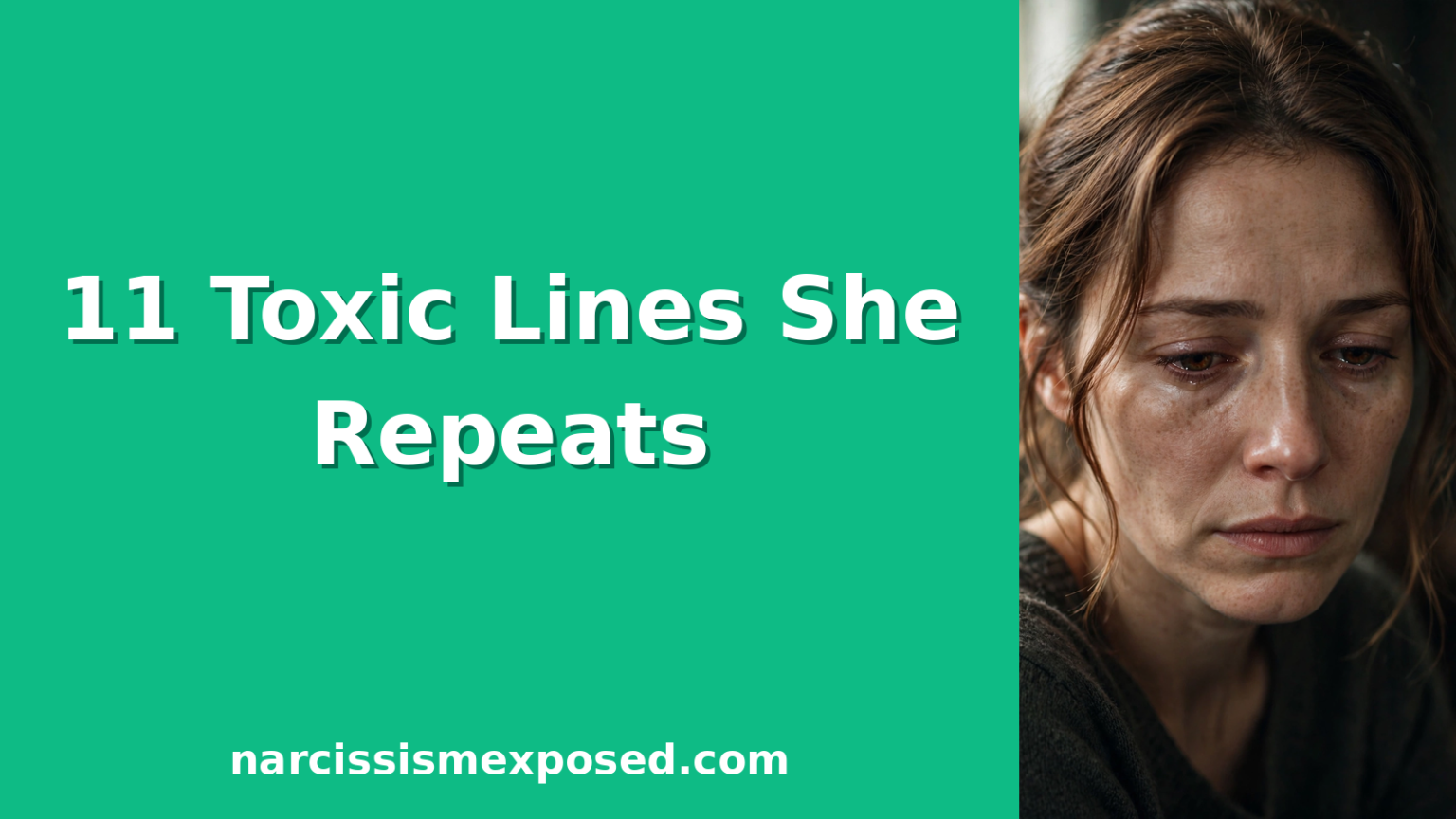
“After everything I have done for you.” You have heard that sentence a thousand times. It was never a statement. It was a bill.
- 1. “After everything I have done for you.”
- 2. “You are too sensitive.”
- 3. “You will never amount to anything.”
- 4. “Nobody will ever love you like I do.”
- 5. “Why can’t you be more like your brother?”
- 6. “You are just like your father.”
- 7. “I sacrificed everything for you.”
- 8. “That never happened. You are making it up.”
- 9. “If you really loved me, you would…”
- 10. “I am the only one who really understands you.”
- 11. “You are the reason I am unhappy.”
- Why These Lines Work: The Machinery Underneath
- How To Answer Her In Real Time
- The Bottom Line On What Narcissistic Mothers Say To Their Children
- Frequently Asked Questions
If you are searching for what do narcissistic mothers say to their children, you already know these phrases by heart, because you did not read them somewhere. You lived them at the kitchen table, in the car, on the phone last week. A narcissistic mother, a parent with the traits of narcissistic personality disorder: grandiosity, entitlement, and a marked lack of empathy, does not simply argue. She uses a fixed repertoire of sentences that sound like parenting but function as control. Clinicians describe these traits plainly: the need for admiration, the inability to recognize other people’s feelings, and the sense that others exist to serve her needs. Every line below carries those traits inside it, and therapists who work with adult daughters of narcissistic mothers describe how this verbal pattern leaves children who cannot see themselves as separate people, only as extensions of their mother’s needs.
This article is not another bare list. You already know the list. For each of the 11 lines, you will get four things: the line itself, what she actually means (the hidden function it performs), the wound it leaves, and the healing reframe that puts the truth back where it belongs.
1. “After everything I have done for you.”
What she really means: your existence is a debt, and she is the collector. This is the guilt induction at the heart of narcissistic parenting, and therapists call the mechanism guilt as a control tool. Parenting tasks that healthy parents perform without keeping score, feeding you, clothing you, driving you to school, are retroactively converted into loans with punishing interest. The function is to make independence feel like theft. Every step you take away from her reads as a defaulted payment.
The wound it leaves: you grow into an adult who cannot receive anything without calculating what it will cost you. Kindness feels like a contract. Compliments feel like setup. You apologize for needing help, and you exhaust yourself repaying debts nobody agreed to, often to partners who never sent you a bill.
The healing reframe: a parent’s care is not a loan. Say it until it lands. “Feeding and sheltering me was her job, not my debt.” You do not owe your adulthood to the person who raised you. You owe your childhood nothing, because you were the child.
2. “You are too sensitive.”
What she really means: your feelings are a problem for me, so they must be a problem with you. This is textbook invalidation, and when it is repeated across years it functions as gaslighting: you learn to distrust your own emotional readings and to consult her version of events instead. The function is convenience. A child who believes she is “too sensitive” stops reporting pain, stops objecting, and stops needing emotional labor from a mother who has none to give.
The wound it leaves: decades later, you still poll other people before trusting your own feelings. “Am I overreacting?” becomes your reflex question. You hand the verdict on your emotions to friends, partners, even strangers, because the one person who was supposed to help you name your feelings trained you to doubt them.
The healing reframe: sensitive is not the insult she made it. Your nervous system was the only honest instrument in that house. “I am not too sensitive. I was a child accurately sensing that something was wrong.” The feeling was data. She just did not like what it said about her.
3. “You will never amount to anything.”
What she really means: your success threatens me, so I will narrate your failure in advance. A narcissistic mother experiences her child’s independence and achievement as abandonment, and sometimes as competition. This sentence is preemptive demolition. If you believe you are doomed, you will not try, and if you do not try, you will not outgrow her. The function is to keep you small enough to need her.
The wound it leaves: the sentence moves in with you. It sits on your shoulder during job interviews, creative risks, and relationships, narrating in her voice. Many adult children of narcissistic mothers describe a strange pattern: they achieve things, then feel guilty or fraudulent about them, because success was defined at home as a betrayal.
The healing reframe: she was describing her fear, not your future. Look at the evidence of your actual life. “I have already amounted to things she said were impossible.” Every certificate, every rent payment, every hard conversation you survived is a rebuttal. The prophecy was never about you. It was a leash.
4. “Nobody will ever love you like I do.”
What she really means: I am your only safe harbor, so do not look for another one. This line sounds like devotion and functions as isolation. It teaches the child that love is a monopoly and that all other relationships are pale imitations or threats. The function is to make leaving her feel like leaving love itself. Therapists note that adult children raised this way often struggle to trust partners, because they were trained to believe no one else’s love could be real.
The wound it leaves: you stay too long in bad relationships because a voice says this is the best love available, or you test good partners relentlessly because you cannot believe affection that does not come with conditions. The line installed a ceiling on how loved you believe you are allowed to feel.
The healing reframe: love that requires your smallness is not love at its strongest, it is control at its most disguised. “Other people can love me, and their love does not have to hurt to be real.” Let that be the sentence you practice. Healthy love feels calm. That calm is not emptiness. It is what love feels like without the tax.
5. “Why can’t you be more like your brother?”
What she really means: I need a ranking system, and you are losing. The golden child and scapegoat dynamic is one of the most documented patterns in narcissistic families. One child is idealized, one is devalued, and the comparison between them is the machinery that keeps both in line. The golden child performs for the praise; the scapegoat performs to escape the criticism. The function is control of both children with a single sentence.
The wound it leaves: sibling relationships fracture. You grow up measuring yourself against people you were supposed to be close to, and the comparison habit generalizes to everyone: colleagues, friends, strangers online. You were trained to believe love is a contest with limited winners.
The healing reframe: you were never competing. The contest was manufactured to keep you both performing. “I do not need to be more like anyone. I needed a mother who could see me.” If you and your sibling can talk honestly as adults, that shared truth can rebuild what the comparisons broke.
6. “You are just like your father.”
What she really means: I am recruiting you into my war with him. This is triangulation: the mother pulls the child into an adult conflict and assigns the child a role in it. Delivered as an insult, the sentence tells the child that half of who they are is contemptible. The function is to make the child police themselves on her behalf, rejecting their own traits, mannerisms, even their face in the mirror, to stay on her good side.
The wound it leaves: identity confusion. You grow up at war with parts of yourself that were never the problem. You may catch yourself apologizing for your laugh, your temper, your ambition, because each one was once labeled with his name and presented as evidence of your defect.
The healing reframe: you are not a side in their marriage. “I am allowed to resemble the people I come from without it being an accusation.” Traits are not crimes. The sentence said everything about her unresolved anger and nothing about your worth.
7. “I sacrificed everything for you.”
What she really means: my life is your fault, and you will pay for it in obedience. This is the martyr script, and it performs a brutal reversal called parentification: the child becomes responsible for the parent’s emotional wellbeing. The mother presents her own choices, her marriage, her career, her happiness, as casualties of your existence. The function is to make your independence feel like cruelty. How can you leave when she gave up everything?
The wound it leaves: you become the family caretaker at eight years old and never retire. You manage everyone’s emotions, anticipate everyone’s needs, and feel crushing guilt for having needs of your own. Writers on the covert side of this dynamic describe how the quiet, corrosive guilt binds love to self denial for decades.
The healing reframe: her sacrifices were her choices, made by an adult, and a child’s existence is never the cause of an adult’s unhappiness. “I was a child. I did not ask to be born, and I did not sign a contract.” You can be grateful for real care she gave without accepting blame for her life.
If untangling this guilt feels impossible on your own, that is not a personal failure. The guilt was installed over thousands of repetitions, and it usually takes structured work to remove. The 30-Day Trauma Bond Recovery Workbook was built for exactly this: thirty days of small, concrete exercises that help you separate the real love from the manufactured obligation and rebuild trust in your own judgment, one day at a time.
8. “That never happened. You are making it up.”
What she really means: your memory is a threat to my story, so I will delete it. This is gaslighting in its purest form. The child reports an event, the mother denies it with total confidence, and the child, who depends on her for reality the way she depends on her for food, folds. The function is narrative monopoly. If she controls what happened, she controls what is allowed to be felt about it, and no complaint can survive without a shared past to stand on.
The wound it leaves: you keep receipts for everything. Screenshots, journals, rehearsed timelines, because some part of you still expects your own memory to be cross examined. You may struggle to make decisions, because decision making requires trusting your read on reality, and yours was systematically overruled.
The healing reframe: write it down anyway. Your memory is not a courtroom exhibit that needs her validation. “It happened. I remember it. Her denial is information about her, not evidence about me.” Many survivors find that a private journal, kept only for themselves, slowly restores the confidence the denials eroded.
9. “If you really loved me, you would…”
What she really means: love is compliance, and I am running the test right now. This sentence turns affection into a loyalty exam with constantly changing answers. Visit more, call less, choose the career she wants, end the relationship she dislikes. The function is to make her approval the measure of your love, which means your love is never quite proven and the test never quite ends. Conditional love is the core wound researchers describe in adult children of narcissistic parents: you learn that love is not based on who you are but on what you do.
The wound it leaves: you become a chronic people pleaser, fluent in everyone else’s needs and illiterate in your own. You say yes while resenting it, then feel guilty for the resentment. Boundaries feel like betrayals because at home, they were.
The healing reframe: love is not a test you pass by disappearing. “Loving someone does not require obeying them.” A mother who loved you well would want to know what you want, not grade how well you perform what she wants. The sentence reveals her definition of love, and her definition was broken.
10. “I am the only one who really understands you.”
What she really means: everyone else is a threat to my access to you. This line is isolation disguised as intimacy. Friends are “using you.” Partners are “not good enough.” Therapists “just want your money.” The function is to cut every competing source of perspective, because any outside voice might name what is happening. A child with no one else to check reality against has only her version.
The wound it leaves: you arrive at adulthood socially starved and suspicious of closeness. You may keep people at arm’s length, convinced they will eventually confirm her verdict, or you may cling to the first person who shows interest because you were taught that connection is scarce.
The healing reframe: understanding that isolates you is not understanding, it is capture. “Other people are allowed to know me, and their view of me does not have to pass through her.” Build the outside relationships anyway. Each one is a window she cannot close.
11. “You are the reason I am unhappy.”
What she really means: my emotions are your responsibility. This is blame shifting raised to a parenting philosophy. The mother’s moods, marriage, and life satisfaction are all laid at the child’s feet, which means the child spends childhood doing emotional labor no child can succeed at: making an unhappy adult happy. The function is to keep the child endlessly working for a reward, her contentment, that never arrives.
The wound it leaves: you become an adult who feels responsible for everyone’s mood in the room. A partner’s bad day feels like your failure. A friend’s distance feels like something you did. You were trained as a tiny emotional janitor, and you never got to clock out.
The healing reframe: her unhappiness predated you and would have existed without you. “I was a child. I did not have the power to make or break her life, and I do not have that power over anyone now.” You can care about people’s feelings without carrying them. That distinction is the whole recovery.
Why These Lines Work: The Machinery Underneath
The 11 lines above are not random cruelty. They are a system, and the system has a name in the clinical literature. Narcissistic personality disorder is defined by grandiosity, a hunger for admiration, and impaired empathy, and in a parent those traits organize into recognizable tactics: guilt induction to enforce compliance, gaslighting to control reality, triangulation to divide the family, parentification to reverse the caregiving roles, and enmeshment to erase the boundary between her feelings and yours. Psychology Today’s overview of narcissistic parents describes exactly this machinery: the parent’s needs first, the child’s feelings unseen, control maintained through shame and guilt.
Understanding the machinery matters because it changes the question. You stop asking “what is wrong with me that she says these things” and start asking “what function does this sentence perform for her.” The first question keeps you in the child’s seat, auditioning for love. The second puts you in the adult’s seat, observing a pattern. That shift is where healing starts, and it is also why simply cutting contact, while sometimes necessary, is not by itself the cure. The lines live in your head rent free long after the phone stops ringing. The real work is evicting them.
How To Answer Her In Real Time
Knowing the translation is only half the battle. The other half is what to do when line number one lands over Sunday dinner and your chest tightens. A few principles that therapists recommend for adult children who are still in contact:
First, do not debate the sentence. You will not win a factual argument with someone defending a psychological need. “That never happened” is not a claim about history. It is a claim about power. Arguing the history dignifies the power play. A calm “I remember it differently” and a subject change costs her the engagement she is after.
Second, answer the function, not the words. When she says “after everything I have done for you,” she is running the guilt program. You can respond to the program: “I appreciate what you did, and I am still making my own decision.” You acknowledge without paying. The sentence only works if guilt converts to compliance. Break the conversion.
Third, keep your exits boring. Grey rock is not about being cold. It is about being uninteresting to someone who feeds on reactions. Short answers, no justifying, no defending, no explaining. Every explanation is new material for the next round.
Fourth, debrief with someone safe afterward. The lines are designed to echo, and an echo needs a wall to bounce off. A friend, a therapist, a journal, or a support group breaks the reverberation. Say the line out loud to someone who loves you and watch how absurd it sounds in daylight. That is the sound of the spell breaking.
The Bottom Line On What Narcissistic Mothers Say To Their Children
What narcissistic mothers say to their children is never just talk. Each phrase is a tool with a job: guilt to keep you close, gaslighting to keep you doubting, comparison to keep you competing, blame to keep you working. The 11 lines in this article are the greatest hits of a system that taught you your feelings were problems, your independence was betrayal, and your love had to be earned daily.
Here is what she never said, and what is true anyway. You were not too sensitive. You were a child sensing accurately. You did not owe her your life for raising you. Raising you was the job. And the voice in your head that still narrates in her sentences is not your conscience. It is an echo, and echoes fade when you stop feeding them rooms to bounce in.
If you are ready to do the deeper work of separating her voice from your own, you do not have to do it alone or unguided. A personalized Clarity Report maps your exact situation: which of these patterns are still running in your family, where your boundaries hold and where they leak, and the concrete steps that fit your life, whether you are in daily contact, low contact, or no contact. No generic advice. Just an honest read on your story and a clear path through it.
Frequently Asked Questions
How do I know if my mother is a narcissist?
Look for the pattern, not a single incident. The signs therapists point to include a consistent lack of empathy for your feelings, love that feels conditional on your compliance, frequent guilt induction, gaslighting of your memories, favoritism or comparison between siblings, and rage or cold withdrawal when you set boundaries. One bad week does not make a narcissist. Years of the same machinery, where her needs always outrank yours and your reality is always negotiable, is the pattern to watch. Only a qualified clinician can diagnose narcissistic personality disorder, so use these signs as education, not as a diagnosis.
What do narcissistic mothers do to their daughters specifically?
Daughters often get a particular mix: competition disguised as closeness. The mother may criticize her daughter’s appearance, choices, and relationships while simultaneously demanding emotional intimacy and loyalty. Many daughters describe being treated as both a rival and a confidante, parentified into managing the mother’s emotions while being told they are too sensitive when they express their own. The result researchers describe is difficulty trusting one’s own judgment, chronic people pleasing, and a tendency to repeat the dynamic in adult relationships because it feels familiar.
How do narcissistic mothers treat their sons?
Sons often face enmeshment rather than open criticism: the mother may idealize her son, depend on him emotionally, and punish his independence with guilt, shame, or withdrawal. Some mothers triangulate the son against his partner, competing for his loyalty. The son learns that his value lies in serving her needs, which can leave him struggling with boundaries and autonomy in his own adult relationships. The machinery is the same as with daughters, guilt, control, conditional love, but the packaging often looks like devotion instead of criticism.
Can a narcissist be a good mother?
A mother with strong narcissistic traits can perform good mothering in public and in moments when it serves her image, but sustained, attuned parenting requires consistently centering a child’s needs, which is exactly what the disorder impairs. Children of narcissistic mothers typically report conditional love, emotional neglect or enmeshment, and invalidation, even when the material care was adequate. The honest answer is that she can love you in the way she is capable of loving, and that way can still leave real wounds that deserve real healing.
Why does my narcissistic mother guilt trip me every time I set a boundary?
Because the guilt is the enforcement mechanism of the whole system. In her framework, your independence reads as abandonment and your boundary reads as an attack, so guilt is deployed to convert your “no” back into compliance. It works because it was installed in childhood, when you had no defenses against it. The guilt you feel is a trained reflex, not evidence that you did something wrong. Expect it, name it as the mechanism, and hold the boundary anyway. The guilt peaks and then fades each time you survive it.
Should I go no contact with my narcissistic mother?
There is no universal answer, and anyone selling you one is selling something. Some adult children find that structured low contact with firm boundaries works. Others find that the pattern only stops when contact stops. The useful question is not what you owe her but what contact costs you: your sleep, your health, your other relationships, your sense of self. If you are unsure, work with a therapist who understands narcissistic family systems before making the decision, and know that the decision can be revisited. Healing is about reclaiming your reality either way.