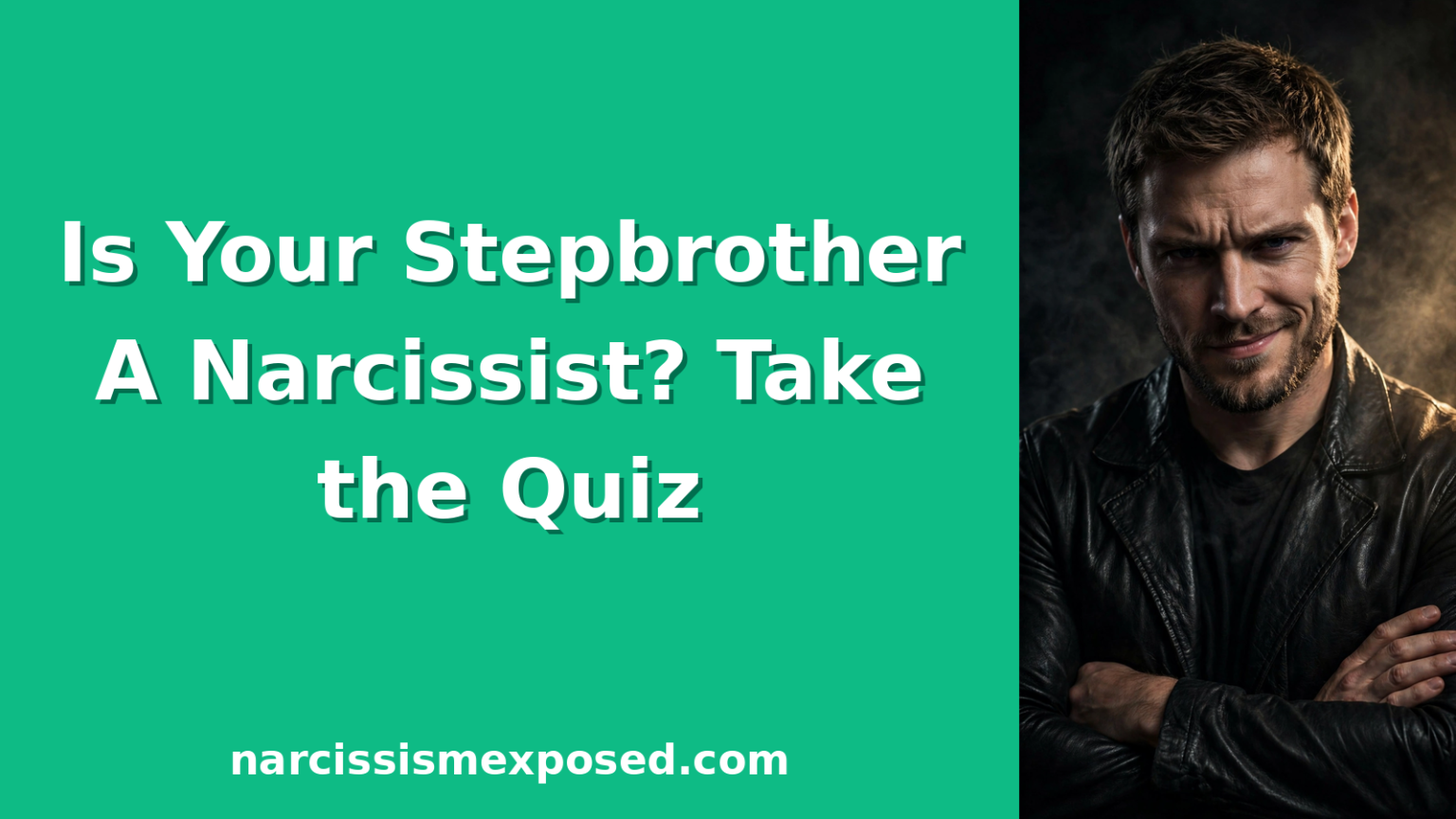
If you have ever typed is my stepbrother a narcissist quiz into a search bar, you probably did it after another family gathering that left you exhausted. Maybe he made the whole day about him, turning every conversation back to his wins, his problems, and his plans. Maybe he treated you like a rival for your parent’s attention, competing for praise, gifts, or time with them. Maybe he reminded you, in words or in actions, that you are not his real brother, and you started to wonder whether the problem was you. This quiz is here to help you look at the pattern clearly, without shame and without guesswork. It is a self reflection tool, not a diagnosis, and it cannot label another person. What it can do is show you, in plain words, how often certain behaviours are showing up in your stepbrother, so you can decide what to do next.
That question is harder than it looks, because a blended family comes with its own unspoken rules. You are expected to love each other like real siblings, even when the family was joined together later, and naming the problem can feel like breaking an unspoken rule. You may also see a very different person from the one other people see. In front of your stepparent he may be charming, helpful, and respectful, while in private messages or one to one he is cold, competitive, or quietly cruel. A stepbrother has no direct authority over you, which makes the pattern harder to name, yet he can still shape the whole family story through gossip, triangulation, and favouritism. That split is exactly why so many people in blended families doubt themselves for years. This quiz asks about behaviour you can actually observe, across many gatherings and many years, not about one bad holiday or one tense family dinner.
Answer for the pattern, not for a single incident. Think about how he usually behaves at family gatherings, in the family group chat, and when boundaries, your parent, or your siblings are involved. A useful result comes from an honest one, so answer for what you have actually seen, even when the answer is uncomfortable, and even when you wish it were different.
What This Quiz Measures
The Is My Stepbrother a Narcissist? Quiz measures how often ten common narcissistic patterns show up in your stepbrother’s behaviour. Each question describes something you can actually observe, such as treating you as a rival for your parent’s attention, playing favourites, gossip and triangulation across the blended family, rewriting shared history, or showing little empathy when you are upset. You answer on a simple frequency scale: Never, Rarely, Sometimes, or Often.

Your answers are scored out of 30. A higher score does not prove a diagnosis, and a lower score does not mean your experience was not real. The score is a snapshot of how strong the pattern feels right now, so you can decide where to set boundaries, what to say to your parent, and what support would help most. The quiz takes about 3 minutes, and you will see your result, with a clear explanation of what your band means, as soon as you finish.
Answer about his behaviour in general, across different family members and different situations, rather than about one person or one event. Patterns matter because they repeat. A single thoughtless comment does not make a pattern, and a single kind gesture does not erase one either. Try to answer for the pattern, and let the result speak for itself.
What Narcissistic Behaviour Looks Like In A Stepbrother
A narcissistic stepbrother often treats you as a rival for your parent’s attention. He competes for praise, gifts, or time with the shared parent, one ups your good news, and treats your achievements as either threats or accessories to his own image. A promotion, a new home, or a happy relationship may be met with a backhanded compliment, a sudden change of subject, or a story about how he did it first and better. That rivalry is not just annoying at a family lunch. Over time it teaches you to hide your successes, to downplay your happiness, and to measure your worth by whether your stepbrother approves.
The second pattern people notice most is the outsider treatment, and it is often the one that hurts most in a blended family. He reminds you that you are not his real brother, or treats you like a guest in your own home, and he may play favourites with your stepparent, praising one child and criticising or ignoring another. He may be warm and charming in front of the parent, then cold or cruel the moment the parent leaves the room. That split is not just unfair in a blended family. It leaves you doubting your own place in the family, wondering whether you belong at all, when the answer is that you do. The favoured child is not safe either, because favour can be withdrawn the moment they stop pleasing him.
The third pattern is gossip and triangulation, and it is often the one that does the most damage across a whole blended family. He gossips about you to other family members, then acts warm to your face. He may pass on a private confidence to the family group chat, tell your parent one version of events and tell you another, or recruit a sibling or a step-relative to take his side when he feels threatened by a boundary. You may find that a relative suddenly goes cold towards you after a private conversation with him, or that a sibling starts repeating his exact words. When that happens, it helps to name it for what it is: a way of keeping control by keeping people divided, rather than a sign that you have done something wrong.
The fourth pattern is entitlement and rewriting history, and the way he reacts when anyone pushes back. A narcissistic stepbrother may borrow your money or belongings, or expect special treatment around shared space, food, or the family car, then act offended when you ask for them back, as if family means you owe him. He may deny things he said or did until you doubt your own memory, criticise your appearance, your choices, or your life in front of others, then call it just joking. If this pattern reminds you of a sibling or a stepparent, read Is My Brother a Narcissist? Quiz and Is My Stepmother a Narcissist? Quiz to compare the patterns side by side, and Is My Stepfather a Narcissist? Quiz if the wider blended family picture needs checking.
10 Signs of a Narcissistic Stepbrother to Check
Before you take the quiz, read through these ten signs slowly. You do not need to tick every one for the pattern to matter. Even a few, showing up often, can explain why family gatherings leave you drained, even when no single event looks dramatic on its own.
- He treats you as a rival for your parent’s attention, competing for praise, gifts, or time with them.
- He reminds you that you are not his real brother, or treats you like an outsider in your own home.
- He plays favourites with your stepparent, praising one child and criticising or ignoring another.
- He turns every conversation back to himself, his wins, his problems, and his plans.
- He gossips about you to other family members, then acts warm to your face.
- He rewrites shared family history, denying things he said or did, until you doubt your own memory.
- He turns relatives against you, recruiting a parent, a sibling, or a step-relative to take his side.
- He borrows your money or belongings, or expects special treatment, then acts offended when you ask for them back.
- He treats your achievements as a threat, or as something he can take credit for.
- He shows little real empathy when you are upset, and quickly turns the focus back to himself.
Notice which signs felt familiar before you even finished reading them. Familiarity is useful information, not a verdict. It often points to the exact behaviour that needs a boundary first.
A Note Before You Start
This quiz is for self reflection only. It is not a diagnosis, it does not label your stepbrother, and it is not a substitute for professional support. A high score means these patterns are showing up often and deserve a clear plan. A low score means they are lighter right now, not that your experience did not matter. Either way, trust what you already know about the pattern alongside the result.
Take the quiz somewhere private, if you can, and give yourself a few quiet minutes afterwards. Some people feel relief when they see their pattern named. Others feel sadness, especially when the result makes the shape of their whole blended family clearer. Both responses make sense. You do not have to fix the whole family today. You only have to see the pattern a little more clearly than you did before you started.
Is My Stepbrother a Narcissist? Quiz
Is My Stepbrother a Narcissist? Quiz measures how often classic narcissistic patterns show up in your stepbrother's behaviour. It takes about 3 minutes, and your result is ready straight away. Start the quiz now!
Start by entering your details. Your result is personalised for you.
Your details stay private. We never share your information.
Interpreting Your Results: What Your Score Means
Your score is out of 30, based on ten questions scored from 0 for Never to 3 for Often. Here is what each band means, in plain words.
0 to 10, Low Likelihood: few narcissistic stepbrother signs are present, or they show up only mildly. Your stepbrother may be competitive, dramatic, or a poor listener at times, but the pattern does not look like a consistent narcissistic style. Keep noticing behaviour over time, and do not let one tense gathering rewrite the whole family picture.
11 to 20, Moderate Likelihood: some narcissistic patterns are present, but the picture is mixed. You may be dealing with a stepbrother who struggles with empathy, accountability, or control, or with the early shape of a more serious pattern. Watch whether the same behaviours repeat with different family members and in different situations, and whether honest feedback ever changes anything.
21 to 30, High Likelihood: many signs are present together. You are very likely dealing with a stepbrother who shows a strong narcissistic pattern: rivalry for your parent’s attention, favouritism, low empathy, blame shifting, triangulation, gaslighting, and guilt as a control tool. That does not prove a diagnosis, but it does mean you need a clear plan for boundaries, limited exposure, records, and self protection, and support from people who believe what you are experiencing.
What to Do With Your Result
If your score is in the low band, keep it simple. Note the one sign that stood out most, and watch whether it repeats over the next few gatherings. A single difficult stepbrother does not need a full strategy, but a repeating pattern does, and early notes make later decisions much easier.
If your score is in the middle band, start with one boundary and hold it for a few visits, such as not passing on messages between family members, shorter visits, or one topic you will not discuss. A boundary held once, and survived, changes the whole dynamic, because it proves that the family can survive your honesty. Talk to your parent about what you have noticed, with one specific example, rather than the label.
If your score is in the high band, protect your peace first and stop measuring your worth by whether this stepbrother approves of you. Limit one to one contact, keep visits short and in group settings, and do not pass on messages between family members. If relatives are being turned against you, the Smear Proof Shield Bundle is built for exactly that pattern, and if the strain is affecting how you see yourself, the Is My Brother a Narcissist? Quiz can help you check the wider picture.
Whatever your band, remember this: you are not required to earn basic respect by enduring rivalry, gossip, or triangulation at family gatherings. Being a stepbrother does not make you an audience for someone else’s performance, and setting a boundary is not disloyalty. It is how you protect your peace and your place in the family.
Frequently Asked Questions
Is this stepbrother quiz a diagnosis?
No. This quiz is a self reflection tool only. It measures how often common narcissistic patterns show up in your answers, and it cannot diagnose your stepbrother or anyone else. Only a qualified professional can make a formal diagnosis, after a proper assessment.
What is the difference between a difficult stepbrother and a narcissistic one?
A difficult stepbrother may be competitive, dramatic, or hard to please, but the behaviour is usually occasional and he can hear feedback. A narcissistic pattern repeats across family members and situations, and it combines rivalry for your parent’s attention, favouritism, low empathy, blame shifting, gaslighting, and control, with little real change when feedback is given.
Why does my stepbrother say I am not his real brother?
The not real family line is one of the most common tools in a blended family with a narcissistic stepbrother. It is a way of keeping you in the outsider role, so he can claim more of the parent’s attention, more of the family story, and more of the shared resources. It is about control and status in the family, not about whether you belong, because you do.
Should I confront my stepbrother about the quiz result?
A quiz result is not a good opening for a confrontation, and it rarely changes a narcissistic pattern. It can help to share one specific behaviour, with an example and a date, rather than the label or the score, and to ask for one concrete change. If he is not able to hear it yet, keep your notes and your boundaries for yourself, and talk to someone outside the family who believes you.
Can the blended family dynamic improve if the pattern is narcissistic?
Change is possible when a person can hear honest feedback and take responsibility, but that is uncommon in a strong narcissistic pattern. What you can usually change is your own position: clearer boundaries, shorter visits, less one to one exposure, and refusing to carry messages between relatives, which often improves daily life even when the other person does not change.
The Smear Proof Shield Bundle is $47, with a 30 day money back guarantee, and it gives you calm scripts for flying monkeys, a clear respond or stay silent plan, and tools to protect your reputation when family members are being turned against you.
Protect Your Name Without Starting A Family War
How to Survive When You Cannot Leave Yet is $27.99, and it gives you 27 quiet survival moves, exact words, and calm scripts for life under the same roof while you plan your next move.
Survive Today While You Plan Tomorrow
The Narcissistic Abuse Clarity Report is $67, and it maps your exact situation, the person, the tactics, and your next moves, in a report you can re-read whenever the fog rolls back in.