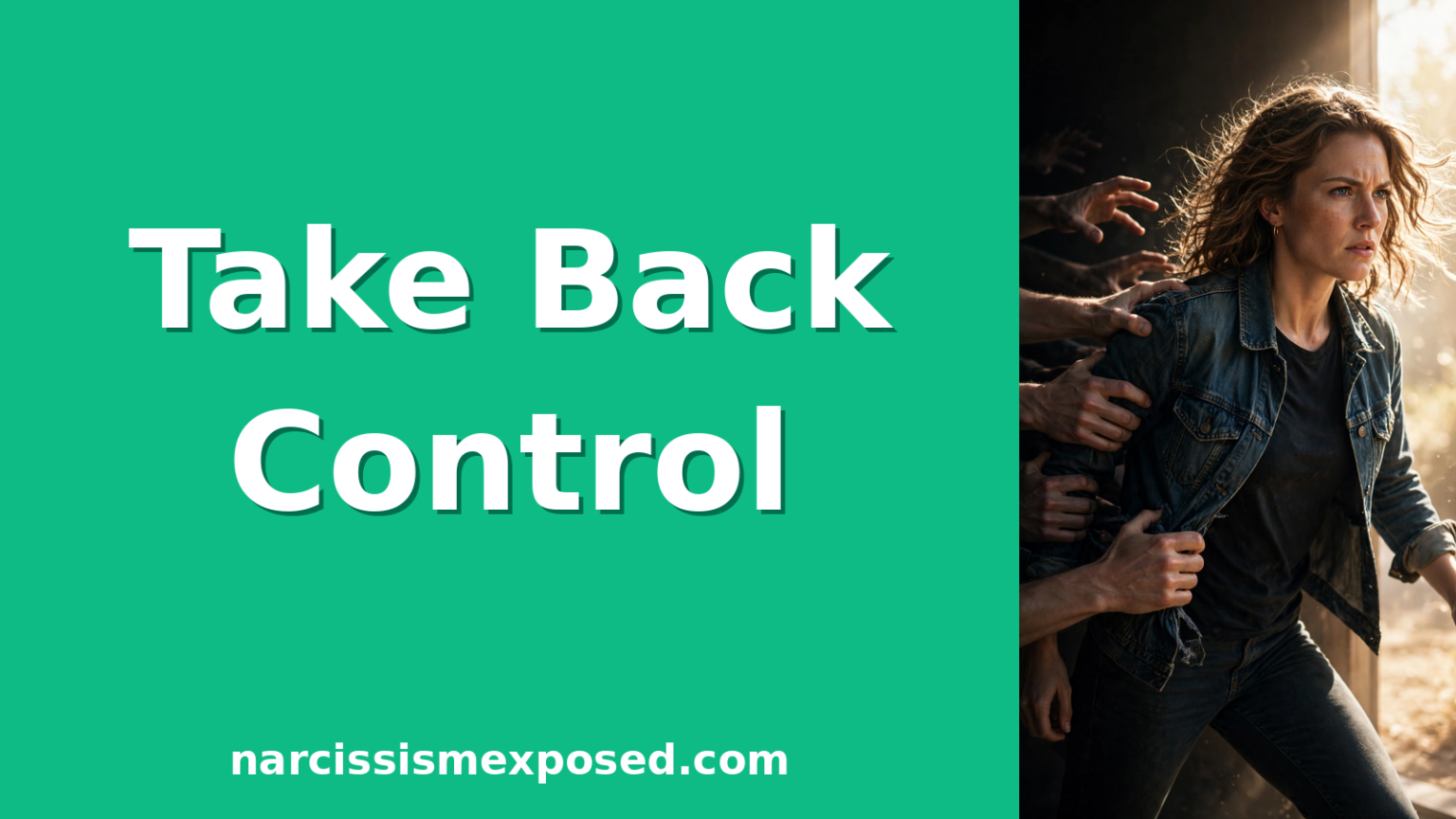
Control is not a side effect of narcissism. It is the point. The grandiosity, the charm, the rage, all of it serves one purpose: making sure the narcissist stays in charge of you, your reality, and your life. Understanding narcissism and control means seeing the takeover for what it is, a systematic campaign that usually happens so gradually you do not notice until you are already living inside it.
Narcissists do not seize control all at once. They take it territory by territory, and each surrender feels small at the time. Here are the 8 domains they conquer, in roughly the order it happens, and how to reclaim each one.
1. Your Attention
It starts here. In the beginning, the narcissist wants all of your attention, and it feels like love. Constant texts, long calls, intense interest in everything about you. You feel chosen, fascinating, finally seen.
But notice the direction: it is always about them holding your focus, never about them sharing theirs. Your attention becomes their property. When you give it to friends, work, or hobbies, there are consequences: sulking, fights, crises that need you right now. Slowly, your world narrows to one person. This is not romance. It is the first territory claimed.
Take it back: deliberately redirect attention to your own life every day. Friendships, interests, goals that have nothing to do with them. Attention is the currency of control, and spending it elsewhere is an act of rebellion.
2. Your Time
Once they have your attention, they take your schedule. Spontaneous demands that cannot wait. Plans that get vetoed. Your time becomes subject to their approval, and asking permission starts to feel normal.
The mechanism is usually framed as love or need: “I just miss you so much.” “This is urgent.” “You always put everything before me.” Each incident seems reasonable. The pattern is not. A partner who consistently treats your time as theirs to allocate is not devoted. They are colonizing your calendar.
Take it back: keep commitments that do not involve them, and keep them visibly. A standing dinner with a friend, a class, a routine they cannot veto. Your time is yours. Act like it before you feel like it.
3. Your Social Circle
This is where control gets strategic. The narcissist begins to poison your other relationships: subtle criticisms of your friends, manufactured drama with your family, guilt about time spent away from them. “Your sister never liked me.” “Your friends are a bad influence.” “Nobody understands you like I do.”
The goal is isolation, because an isolated person has no reality check. When the narcissist is your only mirror, their version of you becomes the only version. If your circle has shrunk to one person, that is not love. That is a siege. Rebuilding takes deliberate effort, and it starts with one honest conversation with someone you trust about what has been happening.
4. Your Money
Financial control is one of the most effective chains because it is practical, not just psychological. It can look like taking over the accounts “because you are bad with money,” running up debt in your name, sabotaging your job, or making you ask for basic spending money like a child asking a parent.
Even without full financial domination, smaller versions work: the constant criticism of your spending, the “jokes” about your income, the way big purchases require their approval but theirs require none. Money is independence in concrete form, and that is exactly why it gets targeted.
Take it back: know every account, every balance, every debt. Get your own account if you do not have one. Financial clarity is not about leaving tomorrow. It is about being able to leave, which changes everything about how you carry yourself today.
5. Your Reality
Gaslighting is control of the most intimate territory: your own mind. “That never happened.” “You are remembering it wrong.” “You are crazy.” Over time, you stop trusting your memory, your judgment, your feelings. You check with them before you trust yourself.
This is the domain where the damage runs deepest, because once your reality is outsourced, every other form of control gets easier. Why would you leave if you cannot trust your own perception that something is wrong? Rebuilding reality-testing is slow work, and it starts with writing things down and believing your own notes. If this is where you are, read the signs you are trauma bonded, because the bond and the reality distortion feed each other.
6. Your Decisions
Somewhere along the way, you stopped deciding things. What to wear, what to eat, who to see, how to spend the weekend, the big life choices, all of it started flowing through them. Disagreeing became so costly, the fights, the sulking, the punishment, that agreement became the path of least resistance.
This is learned helplessness installed by design. Every decision you surrendered trained you to surrender the next one faster. Taking this territory back starts embarrassingly small: choose the restaurant. Pick the movie. Say no to one small thing and survive the reaction. Small decisions are the gym where your autonomy rebuilds its strength.
7. Your Emotions
The narcissist becomes the thermostat of your inner life. Their mood determines your day. You wake up scanning: are they okay? Is today safe? Your own feelings get buried under the full-time job of managing theirs.
This is emotional control at its purest. You do not just obey them. You feel on their schedule. Happy when they are pleased, anxious when they are cold, relieved when the storm passes. Your nervous system has been conscripted into their service. The way out is noticing, daily, what you actually feel underneath the weather report of their mood. Your emotions are data about your life, not theirs.
8. Your Identity
The final territory. After years of this, many survivors cannot answer simple questions: What do you like? What do you want? Who are you without them? The narcissist’s version of you, too sensitive, too difficult, lucky to be tolerated, has replaced your own.
This is the deepest wound and the longest recovery, because identity is not a territory you reclaim in a weekend. It is rebuilt choice by choice, boundary by boundary, in the life you build after. But here is what the narcissist never understood: the self they tried to erase is still in there. It went quiet to survive. It is waiting for safe conditions to speak again. If you need the mechanics of drawing the first lines, start with how to set boundaries with a narcissist.
Why Control Feels Like Love at First
Every one of these takeovers begins disguised as devotion. The attention feels like passion. The time demands feel like longing. The isolation feels like “us against the world.” The financial management feels like competence. By the time the disguise drops, the territories are already occupied.
This is why “just leave” is such useless advice. You are not dealing with one bad behavior. You are dealing with an occupied life, and liberation is a campaign, not a moment. It happens territory by territory, in reverse: your attention first, then your time, then your people, then your money, then your mind, then your choices, then your feelings, then yourself. Psychology Today’s narcissism overview describes the entitlement driving this pattern, and the Mayo Clinic’s personality disorder guide covers the clinical picture.
Control only works in the dark. The Gaslighting Recovery Bundle ($47) shines a light on every territory they took and gives you the map to take it back.
Frequently Asked Questions
Do narcissists know they are controlling?
Many do, at least functionally. They may not use the word control, but they know which behaviors get compliance and they repeat what works. Whether they frame it as love, leadership, or necessity does not change the effect on you.
Is a controlling partner always a narcissist?
No. People can be controlling from insecurity, anxiety, or learned family patterns without having NPD. The narcissistic version is distinguished by entitlement, lack of empathy, gaslighting, and punishment of autonomy. A merely insecure partner can often change when the pattern is named. A narcissist typically escalates.
Why do I let them control me?
Because the control was installed gradually, disguised as love, and enforced with emotional consequences that trained your nervous system. This is not weakness or stupidity. It is conditioning, and it works on intelligent, strong people every day. The question is not why you allowed it. It is what you do now that you see it.
Can a controlling narcissist change?
Genuine change requires insight, accountability, and sustained effort, and the disorder specifically resists all three. Some modify surface behaviors temporarily to keep a partner, but the underlying entitlement rarely shifts. Plan your life around who they are, not who they might become.
How do I take back control without starting a war?
Quietly and gradually. Reclaim small territories first: your attention, your time, one friendship. Document everything. Build resources they cannot see. Do not announce your liberation campaign. And if you are planning to leave, know that the narcissist will keep contacting you afterward, so plan for that too.
What is the first sign a narcissist is trying to control you?
The speed of the attachment combined with subtle vetoes over your other relationships. If someone you just met already has opinions about your friends, your schedule, and your choices, and it feels flattering rather than alarming, pay attention to that feeling. That is the first territory being surveyed.
Eight territories. One life. Yours. Take them back in reverse order, starting today, starting small. The Survival Workbook is the field manual for the whole campaign.