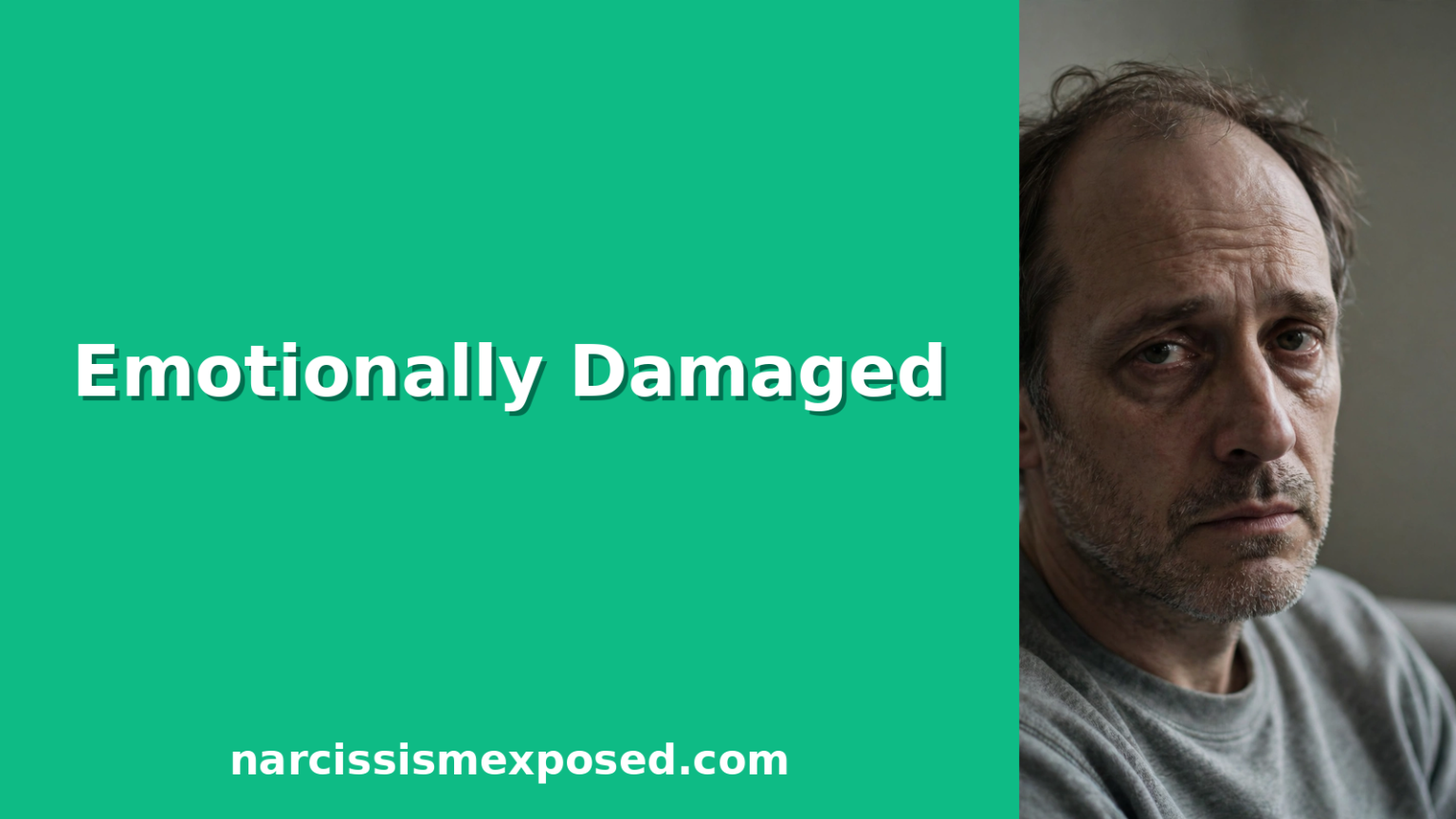
He is sitting on the couch at nine in the evening, staring at the television without watching it. You ask him what is wrong and he says nothing, in a voice that means do not ask again. You have seen this look before, the same flat stare after every argument, every kind word, every attempt to get close. What does emotionally damaged mean, and is this what it looks like? It means a person is carrying lasting emotional harm from experiences that overwhelmed their ability to cope, and the pattern behind it often has a plain name, trauma bonding after a toxic or narcissistic relationship, where kindness and cruelty arrived in the same week so often that the nervous system learned to expect both at once.
- What Does Emotionally Damaged Mean
- What Causes Emotional Damage
- What Are the 7 Signs Someone Is Emotionally Damaged
- Why Do Hurt People Shut Down or Cling
- How Does Emotional Damage Change Attachment
- How Is Emotional Damage Different From Trauma, PTSD, Depression and Grief
- Is an Emotionally Damaged Person a Narcissist
- What Should You Say to an Emotionally Damaged Partner
- Can an Emotionally Damaged Person Love
- Why Do You Keep Choosing the Same Kind of Partner
- How Do You Start Healing From Emotional Damage
- When Should You Seek Qualified Local Support
- Frequently Asked Questions
You will learn what emotionally damaged means in plain language, why it is not a diagnosis, the 7 signs to look for in yourself or someone you love, what causes it, how it changes the way a person attaches to others, how it differs from trauma, PTSD, depression, and grief, how to tell a hurt person from a harmful one, what to say and what never to say, whether an emotionally damaged person can love, why hurt people keep choosing the same kind of partner, and a simple 7 day plan to start healing. You will also get two comparison tables, five word for word scripts, and a printable self-check.
If a past relationship left you flinching at kindness and bracing for the next blow, the Trauma Bond Breaker Bundle was made for exactly that. It walks you through recognising the bond, breaking the cycle, and rebuilding trust in your own judgment, step by step. You can see everything it includes here: Trauma Bond Breaker Bundle.
The short answer is this. Emotionally damaged means a person is living with lasting emotional harm from painful experiences, usually trauma, abuse, neglect, betrayal, or loss, that changed how they feel, trust, and connect with others. It is everyday language, not a medical diagnosis, and it describes a wound that can heal with time, support, and the right help.
Key Takeaways
- “Emotionally damaged” is not a diagnosis. It is everyday language for lasting emotional harm, and it says nothing about a person’s worth or their future.
- The 7 signs are trust problems, emotional numbness, mood swings, withdrawal, hypervigilance, low self-worth, and repeating the same painful relationship pattern.
- The same wound can look like shutting down or like clinging too hard. Both are protection, not personality.
- A hurt person is not the same as a harmful person. The difference is whether they take responsibility and change, or blame you and repeat the harm.
- Healing is not a single decision. It is small daily steps, honest support, and, when the signs interfere with daily life, qualified professional help.
What Does Emotionally Damaged Mean
Emotionally damaged means a person’s emotional world was hurt by experiences that were too much to cope with at the time, and the effects are still shaping how they live today. The direct answer is that it describes lasting harm to how someone feels, trusts, and connects, caused by trauma, abuse, neglect, betrayal, or loss. It is not a term you will find in the DSM-5, the manual clinicians use to diagnose mental health conditions. Psychologists and psychiatrists use specific diagnoses instead, such as post-traumatic stress disorder, depression, or anxiety. “Emotionally damaged” is the phrase ordinary people reach for when none of those labels quite fits what they see.
Think of it like a sprained ankle that never healed properly. The original injury is over, but the person still walks differently, still avoids the stairs, still flinches when someone steps too close to the sore spot. Emotional damage works the same way. The event ended, but the nervous system kept the lesson. A raised voice still means danger. A kind gesture still feels like a trap. A quiet evening still feels like the calm before a storm. The person is not being difficult. Their emotional system is still guarding a wound.
Three things are important to hold at once. First, emotional damage is real, even though it is invisible. There is no bruise to point at, which is why other people so often say “just get over it” and why the person themselves so often feels ashamed for still struggling. Second, it is not a life sentence. People heal from emotional damage every day, and healing does not mean forgetting what happened. It means the past stops running the present. Third, it is not an excuse for harming others. A person can be deeply hurt and still be responsible for how they treat the people around them. Pain explains behaviour, it never justifies cruelty.
The phrase is often used in two different ways, and the difference matters. Sometimes it describes a person who was hurt and is now struggling, which is most of this article. Sometimes it is used as a warning label, as in “stay away, he is emotionally damaged”, which treats a wound as if it were a character flaw. This article uses the first meaning. A person who has been hurt deserves understanding, and also deserves honesty about the work healing takes.
What Causes Emotional Damage
Emotional damage is caused by experiences that overwhelm a person’s ability to cope, especially when those experiences repeat or come from someone who was supposed to be safe. The direct answer is that the most common causes are childhood neglect or abuse, a toxic or abusive relationship, betrayal, sudden loss, and long periods of chronic stress. One bad week rarely causes lasting damage. What causes it is usually a pattern, or a single event so severe that it rewrites what a person expects from the world.
Childhood is where the deepest roots grow. A child who is ignored, criticised, frightened, or left to manage adult emotions learns early that closeness is unsafe and that their own needs are a burden. That child grows into an adult who either apologises for existing or expects to be abandoned, and often both in the same week. A narcissistic parent is one of the most common sources, because the child learns that love is conditional on performance and that their feelings do not count. The wound is not one memory. It is a thousand small lessons about who they are allowed to be.
Adult relationships can cause it too, and this is where most readers of this article will recognise themselves. A partner who love bombs you, then withdraws, then blames you for the withdrawal, teaches your nervous system that affection is a trap. Trauma bonding is the name for the attachment that forms in that cycle, and it is one of the fastest ways a healthy person becomes emotionally damaged. Gaslighting adds a second wound, because the person stops trusting their own memory and judgment. The guide to what gaslighting looks like in a relationship explains how that slow erosion of reality works, and why it leaves people doubting themselves long after the relationship ends.
Betrayal is a cause of its own. Discovering an affair, learning a business partner stole from you, or finding out a trusted friend spread your secrets does not just hurt in the moment. It changes the rulebook. The person starts to assume that anyone kind has a hidden motive, and they check every new relationship for the betrayal they now expect. Loss can do the same. The sudden death of a parent, a child, or a partner can leave a person braced for the next loss for years, unable to relax into happiness because happiness now feels like a setup. Chronic stress is the quietest cause. Years of financial fear, workplace bullying, or caring for a sick relative without support can wear down emotional reserves until a small event causes a large collapse. None of these causes makes a person weak. They make a person human, and the damage they leave is the price of having coped for too long without enough support.
What Are the 7 Signs Someone Is Emotionally Damaged
The 7 signs of emotional damage are trust problems, emotional numbness, mood swings, withdrawal, hypervigilance, low self-worth, and repeating the same painful relationship pattern. The direct answer is that no single sign proves anything on its own, and a person can show one sign strongly and barely show the others. What matters is the pattern, how long it has lasted, and whether it interferes with daily life. Each sign below comes with what it looks like at home, what it sounds like in real words, and what it is protecting the person from, because every sign is a defence that once made sense.
1. They Cannot Trust, Even When There Is No Reason Not To
Trust problems are the most common sign of emotional damage, and the hardest for a partner to live with. The direct answer is that a person who has been betrayed or abandoned learns to treat trust as dangerous, so they test, check, and expect the worst even when the evidence is good. At home it looks like reading your phone over your shoulder, asking who you were talking to, or needing to know exactly where you were and why you were ten minutes late. It sounds like “Who was that?” asked with an edge, or “You would tell me if something was going on, right?” asked for the fifth time this week. What it is protecting them from is the shock of being blindsided again. If they expect betrayal, the thinking goes, it cannot ambush them. The cost is that no amount of reassurance ever feels like enough, because the fear is not about what you did. It is about what someone else did, years ago, and the person is still scanning every room for that same danger.
2. They Go Numb When Feelings Get Too Big
Emotional numbness is the sign most people miss, because a numb person looks calm. The direct answer is that numbness is the nervous system switching off feelings it cannot process, so the person feels flat, empty, or far away, even at moments that should matter. At home it looks like staring through the television, answering in one word, or sitting through a birthday dinner like a guest at someone else’s table. It sounds like “I am fine”, said in a voice that is not fine at all, or “I do not know”, when asked what they feel. What it is protecting them from is being overwhelmed. When feelings were punished or ignored in the past, the brain learned that feeling nothing is safer than feeling everything. The cost is that numbness does not filter. It blocks joy and tenderness along with pain, so the person can feel lonely in a room full of people who love them.
3. Their Moods Swing Fast and Hard
Mood swings in emotional damage are not ordinary bad days. The direct answer is that a person whose emotional reserves are already spent reacts to small triggers with big feelings, because there is nothing left in the tank to absorb a normal stress. At home it looks like a relaxed morning turning into a slammed door over a burnt piece of toast, or laughter at lunch followed by tears in the car for no reason anyone can name. It sounds like “Why are you always on at me?” when nobody was on at them, or an apology ten minutes later that is genuinely sorry and genuinely confused. What it is protecting them from is nothing, and that is the painful part. The swing is not a strategy, it is a system with no brakes. The person often feels ashamed afterwards, which adds a second layer of distress on top of the first, and the shame makes the next swing more likely.
4. They Pull Away From the People Who Love Them
Withdrawal is the sign that confuses partners most, because it looks like rejection. The direct answer is that a person who expects closeness to end in pain pulls away first, so they can control when and how the distance happens. At home it looks like declining invitations, staying late at work, spending evenings in a separate room, or answering messages a day late. It sounds like “I just need some space”, said every week, or “Do not worry about me”, said by someone who clearly needs worrying about. What it is protecting them from is vulnerability. If nobody gets close, nobody can leave, betray, or disappoint them. The cost is loneliness, and it is a loneliness the person often chooses while hating the choice, because being alone feels safer than being known and then hurt again.
5. They Are Always Braced for the Next Bad Thing
Hypervigilance means living with the alarm switched on all the time. The direct answer is that a person who has lived through unpredictable harm stays alert for threat, scanning tone of voice, facial expressions, and silences for signs of danger. At home it looks like flinching at a raised voice that was not angry, waking at small noises, or reading a short text message ten times to work out what it really means. It sounds like “Are you angry with me?” when you are only tired, or “What did you mean by that?” after an innocent comment. What it is protecting them from is surprise. If they spot the danger early, they can prepare, leave, or please the other person before it lands. The cost is exhaustion. A nervous system cannot stay on high alert forever, which is why hypervigilance often collapses into the numbness of sign 2, and the person swings between wired and flat for years.
6. They Believe They Are the Problem
Low self-worth is the quietest sign and the one that does the most damage over time. The direct answer is that a person who was repeatedly blamed, criticised, or treated as unlovable starts to believe the treatment was deserved, and carries that belief into every new relationship. At home it looks like apologising for things they did not do, refusing compliments, or staying in a bad relationship because they believe nobody better would want them. It sounds like “I am too much trouble”, “You will leave once you really know me”, or “Sorry, sorry, I know”. What it is protecting them from is hope. If they expect nothing, they cannot be disappointed. The cost is that low self-worth makes a person accept treatment they would never accept for a friend, and it makes every kindness feel suspicious, because kindness does not fit the story they were taught about themselves. The slow hollowing out this causes is described in the guide to self erosion in toxic relationships, where a person loses the sense of who they were before the harm.
7. They Keep Choosing the Same Kind of Partner
Repeating the same painful pattern is the sign that proves the wound is still running the show. The direct answer is that a person who has not healed tends to choose partners who feel familiar, even when familiar means harmful, because the nervous system mistakes recognition for safety. At home it looks like a new relationship that starts differently and ends the same way, the same arguments, the same walking on eggshells, the same apology tour. It sounds like “Why does this always happen to me?” or “All men are the same”, or “All women are the same”, when the real pattern is the type of person they keep choosing. What it is protecting them from is the unknown. A healthy, steady partner can feel boring or even frightening to someone whose system learned that love means intensity, chaos, and repair. The cost is that each repetition adds a new layer of damage and a new reason to believe the problem is them. The 7 signs you are trauma bonded, not in love, can help you tell whether the pull you feel is love or a bond built on the cycle of harm and relief.
Why Do Hurt People Shut Down or Cling
Hurt people shut down or cling because both are attempts to stay safe, and the same wound can produce either one depending on the moment. The direct answer is that shutting down protects a person by creating distance, while clinging protects a person by preventing abandonment, and both come from the same fear that closeness leads to pain. This is why an emotionally damaged person can seem cold one day and needy the next, and why partners often feel confused. They are not two different people. They are one person using two different shields.
Shutting down usually appears when closeness feels threatening. The person goes quiet, leaves the room, or turns their attention to work, their phone, or sleep. To a partner it feels like a wall going up. Inside, the person is often thinking that if they say what they really feel, they will be mocked, punished, or left. So they say nothing, and the silence protects them while starving the relationship. Clinging usually appears when distance feels threatening. The person texts repeatedly, asks for reassurance, or panics when a partner is late. To a partner it feels like pressure. Inside, the person is often thinking that if they let go for a moment, the other person will disappear. So they hold tighter, and the holding pushes the other person away, which confirms the fear.
The shift between the two can happen fast. A person can cling all morning, feel ashamed of needing so much, and then shut down all evening to punish themselves for it. A partner who only sees the behaviour will think the person is unpredictable or manipulative. A partner who understands the fear underneath will see someone swinging between two defences, neither of which they chose freely. Both defences soften when the person feels genuinely safe over time, and both harden again the moment safety is doubted. That is why consistency matters more than intensity. One grand gesture does not heal a wound built on a thousand small betrayals. A hundred small moments of showing up on time, telling the truth, and staying calm during conflict do.
How Does Emotional Damage Change Attachment
Attachment is the pattern a person learned in childhood for how close relationships work, and emotional damage can bend that pattern out of shape. The direct answer is that damage usually pushes a person toward one of three insecure patterns, anxious, avoidant, or disorganised, and each one shows up differently in adult relationships. Attachment theory comes from the work of psychiatrist John Bowlby and developmental psychologist Mary Ainsworth, who showed that the way a child is cared for shapes how they bond as an adult. Psychology Today has published a clear explanation of why anxious and avoidant attachment attract each other, and the push and pull it describes is exactly what many emotionally damaged couples live through.
| Attachment pattern | What it looks like | What the person fears most | What helps |
|---|---|---|---|
| Secure | Comfortable with closeness and with space, asks for what they need, repairs after conflict | Losing connection, but believes repair is possible | This is the pattern healing moves toward, not a starting point most hurt people have |
| Anxious | Texts often, needs constant reassurance, panics at distance, reads too much into silence | Abandonment, being left for someone better | Steady, predictable contact, reassurance given freely before it is begged for |
| Avoidant | Values independence, pulls back when things get close, minimises feelings, leaves during conflict | Being trapped, losing themselves in closeness | Space without punishment, closeness offered gently, no chasing |
| Disorganised | Wants closeness and fears it at the same time, swings between clinging and shutting down, expects harm from the people they love most | Closeness itself, because closeness once meant danger | Safety first, slow pace, professional support, a partner who stays calm through the swings |
No attachment pattern is a diagnosis, and no pattern is permanent. Attachment styles are learned, which means they can be relearned. A person with an anxious pattern can learn to self-soothe instead of seeking reassurance every hour. A person with an avoidant pattern can learn that closeness does not have to mean losing themselves. A person with a disorganised pattern can learn, slowly, that not every kind person is a threat. The work is slow and it is rarely linear, but the table above shows why understanding the pattern matters. You cannot fix a fear of abandonment by giving someone more space, and you cannot fix a fear of engulfment by demanding more closeness. The help has to match the fear.
How Is Emotional Damage Different From Trauma, PTSD, Depression and Grief
Emotional damage is often confused with trauma, PTSD, depression, and grief, because the signs overlap. The direct answer is that emotional damage is the broad everyday phrase for lasting harm, trauma is the event or experience that caused it, PTSD is a specific diagnosable condition with strict criteria, depression is a mood disorder that can follow damage, and grief is the natural response to loss. They are related, but they are not the same thing, and the table below shows the difference in plain language.
| Emotional damage | Trauma | PTSD | Depression | Grief | |
|---|---|---|---|---|---|
| What it is | Everyday language for lasting emotional harm | The event or experience that overwhelmed coping | A diagnosable condition with specific criteria in the DSM-5 | A mood disorder marked by persistent low mood and loss of interest | The natural emotional response to loss |
| What causes it | Trauma, abuse, neglect, betrayal, loss, chronic stress | A deeply distressing event or ongoing harmful situation | A traumatic event, with symptoms lasting over a month and interfering with daily life | Many causes, including trauma, biology, and life stress | Death, breakup, or any major loss |
| Main signs | Trust problems, numbness, mood swings, withdrawal, hypervigilance | Shock, fear, helplessness, intrusive memories | Flashbacks, nightmares, avoidance, hypervigilance, negative mood changes | Persistent sadness, emptiness, fatigue, loss of pleasure, sleep changes | Sadness, longing, waves of pain, difficulty accepting the loss |
| Is it a diagnosis | No, it is a descriptive phrase | No, it describes an experience | Yes, diagnosed by a qualified clinician | Yes, diagnosed by a qualified clinician | No, it is a normal human process |
| What helps | Support, boundaries, self-care, therapy when needed | Safety, support, processing the experience with help | Trauma-focused therapy such as TF-CBT or EMDR, and sometimes medication | Therapy, lifestyle changes, and sometimes medication | Time, support, rituals, and help when grief becomes stuck |
The Mayo Clinic explains the four groups of PTSD symptoms, intrusive memories, avoidance, negative changes in thinking and mood, and changes in physical and emotional reactions, which is a useful check if you are wondering whether what you feel goes beyond emotional damage. If symptoms have lasted more than a month and interfere with work, sleep, or relationships, that is the point to talk to a qualified professional rather than trying to work it out alone. You do not need a label to deserve help. You only need to be struggling.
Is an Emotionally Damaged Person a Narcissist
An emotionally damaged person is not automatically a narcissist, and confusing the two causes real harm in both directions. The direct answer is that a hurt person is struggling with wounds from their past, while a narcissistic pattern is defined by entitlement, lack of empathy, and a repeated refusal to take responsibility, and the difference shows in what the person does when they are told they hurt you. This distinction matters, because calling a hurt person a narcissist can shame someone who needs support, and calling a narcissist “just damaged” can keep someone in a harmful relationship far too long.
| Emotionally damaged person | Narcissistic pattern | |
|---|---|---|
| Core experience | Pain, fear, and shame from past harm | Entitlement, fragile self-worth protected by blame and control |
| How they react to being told they hurt you | Often distressed, apologetic, and willing to listen, even if clumsily | Often deflects, denies, reverses blame, or attacks, a pattern known as DARVO |
| Empathy | Usually present, though it can be blocked by their own pain | Consistently limited, especially when empathy would require admitting fault |
| Accountability | Takes responsibility, sometimes too much, and tries to change | Avoids responsibility, repeats the harm, and expects the other person to adapt |
| Change over time | With support and honest effort, the signs soften | Change is rare without sustained professional help and genuine willingness |
| How it feels to love them | Hard, but there are moments of real warmth, honesty, and repair | Confusing and exhausting, with warmth that appears mainly when something is wanted |
DARVO stands for Deny, Attack, and Reverse Victim and Offender. It is the pattern where a person accused of harm denies it, attacks the person who raised it, and ends up positioned as the victim. If you raise a hurt and the conversation ends with you apologising for raising it, that is DARVO, and it is a sign of a harmful pattern rather than a wound. A hurt person may get defensive in the moment, most people do, but they come back, they listen, and they try to do better. A person running a narcissistic pattern does not come back to repair. They come back to win. This article does not diagnose anyone. Only a qualified clinician can diagnose a personality disorder, and no article can do it from a list of signs. What the table gives you is a way to judge behaviour, which is the only thing you can reliably judge from inside a relationship.
What Should You Say to an Emotionally Damaged Partner
What you say to an emotionally damaged partner matters less than how steady you are when you say it. The direct answer is that the best words are short, honest, and specific, they name what you see without labelling the person, and they are followed by consistent behaviour, because a person who has been lied to trusts actions far more than promises. The five scripts below cover the hardest moments. Use them word for word or adapt them to your own voice, but keep the shape, one observation, one feeling, one clear ask.
When they shut down mid-conversation, try this. “I can see you have gone quiet, and I am not going to chase you for an answer right now. I am here when you are ready, and we can finish this when you feel able to.” This works because it names what you see without demanding a response, and it promises you will still be there later. What never to say is “Why do you always do this?” or “You never talk to me.” Those lines turn a shutdown into a trial, and the person will shut down harder.
When they ask for reassurance for the tenth time today, try this. “I love you, and I am not going anywhere. I know that fear is still loud for you, and I am going to keep showing you with how I act, not just with words.” This works because it answers the fear directly instead of arguing with it. What never to say is “I already told you, how many times do you need to hear it?” That tells the person their fear is a burden, and they will stop asking while the fear grows.
When they flinch at something innocent, try this. “That was not anger, I was just tired. I understand why a raised voice puts you on edge, and I will be more careful with my tone.” This works because it separates your intention from their trigger without dismissing either one. What never to say is “You are overreacting” or “That is not what happened.” Those lines repeat the exact experience that caused the damage, being told their reality is wrong.
When they apologise for something they did not do, try this. “You do not need to apologise for that. You did nothing wrong, and I am not upset with you.” This works because it interrupts the apology habit with a clear, calm fact. What never to say is “Well, you should be sorry”, even as a joke. A person who apologises constantly is already carrying more blame than they deserve.
When they push you away, try this. “I am going to give you some space, and I will be in the next room. Come and find me when you are ready, I am not leaving.” This works because it gives space without giving abandonment, which is the exact combination a hurt person needs. What never to say is “Fine, I will just go then”, or a silent treatment of your own. Matching withdrawal with withdrawal confirms the person’s worst belief, that closeness always ends in being left alone.
Can an Emotionally Damaged Person Love
An emotionally damaged person can love, and many do, deeply and loyally. The direct answer is that damage changes how love is expressed, not whether it exists, and the question that matters is not whether they can love but whether they can love in a way that is safe and steady for both people. Love from a hurt person often looks different from the easy, relaxed love in films. It can be intense, anxious, watchful, and fiercely loyal. The person may love you with everything they have and still flinch when you are kind, still test you, still pull away after a good day because a good day feels unfamiliar and therefore unsafe.
That does not mean you should accept being hurt in return. Loving a hurt person takes patience, but patience is not the same as endurance. There is a line, and the line is behaviour. A person who is working on their wounds, who listens when you say something hurt, who apologises and changes, can build a good relationship with you. A person who uses their wounds as a reason why they never have to change, who hurts you and then points at their past as if the past did it, is not loving you. They are asking you to carry the cost of their damage, and that cost grows every year.
If you are the one who is hurt, the same honesty applies. You are not too damaged to be loved, and anyone who tells you that is wrong. You are worthy of love exactly as you are, and you are also responsible for the work healing asks of you. Love does not require you to be fixed first. It does require you to be honest about where you are, to keep getting help, and to stop choosing partners who reopen the wound. The guide to how long it takes to recover from narcissistic abuse is honest about the timeline, and the honest answer is that healing takes months and years, not weeks, and that the pace is different for everyone.
Why Do You Keep Choosing the Same Kind of Partner
You keep choosing the same kind of partner because your nervous system mistakes familiarity for safety. The direct answer is that a person raised on chaos finds calm suspicious and intensity familiar, so they are drawn to the very traits that hurt them before, and they call that pull chemistry. This is not a character flaw and it is not stupidity. It is a learned pattern, and learned patterns can be unlearned once they are seen clearly.
The pattern usually starts in childhood. If love in your home meant walking on eggshells, earning approval, or managing a parent’s moods, then an adult partner who needs managing feels like home. A steady, kind partner who communicates clearly can feel boring, or even frightening, because there is no crisis to manage and no approval to earn. The nervous system does not know what to do with peace, so it reads peace as a lack of feeling and goes looking for intensity instead. Intensity is then mistaken for passion, and the cycle starts again.
Breaking the pattern starts with noticing it before the third date, not after the third year. Ask yourself three questions about every new person. Do I feel calm or activated around them, and am I calling activation chemistry? Do they respect a small no early on, or do they push past it with charm? Do I feel more like myself around them, or more like a version of me that is performing? If the answers worry you, slow down. Slowing down is not rejection, it is information. A person worth your time will respect a slow pace. A person who pressures you to move faster is showing you exactly who they are, and believing them the first time saves years.
How Do You Start Healing From Emotional Damage
Healing from emotional damage starts with small, daily steps, not with one grand decision. The direct answer is that the first week should focus on safety, honesty, and one small act of care per day, because a nervous system that has lived on high alert needs proof, repeated daily, that the danger is over. The 7 day plan below is a starting point, not a treatment plan, and it works best alongside qualified professional support if the signs interfere with your daily life.
Day 1, name it plainly. Write down, in one sentence, what happened and how it still affects you. “My ex blamed me for everything, and now I apologise before I speak.” Naming the pattern takes it out of the fog and puts it somewhere you can look at it. Day 2, tell one safe person. Choose the kindest, steadiest person you know and tell them one true sentence about how you feel. You do not need to tell the whole story. One sentence is enough to break the isolation. Day 3, set one small boundary. Say no to one thing you would normally agree to out of fear, and notice that the world does not end. Day 4, move your body. Walk for thirty minutes, stretch, or do anything physical that reminds your body it is yours and it is safe right now. Day 5, catch one apology. Notice the next time you apologise for something you did not do, and say the corrected sentence out loud to yourself. “I did nothing wrong.” Day 6, do one thing that is only for you. Not for a partner, not for work, not to earn approval. One small pleasure, chosen by you, for you. Day 7, review the week honestly. What helped, what felt impossible, what do you want to carry into next week. Write it down, and if the week felt overwhelming, that is useful information to take to a therapist, not a failure.
The self-check below is a simple way to track where you are. It is not a diagnosis, and it cannot replace a professional assessment. It is a mirror, and mirrors are useful when they are honest.
| Sign | Never | Sometimes | Often | Almost always |
|---|---|---|---|---|
| I struggle to trust people, even when they have given me no reason not to | ||||
| I feel numb or far away, even at moments that should matter | ||||
| My moods swing fast and hard over small things | ||||
| I pull away from people who care about me | ||||
| I stay braced for the next bad thing, even when things are calm | ||||
| I believe I am the problem in my relationships | ||||
| I keep choosing partners who hurt me in the same way |
If most of your answers fall in “often” or “almost always”, and the signs have lasted for months and interfere with work, sleep, or relationships, that is a clear signal to seek qualified professional help. If most fall in “sometimes”, the 7 day plan and steady support may be enough for now, and you can repeat the check in a month to see what has moved. Either way, the check is not a verdict. It is a starting point, and starting points are how healing begins.
Psychology Today has a clear overview of trauma and its effects, which explains why these signs cluster together and why they persist long after the original events. Reading it can help you understand that your reactions are normal responses to abnormal experiences, not evidence that something is wrong with you.
When Should You Seek Qualified Local Support
You should seek qualified local support when the signs of emotional damage interfere with your daily life, and you should not wait until you are in crisis to ask. The direct answer is that the right time is when sleep, work, appetite, or relationships are suffering, when you feel numb or overwhelmed most days, when you keep repeating the same harmful pattern, or when someone you trust has gently suggested you talk to someone. Seeking help is not a sign of weakness. It is a sign that you are taking the wound seriously, which is exactly what healing requires.
A therapist who works with trauma can help in ways a well-meaning friend cannot. Trauma-focused cognitive behavioural therapy helps you notice and rework the beliefs the damage installed, such as “I am unlovable” or “everyone leaves”. EMDR, which stands for Eye Movement Desensitisation and Reprocessing, helps the brain process memories that are stuck in the alarm state. Dialectical behaviour therapy teaches practical skills for managing intense emotions and building steadier relationships. None of these is a quick fix, and a good therapist will tell you that on the first session. What they offer is a safe, steady relationship in which your nervous system can learn, slowly, that closeness does not have to mean danger.
If the topic touches immediate danger, for example if you feel unsafe at home or you are worried you might harm yourself, seek qualified local support right away, through your doctor, a local mental health service, or emergency services in your country. You do not need to have the right words. You only need to say that you need help now, and the professionals on the other end will know what to do next. If someone you love is in that place, stay with them if you safely can, listen without judging, and help them reach that support. Your calm presence in that moment matters more than any advice you could give.
Frequently Asked Questions
What does emotionally damaged mean?
Emotionally damaged means a person is living with lasting emotional harm from painful experiences, usually trauma, abuse, neglect, betrayal, or loss, that changed how they feel, trust, and connect with others. It is everyday language, not a medical diagnosis, and it describes a wound that can heal with time, support, and the right help.
How do you know if you are emotionally damaged?
You may be emotionally damaged if you struggle to trust people, feel numb or overwhelmed, swing between shutting down and clinging, stay braced for bad news, believe you are the problem, or keep choosing partners who hurt you the same way. No single sign proves it, and only a qualified professional can assess you properly, but the self-check in this article is a useful starting point.
How can you tell if someone is emotionally damaged?
Look for a pattern, not a single moment. Signs include trust problems, emotional numbness, fast mood swings, withdrawal, hypervigilance, low self-worth, and repeating the same painful relationship pattern. Approach them with empathy, never label them to their face, and encourage qualified professional support if the signs interfere with their daily life.
What is the difference between emotional and mental damage?
Emotional damage refers to harm to a person’s emotional well-being, such as trust issues, emotional instability, and intimacy difficulties. Mental damage is a broader everyday phrase covering harm to thinking and overall mental health, including conditions such as anxiety disorders, depression, and PTSD. Neither phrase is an official diagnosis.
What is an example of emotional damage?
An example is a person who lived through repeated verbal and emotional abuse in a relationship and afterwards developed low self-esteem, constant anxiety, and a fear of forming new relationships. They may struggle to regulate their emotions, experience frequent mood swings, and find it hard to trust kindness, even years after the relationship ended.
Can you fully recover from emotional damage?
Yes, many people recover fully, in the sense that the past stops running their present life. Recovery usually involves support, honest boundaries, and often therapy, and the timeline is different for everyone. Healing does not mean forgetting what happened. It means the experience no longer controls how you feel, trust, and connect.
Can an emotionally damaged person love?
Yes. Emotional damage changes how love is expressed, not whether it exists. A hurt person can love deeply and loyally, though their love may come with anxiety, testing, or withdrawal. What matters is whether they take responsibility for their behaviour and keep working on healing, so their love is safe and steady for both people.
Am I too damaged for a relationship?
No, you are not too damaged to be loved or to be in a relationship. You are deserving of love at every stage of healing. What matters is honesty about where you are, a willingness to keep getting help, and choosing partners who treat you with kindness rather than reopening old wounds.
How long does it take to heal from emotional damage?
There is no fixed timeline, and anyone who promises one is not being honest. Healing depends on what happened, how long it lasted, the support around you, and whether you get professional help. Some people feel real change in months, others need years, and progress is rarely a straight line. Small steady steps matter more than speed.
Is it necessary to seek professional help for emotional damage?
It is not always necessary, but it is strongly recommended when the signs interfere with sleep, work, appetite, or relationships, or when you keep repeating the same harmful pattern. A qualified therapist can offer tools and a safe relationship that friends and articles cannot, and asking for help is a sign of strength.
Can emotional damage affect physical health?
Yes. Emotional distress can show up in the body as headaches, stomach problems, muscle tension, fatigue, and disrupted sleep. Chronic stress linked to emotional trauma can wear down the body’s stress response over time, which is one more reason to take emotional wounds seriously and seek support early.
How do you help an emotionally damaged partner?
Be steady, patient, and honest. Listen without judging, keep your promises, stay calm during conflict, and do not take their defences personally. Use the scripts in this article, set kind boundaries for yourself, and encourage qualified professional support. You cannot heal someone else, but you can be the safe person their nervous system learns to trust.
If this article described your life, the Trauma Bond Breaker Bundle is the next step. It gives you the full framework for recognising the bond, breaking the cycle, and rebuilding trust in your own judgment, so the next relationship does not repeat the last one. It is $47 (was $97, Save $50), with instant download and a 30-Day Money-Back Guarantee. You can get it here: Trauma Bond Breaker Bundle.
You are not broken, and you are not too damaged to be loved. You are a person who learned to survive something hard, and the defences that saved you then are the ones you are learning to soften now. Start with one honest sentence, one small boundary, one safe conversation, and let the proof build day by day. The past shaped you, but it does not have to run your future, and the fact that you read this far means you are already doing the work.