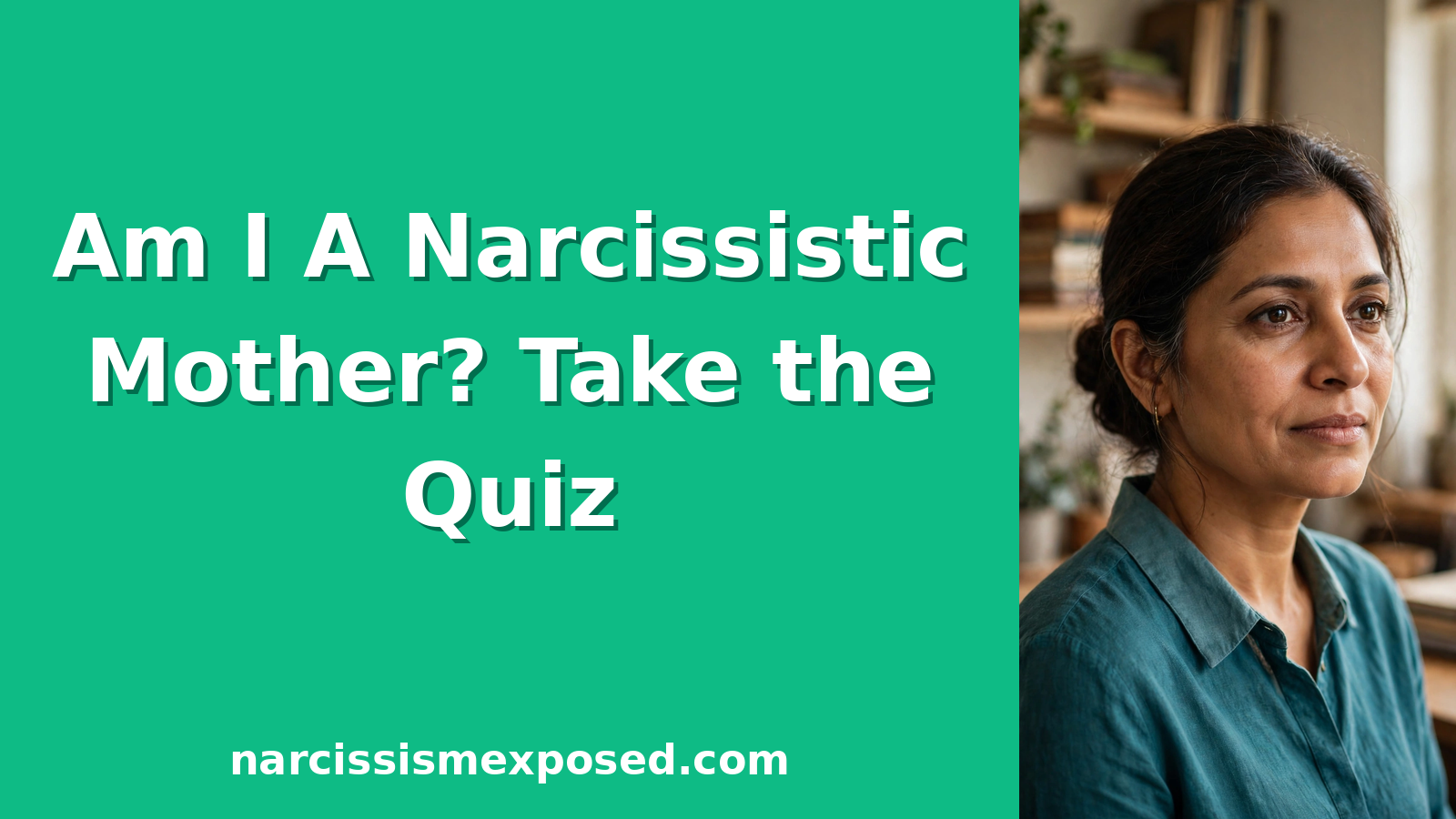
If you have ever typed am i a narcissistic mother quiz into a search bar, you probably did it in a quiet moment, maybe late at night, maybe after a row with your child, maybe after reading something that sounded uncomfortably familiar. It takes courage to ask this question about yourself, and the fact that you are asking it already says something good about you. Most people who never question themselves never change. You are here because you want to know the truth about how you come across to your children, and because some part of you wants to do better. This quiz is here to help you look at your own patterns clearly and honestly, without shame and without excuses, so you can see what needs to change and where to begin. It is a self reflection tool, not a diagnosis, and it cannot label you or decide who you are. What it can do is show you, in plain words, how strongly the signs of a narcissistic pattern show up in your behaviour as a mother, and where that pattern may be hurting the people you love most.
The reason this question is so hard to answer on your own is that we all see ourselves through the kindest possible lens. You may remember the sacrifices you made, the nights you stayed up, the money you spent, and the love you feel, and all of that is real. But your children experience you from the other side, and what they feel may not match what you intended. A mother can love her children deeply and still, without meaning to, make most conversations about herself, dismiss a child’s feelings, use guilt to get her way, or turn cold when a boundary is set. None of that makes you a bad person. It makes you a person with patterns, and patterns can be seen, owned, and changed, once you are willing to look at them honestly.
Answer for your usual behaviour, not for your best days and not for your worst ones. Think about how you usually respond when your child is upset, when your child disagrees with you, when your child succeeds, and when your child needs something from you that you do not want to give. A useful result comes from an honest one, so answer for what you actually do, even when the answer is uncomfortable, and even when you wish the pattern were simpler. What matters here is a repeated pattern across time, not one difficult phase, and not one bad day. Noticing a pattern is a brave first step, and change is possible when a person can see the pattern and take responsibility for it.
What This Quiz Measures
The Am I a Narcissistic Mother? Quiz measures how often ten common signs of a narcissistic pattern show up in your own behaviour as a mother. Each question describes something you can actually notice in yourself, such as making most conversations about you, loving your child mainly when they please you, using guilt trips to get your way, expecting special treatment from your children, dismissing or invalidating your child’s feelings, taking credit for your child’s achievements, comparing your children or favouring one over another, feeling jealous or competitive when your child succeeds, needing your child to manage your emotions for you, and reacting with rage or the silent treatment when a boundary is set. You answer on a simple frequency scale: Never, Rarely, Sometimes, or Often.
Your answers are scored out of 30. A higher score does not prove a diagnosis, and a lower score does not mean there is nothing to work on. The score is a snapshot of how strongly the pattern shows up in your mothering right now, so you can decide what to change, what conversations to have, and what support to seek. The quiz takes about 3 minutes, and you will see your result, with a clear explanation of what your band means, as soon as you finish. Remember that the quiz measures a pattern, not a person, and that noticing a pattern is never a reason to shame yourself. It is a reason to start.
Answer about your real behaviour honestly, across years, rather than about one moment or one argument. Patterns matter because they repeat. A single impatient day does not make a narcissistic mother, and a single kind week does not erase a pattern. Try to answer for the pattern, and let the result speak for itself. If a question stings, that sting is useful information. It often points to the exact part of the pattern that needs attention first, and to the change that would help your children most.
What Narcissistic Traits Look Like In A Mother
The pattern often starts with a simple reversal. In a healthy family, a mother’s love helps her children grow into themselves. In a narcissistic pattern, that balance quietly tilts, and the children’s job becomes managing their mother’s feelings, protecting her image, and earning her approval. Your child’s feelings start coming second to yours. Your child’s achievements become yours to display. Your child’s boundaries become a personal insult. This does not always look cruel from the outside. It can look like a devoted mother who sacrifices everything, organises the family, and tells everyone how much she gives, while expecting gratitude, obedience, and admiration in return. The problem is not that you care about yourself. The problem is that your children’s needs keep coming second, and over time they learn that love has to be earned.
The second part of the pattern is conditional love. When a child pleases you, does well, or reflects well on you, they are loved loudly and warmly. When a child disappoints you, disagrees with you, or simply has a feeling you do not like, the warmth disappears. The child learns, very young, that love is something to perform for, not something they can rely on. You may not have planned this. You may have learned it yourself, from a parent who loved you the same way. But your children feel it every day, in the warmth that arrives with success and vanishes with failure. If you want to understand how this pattern looks from your child’s side, read How to Deal With a Narcissistic Mother, 25 Characteristics of a Narcissistic Mother, Narcissistic Mother Checklist, and How to Heal From a Narcissistic Mother to see the pattern through the eyes of the children living inside it.
The third part is the way feelings get handled in the house. When your child is upset, the conversation somehow becomes about your feelings instead. When your child tells you something hurt them, you may hear it as an attack, deny it happened, or remind them of everything you have done for them. Over time your child stops bringing you their feelings, because they have learned that their feelings will be dismissed, minimised, or turned back on them. This is one of the most painful parts of the pattern, because it teaches a child that their inner life does not matter. If you notice that your child has stopped telling you how they feel, that silence is worth honest attention, not anger.
The fourth part is competition with your own child. A mother in this pattern may feel threatened when her child succeeds, shines, or receives attention she wanted for herself. She may downplay the achievement, take credit for it, or find a flaw in it. She may compare her children with each other, favouring the one who pleases her most, and leaving the others to compete for her approval. None of this is planned cruelty. It often comes from a deep insecurity, a feeling of not being enough that was never healed. But your children feel it as jealousy, and they learn to hide their successes from you, which is a lonely way for a child to grow up.
The fifth part is the way boundaries are treated. When your child sets a boundary, says no, or asks for space, a mother in this pattern may hear it as rejection, disrespect, or betrayal. The response can be rage, tears, guilt, or the silent treatment, and each of these teaches the child the same lesson: your boundaries hurt your mother, so stop having them. Over time the child either gives up their boundaries entirely, or they cut contact to protect themselves. If you want your children close to you as adults, their boundaries are not the enemy. They are the way a healthy adult relationship is built, and respecting them is one of the most loving things a mother can do.
The sixth part is the rewriting of the past. When a child brings up something painful from childhood, a mother in this pattern may deny it happened, insist it was not that bad, or say the child is remembering it wrong. This is not always deliberate lying. Memory is genuinely selective, and it is painful to hear that you hurt your child. But when denial becomes the usual response, your child learns that their memories cannot be trusted, and that talking to you about the past is pointless. An apology does not need you to agree with every detail. It needs you to hear that your child was hurt, and to take that seriously. That one shift, from defending yourself to listening, can change a relationship more than any other single change.
10 Signs Of A Narcissistic Mother To Check
Before you take the quiz, read through these ten signs slowly. They are written as self check behaviours, so read each one as a question to yourself. You do not need to tick every one for the pattern to matter. Even a few, showing up often, can explain why your children pull away, why conversations turn into rows, or why your family feels tense when you are in the room.
- I make most conversations about me, even when my child is upset or trying to tell me something important.
- I show love mainly when my child pleases me, and withdraw warmth when my child disappoints me or disagrees with me.
- I use guilt trips or manipulation to get my child to do what I want, rather than asking honestly.
- I expect special treatment from my children, and I become angry or hurt when I do not get it.
- I dismiss or invalidate my child’s feelings, telling them they are overreacting, too sensitive, or wrong to feel that way.
- I take credit for my child’s achievements, or I downplay them when they do not reflect well on me.
- I compare my children with each other, or I favour the child who pleases me most.
- I feel jealous or competitive when my child succeeds, shines, or gets attention I wanted for myself.
- I need my child to manage my emotions, comfort me, or reassure me, instead of the other way around.
- I react with rage, tears, guilt, or the silent treatment when my child sets a boundary, and I struggle to apologise or admit I was wrong.
Notice which signs felt familiar before you even finished reading them. Familiarity is useful information, not a verdict. It often points to the exact part of the pattern that needs attention first, and to the change that would help your children most. If reading this list hurt, let it hurt for a moment, and then let it help you. Pain that is faced honestly is the beginning of change, not the end of hope.
A Note Before You Start
This quiz is for self reflection only. It is not a diagnosis, it does not label you, and it is not a substitute for professional support. A high score means the signs of a narcissistic pattern show up strongly in your mothering and deserve a clear plan, honest work, and support from someone who understands these patterns. A low score means they are lighter right now, not that there is nothing to notice. Either way, trust what you already know about yourself alongside the result, and remember that this quiz never shames you. It gives you clarity, so you can decide what to change, and a decision made with open eyes is always a better one than a decision made in the dark.
Take the quiz somewhere private, if you can, and give yourself a few quiet minutes afterwards. Some people feel relief when they see the pattern named, because at last they know what has been going wrong. Others feel sadness or guilt, especially when the result makes the scale of the problem clearer. Both responses make sense. You do not have to fix everything today. You only have to see it a little more clearly than you did before you started, and to choose one honest change to begin with.
Am I a Narcissistic Mother? Quiz
Am I a Narcissistic Mother? Quiz is an honest self check for a mother who is brave enough to ask a hard question about herself. It takes about 3 minutes, and your result is ready straight away. Start the quiz now!
Start by entering your details. Your result is personalised for you.
Your details stay private. We never share your information.
Interpreting Your Results: What Your Score Means
Your score is out of 30, based on ten questions scored from 0 for Never to 3 for Often. Here is what each band means, in plain words. Remember that these bands describe a pattern, not a diagnosis, and that they never decide who you are. A quiz cannot diagnose anyone. Noticing a pattern is a brave first step, change is possible when a person can see the pattern and take responsibility for it, and professional support helps a great deal along the way.
0 to 10, Low Pattern: few signs of a narcissistic pattern are present, or they show up only mildly. You may have habits that frustrate your children, a bad temper now and then, or moments of selfishness, but the pattern does not look like a strong narcissistic one. Keep noticing whether the same behaviours repeat, and whether honest conversation with your children helps, because a mother who can listen, apologise, and adjust is in a very different situation from a pattern that never changes.
11 to 20, Moderate Pattern: some signs of a narcissistic pattern are present, but the picture is mixed. You may be dealing with conversations that always come back to you, conditional love, guilt trips, a need for special treatment, dismissed feelings, taking credit, comparing your children, jealousy of their success, needing them to manage your emotions, and a harsh reaction to boundaries, alongside periods when you are warm, generous, and able to apologise. Watch whether the same behaviours repeat, whether your children have started walking on eggshells around you, and whether the pattern is getting stronger as they grow older. A mixed picture still deserves honest work, clear conversations, and support from someone who understands narcissistic patterns.
21 to 30, Strong Pattern: many signs are present together. You are very likely showing a strong narcissistic pattern as a mother: most conversations coming back to you, love that depends on pleasing you, guilt and manipulation, entitlement, dismissed feelings, taking credit for achievements, favouritism or comparison, jealousy of your child’s success, needing your child to manage your emotions, and rage or the silent treatment when boundaries are set, with little ability to apologise. That does not prove a diagnosis, and it does not make you a bad person, but it does mean the pattern is hurting your children, and that you need a clear plan, honest work, and professional support, as soon as you can arrange it. Change is possible, and it starts with seeing the pattern clearly and taking responsibility for it.
What to Do With Your Result
If your score is in the low band, keep it simple. Note the one sign that stood out most, and watch whether it strengthens when you are tired, stressed, or criticised. A difficult week does not always need a full strategy, but a repeating pattern does, and early notes make later change much easier. Keep practising the habits that already work: listening before you respond, apologising when you get it wrong, and letting your children have feelings you do not agree with.
If your score is in the middle band, start with one honest change and one honest conversation. Pick the sign that stings most, and practise a different response for one week. When your child is upset, listen first, before you explain yourself. When your child sets a boundary, say thank you for telling me, even if it hurts to hear. Tell one trusted person what you are working on, so you are not carrying it alone, and consider professional support, because a mixed picture still deserves honest help, and the time to get it is now. If you want to understand the pattern from your child’s side, read Am I a Narcissistic Parent? Quiz alongside your result.
If your score is in the high band, treat the pattern as something to face now, not something to hope will fade on its own. The work now is steady and practical: noticing the pattern in the moment, pausing before you react, listening before you defend yourself, and apologising properly when you get it wrong. Seek professional help as soon as you can arrange it, because a pattern this strong is hard to change without an outside voice, and it will not get easier with time alone. The Life After the Narcissist Bundle can help with understanding the pattern, rebuilding trust in your own judgement, and learning steadier ways of relating to the people you love.
Whatever your band, remember this: asking the question about yourself is one of the bravest things a mother can do. Most people in this position never ask it at all. You did, and that means you still have choices, time, and room to change. A label will not decide who you are. Honest reflection, steady new habits, and real support can, and the change you make with open eyes will be one your children can feel, whatever it is.
Frequently Asked Questions
Does a high score mean I am a narcissist?
No, this quiz cannot diagnose you, and it does not try to. A high score means many signs of a narcissistic pattern show up often in your behaviour as a mother, and that is serious information, not a verdict. What it does mean is that the pattern is real, it is affecting your children, and it deserves honest work and professional support. Many mothers in this position find that seeing the pattern clearly is the first step toward changing it. The score describes a pattern, not who you are, and patterns can change when a person is willing to see them and take responsibility.
Can a narcissistic mother really change?
Change is possible, but it does not happen by wishing for it, and it does not happen overnight. A mother can learn to listen before reacting, to apologise without defending herself, and to respect her children’s boundaries, but only if she can first see the pattern and take responsibility for it. Change takes steady new habits, honest feedback, and often professional support. The mothers who change are usually the ones who hear the truth, own their part, and keep practising a calmer response, even when it feels hard. A mother who meets every concern with rage, guilt, or the silent treatment is showing her children that change has not started yet.
What if I learned these patterns from my own mother?
That is very common, and it does not excuse the pattern, but it does explain where it came from. Many mothers who show narcissistic traits grew up with a parent who loved them conditionally, dismissed their feelings, or used guilt to control them. You learned a way of relating before you had any choice in the matter. Understanding that can soften the shame you feel, and it can also give you a reason to break the cycle. You did not choose how you were raised, but you can choose what you pass on to your own children, and that choice starts with seeing the pattern clearly.
Should I tell my children I took this quiz?
That depends on your children, their ages, and the state of your relationship, so there is no single right answer. If your children are adults, an honest conversation can be healing, especially if you are ready to listen to what they tell you without defending yourself. A simple, honest sentence can open a door: I have been thinking about how I come across, and I want to do better. If your children are young, the change matters more than the words. Children notice what you do far more than what you say, so showing them a calmer, kinder response will mean more to them than any explanation.
What should I do first if my score is high?
Start by telling one trusted person what you are seeing in yourself, so you are not carrying it alone. Then pick one behaviour to change this week, and practise it every day, such as listening to your child fully before you respond, or saying sorry properly when you get it wrong. Look for professional support, such as a therapist who understands narcissistic patterns, because a pattern this strong is hard to change without an outside voice. And give yourself permission to take it one step at a time. You do not have to fix everything at once. You only have to start, honestly, and keep going.
The Life After the Narcissist Bundle is $47, with a 30 day money back guarantee, and it gives you a clear plan for understanding the pattern, rebuilding trust in your own judgement, and learning steadier ways of relating to the people you love.
Rebuild After The Pattern
How to Survive When You Cannot Leave Yet is $19, and it gives you 27 quiet survival moves, exact words, and calm scripts for hard days while you plan your next move.
Survive Today While You Plan Tomorrow
The Narcissistic Abuse Clarity Report is $67, and it maps your exact situation, the person, the tactics, and your next moves, in a report you can re-read whenever the fog rolls back in.