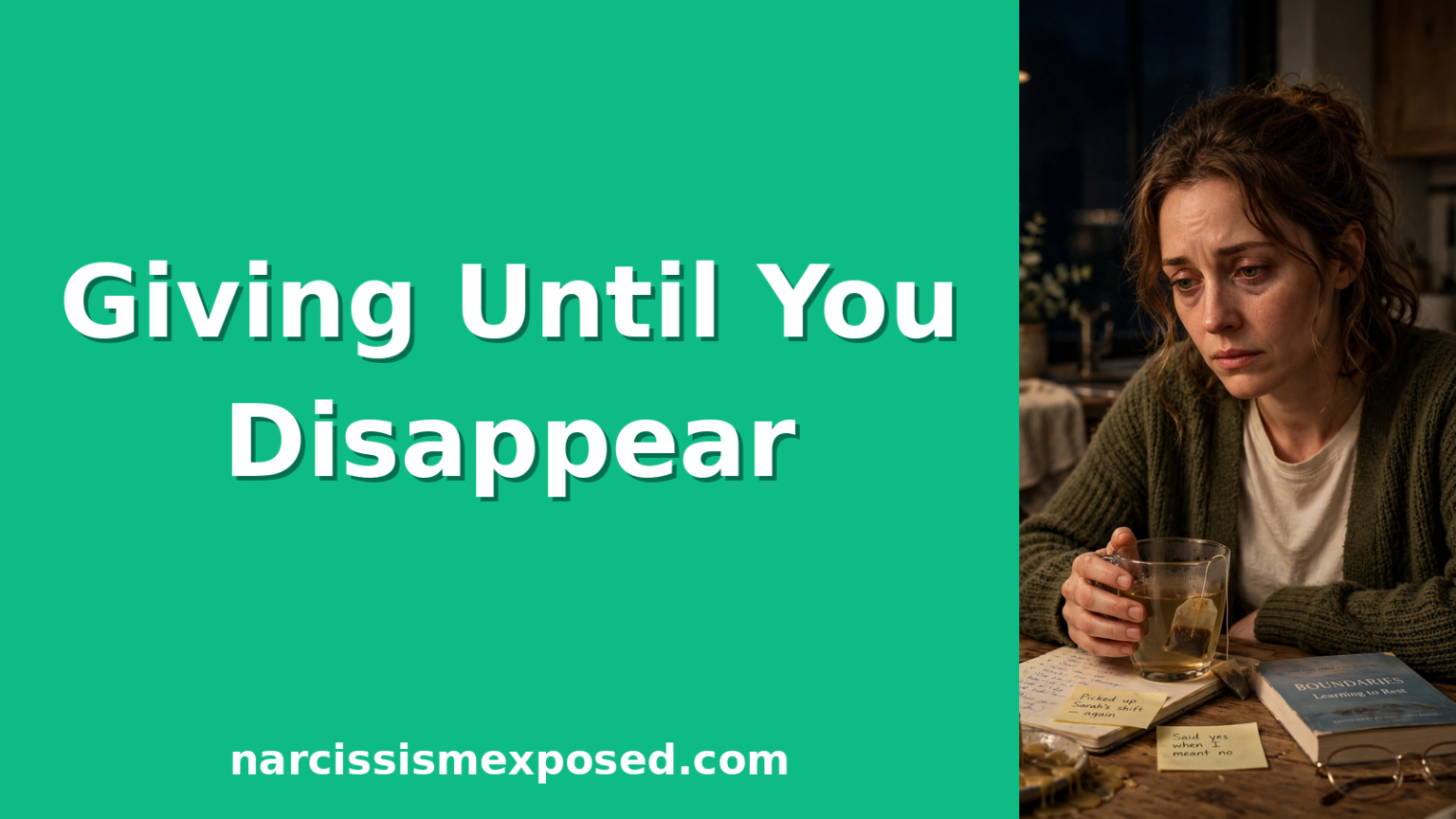
You cancel your own plans again, and you tell yourself it is just one more time. Your partner is upset, your mother needs you, your friend is in crisis, and you are the person who always shows up. By midnight you are exhausted, a little resentful, and already worried that tomorrow you will do it all over again. If that feels familiar, you are looking for an example of codependency, and you have probably already lived several of them without ever calling them that.
- What an Example of Codependency Actually Looks Like
- Example of Codependency in a Romantic Relationship
- Example of Codependency in a Family
- Example of Codependency in a Friendship
- Example of Codependency at Work
- The Signs, in Plain Words
- Codependency vs Healthy Support
- Codependency vs Enabling, and Codependency vs a Trauma Bond
- Why Codependency Forms
- Codependency With a Narcissistic Partner
- What Codependency Costs You
- How to Stop Being Codependent, a Realistic First Week
- What to Do When the Other Person Will Not Change
- A Kinder Way to Think About All of This
- Frequently Asked Questions
In plain words, an example of codependency is any pattern where one person keeps putting another person’s needs, moods, and problems ahead of their own, again and again, until their own life starts to disappear. It is not one kind act. It is not helping someone through a hard week. It is the repeated trade where your time, your money, your sleep, your friendships, and your own feelings get set aside so someone else can stay comfortable, and you start to feel worthwhile only when you are needed. This article gives you many concrete examples, in romantic relationships, in families, in friendships, and at work, plus the signs that separate caring from codependency, why the pattern forms, how it overlaps with narcissistic relationships and trauma bonds, and what a realistic first week of change looks like.
What an Example of Codependency Actually Looks Like
Most articles define codependency and stop there. That does not help, because codependency rarely announces itself with a label. It looks like being a good partner, a good daughter, a good friend. The difference is in the pattern and the cost.
A healthy helper can say, I helped today, and I am tired, so I will rest tomorrow. A person caught in codependency thinks, if I stop helping, they will fall apart, or they will leave, or I will be a bad person. The help stops being a choice and starts feeling like a duty. That feeling is the clearest test. Ask yourself, could I say no to this request and still feel okay about myself an hour later. If the answer is no, and that no comes with guilt, panic, or a fear of punishment, you are looking at something deeper than kindness.
Codependency is also not a formal diagnosis in the DSM-5, the manual mental health professionals use. It is a descriptive term for a relationship pattern. That matters, because it means no one can diagnose you from an article, including this one. What an article can do is help you recognise a pattern, so you can talk about it clearly with a therapist, a support group, or a trusted friend, and decide what you want to change.
Another point people miss is that codependency has two sides, and the same person can play both. The giver over-functions. They manage, fix, pay, soothe, and carry. The taker under-functions. They lean, avoid, and let the giver carry more and more. But roles switch. The giver who feels unappreciated can turn controlling, keeping score and using guilt as leverage. The taker who feels smothered can turn cold and punishing. It is not two personality types. It is one dance, and both people can change steps.
Example of Codependency in a Romantic Relationship
Romantic relationships are where most people first notice the pattern, because the stakes are highest and the attachment is strongest. Here are everyday examples, not textbook definitions.
One, you check their mood before you check your own. You walk in from work and you scan their face, their tone, the way they put the keys down. If they are quiet, your stomach drops. You spend the evening trying to fix a mood they have not even named, and by bedtime you have no idea how your own day went. Your mood has become a mirror of theirs.
Two, you apologise for things you did not do, just to end the tension. They are upset about work, or traffic, or their own family, and somehow you are saying sorry. You are not sorry for a specific action. You are sorry that they are uncomfortable, and you hope the apology will bring the peace back. Over time, sorry becomes your default sentence, and your real opinion never gets said.
Three, you cancel your own plans to manage their crisis, again. You had a dinner with a friend, a class, a walk you were looking forward to. They call, upset, and you cancel without even weighing it. Once is caring. Every week is a pattern. Your calendar slowly empties of anything that is only for you.
Four, you pay for things you cannot afford, because saying no feels like abandonment. You cover their rent, their car repair, their night out, while your own bills wait. You tell yourself love means sacrifice. But love that regularly leaves you in debt, or lying to your bank, or hiding spending from your family, is not sacrifice. It is a pattern that keeps them comfortable and keeps you anxious.
Five, you lie to protect them. You tell their boss they were sick when they were hungover. You tell your family they are doing fine when they lost another job. You tell yourself you are being loyal. In truth, you are removing the consequences that might push them to change, and you are carrying a secret that isolates you from the very people who could support you.
Six, you stay after repeated hurt because leaving feels worse than staying. You have told yourself you will leave if it happens again, and it happened again, and you stayed. That is not weakness. It is often a mix of fear, attachment, and a belief that your love should be enough to fix them. Naming it honestly is the first step out of it, not a reason to shame yourself.
Seven, you lose your tastes, your friends, and your opinions. You used to love a certain kind of music, a hobby, a group of friends. Slowly, those things faded, because they did not interest your partner, or they made your partner jealous, or they took time away from the relationship. One day you look up and realise you cannot name what you enjoy on your own anymore. That loss of self is one of the most reliable signs of codependency.
Example of Codependency in a Family
Family codependency often starts in childhood and then repeats in adult life, which is why it can feel so normal. It is just how our family works, people say, even when how it works is exhausting everyone.
One example is the adult child who organises their whole life around a parent. You turn down a job in another city because your mother would be lonely. You skip holidays because your father would be upset. You call three times a day, not because you want to chat, but because if you do not, you feel crushing guilt, and they make you feel it too. You are not choosing closeness. You are managing their emotions from a distance.
Another example runs the other way. A parent who cannot let an adult child struggle. Your son is thirty, and you still pay his rent, call his employer when he is late, and argue with his landlord on his behalf. You say you are helping, and part of you is. But he never learns to handle a hard conversation, a missed payment, or a consequence, because you always step in first. Your identity has become being the parent who fixes everything, and his identity has become being the child who needs fixing.
A third family example is the child who became the parent. Maybe you grew up comforting a parent who was overwhelmed, or keeping the peace between fighting adults, or looking after younger siblings while the adults checked out. Therapists sometimes call this parentification. As an adult, you keep doing the same job in every relationship. You are the calm one, the responsible one, the one who never needs anything. People praise you for it. Inside, you may barely know what you need, because you were never allowed to practise asking.
A fourth example is the sibling who keeps bailing out a brother or sister. You have paid off the same debt three times. You have covered for the same missed work shift, the same broken promise, the same crisis. Each time you tell yourself, this is the last time, and each time the guilt wins. You are not a bad sibling for wanting to help. You are caught in a pattern where helping has replaced honesty, and honesty would mean saying, I love you, and I will not keep paying for choices you will not change.
Example of Codependency in a Friendship
Friendship codependency is easy to miss, because friendship is supposed to involve showing up for each other. The line is crossed when one friendship swallows your whole life.
You have a friend who calls every night in crisis, for hours. You listen, you advise, you soothe, you cancel your own evening, again. When you try to share your own hard day, they change the subject back to themselves, or they go quiet, or they make you feel selfish for needing support too. You keep showing up, because you are afraid that if you set a limit, you will lose the friendship. A friendship where only one person is allowed to need things is not mutual. It is codependent.
Another example is jealousy dressed up as loyalty. Your friend gets a new hobby, a new partner, a new group of friends, and you feel panicked, or angry, or left out. Instead of saying, I miss you, you criticise the hobby, or you guilt trip them for spending less time with you, or you create a crisis that pulls them back. That is not loyalty. That is a fear of abandonment running the friendship.
A third example is the friend who cannot say no to a group. You agree to every plan, every expense, every favour, even when you are exhausted or broke, because you fear being left out. You laugh at jokes you do not find funny. You agree with opinions you do not hold. You leave every gathering feeling hollow, because you spent the whole time performing a version of yourself that the group would approve of.
Example of Codependency at Work
Work is the context competitors almost never cover, and it is where many people first practise the pattern without noticing.
You are the colleague who always covers shifts, finishes other people’s projects, and answers messages at midnight. Your own work slips, your manager barely notices your extra effort, and you feel resentful, but you cannot stop, because being indispensable feels like safety. If you stop, you fear you will be seen as difficult, or replaceable, or not a team player.
Another work example is the manager who cannot delegate. You rewrite every report, you check every email, you stay late to fix work you already assigned to someone else. You tell yourself no one else does it right. In truth, you may be afraid of what happens if you let go, afraid of criticism, afraid of being unnecessary. Your team never grows, and you burn out, and both of those outcomes feel like proof that you were right to hold on so tightly.
A third example is staying in a punishing job because the boss needs you. You have been promised a promotion for two years. You work weekends. You absorb blame that is not yours. You stay because leaving would let them down, or because you believe no one else could handle the role. That belief is flattering, and it is also a trap. A job that depends on you never resting is not valuing you. It is using your pattern.
The Signs, in Plain Words
If you want a quick check, look for a cluster, not a single sign. One sign alone proves nothing. Several together, repeated over months, describe the pattern.
You have trouble saying no without guilt or panic. You feel responsible for other people’s feelings, choices, and consequences. Your self-worth rises and falls with whether someone needs you or praises you. You avoid conflict by agreeing, apologising, or going silent. You struggle to name your own feelings, but you can describe the other person’s feelings in detail. You fear being alone, or being abandoned, more than you fear staying unhappy. You keep score of your sacrifices, and you feel angry when they go unnoticed. You stay in relationships that drain you, because leaving feels like failing.
The PsychCentral guide to the signs of codependency lists the same core themes, including self-sacrifice, a focus on others, a need for control, and difficulty recognising and expressing emotions. A 2018 research review cited there found those four themes again and again, which is reassuring in a strange way. Your pattern is recognisable, and recognisable patterns can be worked on.
Codependency vs Healthy Support
This is the question almost everyone asks, and it deserves a clear answer. Healthy support and codependency can look identical from the outside. The difference is on the inside, in choice, cost, and mutuality.
Healthy support is chosen, limited, and mutual. You help your partner through a hard month, and you still sleep, eat, see friends, and say what you need. You can tolerate their disappointment when you say no. You can let them face a consequence without feeling like you failed. Your identity stays intact when they are unhappy.
Codependency is compulsive, unlimited, and one sided. You help even when it harms you. You cannot tolerate their disappointment. You feel responsible for fixing their feelings, not just supporting them through those feelings. Your identity wobbles when they pull away. The WebMD overview of codependency signs makes a similar point, noting low self-esteem, trouble identifying your own emotions, trouble making decisions, and an excessive sense of responsibility for how others act.
A useful test is the rest test. After helping, can you rest without guilt. After saying no, can you sleep without rehearsing an apology all night. After they succeed without you, can you feel glad, rather than threatened or unnecessary. If rest, sleep, and gladness all feel out of reach, the pattern is costing more than it gives.
Codependency vs Enabling, and Codependency vs a Trauma Bond
Two confusions keep people stuck, so let us clear them both up.
Enabling is a behaviour. Codependency is a pattern. Enabling means removing consequences for someone’s harmful behaviour, like paying a debt they created, lying for them, or cleaning up after them so they never face what happened. Codependency is the wider relationship pattern that often includes enabling, along with people pleasing, poor boundaries, fear of abandonment, and losing yourself. You can enable someone once, out of love or panic, without being codependent. When enabling becomes your main job in the relationship, and your own life shrinks around it, you are inside codependency.
A trauma bond is different again, though the two often travel together. A trauma bond and codependency can look similar from the outside, because both involve staying in a painful relationship. But a trauma bond is built from cycles of intense closeness followed by hurt, betrayal, or withdrawal, which make the highs feel higher and leaving feel like withdrawal. Codependency is built from over-functioning, caretaking, and fear of abandonment, even in relationships that are not abusive. Our guide on signs you are trauma bonded can help you tell which pattern is running your relationship, because the way out is slightly different for each. If both are present, which is common with a narcissistic partner, you need to work on both, not just one.
Why Codependency Forms
Codependency rarely starts in adult life. It usually starts as a smart survival strategy in childhood, and then keeps running long after childhood ends.
If you grew up in a home where love felt conditional, where you had to be useful, quiet, helpful, or cheerful to stay safe, you learned to watch other people closely. You learned to guess moods, prevent conflict, and put your own needs last. That was not a flaw. That was adaptation. A child who keeps the peace in a chaotic home is doing brilliant survival work.
If a parent struggled with addiction, illness, or emotional immaturity, you may have become the caretaker far too young. You may have been praised for being so mature, so responsible, so easy. That praise taught you that your value comes from being needed. As an adult, you keep auditioning for that same praise in every relationship.
Low self-worth keeps the pattern going. If you quietly believe you are not enough on your own, being needed feels like proof that you matter. Saying no then feels dangerous, because it risks the only proof you trust. Fear of abandonment does the rest. If your core belief is, I am only safe as long as this person stays, then over-giving, people pleasing, and avoiding conflict all make perfect sense. They are strategies to prevent the one outcome that feels unbearable.
The Cigna guide to understanding codependency notes the same roots, including bending over backward to care for others, guilt for not doing enough, and staying in bad relationships. It also makes a hopeful point that matters here. Recovery is a process of learning to take care of yourself and letting others take care of themselves, not a process of stopping caring altogether.
Codependency With a Narcissistic Partner
This is where the pattern turns especially painful, and where this site’s readers most often recognise themselves.
A narcissistic partner often needs constant admiration, control, and validation, and gives very little real empathy in return. A codependent partner often needs to be needed, fears abandonment, and gives endlessly in hopes of earning love. Put those two patterns together and they lock like puzzle pieces. One person takes, the other over-gives, and both call it love.
In that pairing, an example of codependency might look like this. Your partner criticises you in public, then apologises in private with intense affection. You forgive them, because the affection feels like proof they care. Then the criticism returns, and you work harder to avoid it, by being quieter, kinder, more careful. You start to believe that if you could just get it right, the kind version would stay. That is not only codependency. That is also a trauma bond forming, cycle by cycle, and it explains why leaving feels so hard even when staying hurts.
Another example is the rescuer trap. You believe you can heal your partner’s childhood wounds, or their anger, or their drinking, if you love them well enough. You read books for them, you find therapists for them, you make excuses for them. They never do the work, but they enjoy being rescued, and you enjoy feeling essential. Years pass, and you realise you have been waiting for a change that only they can choose.
If this is your situation, be honest with yourself about one thing. You cannot love someone into accountability. You can set boundaries, you can offer support, you can leave, and you can get your own support. You cannot do their inner work for them, no matter how hard you try, and trying harder usually just deepens the pattern.
If you keep going back to a person who hurts you, even when you know better, willpower is not the missing piece. The Break a Trauma Bond Bundle gives you a step by step plan for the cravings, the urges to check on them, and the moments when missing them feels stronger than the truth you already know.
What Codependency Costs You
People talk about codependency as if the cost is only emotional. It is much wider than that, and naming the full cost often gives people the push they need to change.
Your health pays first. Poor sleep, constant tension, headaches, stomach problems, and exhaustion are common companions of a life spent managing other people’s emotions. You skip meals, you skip exercise, you skip doctor visits, because someone else always needs you first. Over months and years, that neglect adds up.
Your money pays too. Covering other people’s debts, lending money you cannot spare, turning down work or promotions to stay available, all of it quietly drains your security. Many people in codependent patterns discover, only when they stop, how much financial ground they lost while they were busy keeping someone else afloat.
Your other relationships pay. Friends drift away, not because they stopped caring, but because you stopped showing up. Family gatherings become stressful, because you are managing one person’s mood the whole time. Your children, if you have them, learn by watching you that love means self-erasure, which is a lesson you would never choose to teach them on purpose.
Your sense of self pays most of all. When you cannot name what you want, what you enjoy, or what you believe, apart from another person, you lose the compass you need to make any other decision. That is why recovery starts with small acts of self-knowledge, not with grand gestures. You rebuild a self, one preference, one boundary, one honest sentence at a time.
How to Stop Being Codependent, a Realistic First Week
You do not need to fix your whole life this week. You need to practise a few small, repeatable changes, and notice what happens when you do. Here is a first week plan that many people find workable.
Day one, notice without judging. Keep a simple note on your phone. Each time you say yes when you meant no, or you fix a feeling that is not yours, or you cancel your own plan for someone else, write one line. No self-criticism. Just observation. Awareness is the foundation, because you cannot change a pattern you cannot see.
Day two, pick one small boundary and hold it. Not the biggest, hardest boundary in your life. A small one. For example, I will not answer work messages after 8 p.m., or I will not lend money this week, or I will keep my Saturday walk, no matter who calls. Tell the person plainly, and tolerate their disappointment. Disappointment is not danger, even when your body tells you it is.
Day three, practise a script. Scripts help because in the moment, guilt scrambles your words. Try these, in your own voice. I love you, and I cannot do that today. I hear that you are upset, and I trust you to handle this one. I need an hour to myself, and then I will call you back. I am not available to cover that cost this month. Notice that none of these scripts attack the other person. They simply state a limit, kindly and clearly.
Day four, reclaim one thing that is only yours. A hobby, a walk, a friend, a book, a meal you enjoy. Do it without apologising for it, and without inviting the other person to approve it first. This is not selfish. This is how you remember who you are outside the relationship.
Day five, let someone face a natural consequence, without rescuing them. If they forgot a deadline, let them explain it. If they overspent, let them handle the call. This will feel cruel at first, especially if you were raised to rescue. It is not cruel. It is respect. You are treating them as an adult who can learn, rather than as a child who needs you to survive.
Day six, talk to one person outside the pattern. A friend, a therapist, a support group for codependency, or a trusted community. Tell them one honest thing about the pattern. Isolation is what keeps codependency strong. One honest conversation weakens it more than a month of private resolutions.
Day seven, review your notes. What was hardest. What felt surprisingly freeing. What boundary held, and what collapsed. Then pick one boundary to keep for next week, and one to add. Recovery is not a single decision. It is a series of small decisions, repeated until they feel less frightening.
Our guide on how to set healthy boundaries without feeling guilty walks through the guilt part in detail, because guilt is usually what pulls people back. And if the pattern is tied to a narcissistic partner, our guide on how to break a trauma bond with a narcissist covers the pull back to that person specifically, which boundary scripts alone do not always solve.
What to Do When the Other Person Will Not Change
This is the hardest part, and it deserves honesty. You can change your half of the pattern, even if the other person never changes theirs. You cannot force them to change, and you cannot control whether they like your boundaries.
Some people will respect a new boundary, even if they grumble at first. Some will test it, push it, guilt trip you, or punish you with silence. Testing does not mean your boundary was wrong. It often means the boundary was needed, because the old pattern depended on you having none.
If the other person responds to boundaries with threats, coercion, intimidation, or any form of abuse, that is no longer a boundary exercise. That is a safety matter. You deserve support right away, and you can contact local emergency services or a domestic violence helpline in your country. No article, no relationship rule, and no hope for change comes before your safety.
You may also need to accept a painful truth. Some relationships cannot become healthy, even with better boundaries, because only one person is willing to do the work. In that case, loosening the pattern may mean loosening the relationship itself, or ending it. That is not failure. That is the moment you stop negotiating with a cycle and start choosing yourself. If you are not ready to leave, that is also allowed. Readiness is a process, and the steps above are useful whether you stay for now or go.
A Kinder Way to Think About All of This
Codependency is not a character flaw, and it is not proof that you are broken. It is a learned way of staying connected, learned in a time and place where it probably helped you survive. You can honour what that pattern did for you, and still decide it no longer serves you.
Healthy love does not require you to disappear. It asks you to show up as a whole person, with needs, limits, opinions, and a life outside the relationship, and it asks the same of the other person. That kind of love feels less intense at first, because it is not fuelled by panic and rescue. Over time, it feels steadier, kinder, and more sustainable, for both people.
If you recognised yourself in these examples, you are not alone, and you are not stuck. You noticed a pattern, you named it, and you are already doing the hardest part, which is seeing clearly instead of explaining it away. Keep going, one small boundary at a time.
Frequently Asked Questions
What is an example of codependency?
A clear example of codependency is cancelling your own plans to manage someone else’s emotions, paying for things you cannot afford to keep them happy, or lying to cover up their behaviour, again and again, while your own needs, sleep, money, and friendships shrink. One kind act is not codependency. The repeated pattern, at a cost to you, is.
What is a simple example of codependent behavior?
A simple example is saying yes when you mean no, because saying no brings guilt or panic. You agree to help a friend move even though you desperately need a day to rest, you cover a coworker’s project even though your own work will suffer, or you apologise for a mood you did not cause, just to restore peace.
What are the most common signs of codependency in a relationship?
The most common signs are trouble saying no, feeling responsible for another person’s emotions, low self-worth tied to being needed, people pleasing, avoiding conflict, neglecting your own needs, fear of abandonment, and losing your own interests and friendships. Several signs together, over time, point to the pattern more than any single sign alone.
What is the difference between codependency and being supportive?
Being supportive maintains your identity and boundaries while you help someone. Codependency sacrifices your wellbeing for another person’s approval. A supportive person can tolerate another person’s disappointment. A codependent person organises their emotional life around preventing that disappointment, even at a real cost to themselves.
Can codependency exist in friendships and family relationships?
Yes. Codependency can exist in any close relationship, including friendships, parent and child relationships, sibling relationships, and work relationships. It is not limited to romantic partners or to relationships affected by addiction, though it often starts there.
What exactly is codependency?
Codependency is a learned relationship pattern where one person’s sense of identity and self-worth becomes tied to meeting another person’s needs. It often creates an imbalance where one person over-functions and the other under-functions, and it is not a formal diagnosis in the DSM-5.
How can someone begin breaking free from codependency?
Start by noticing the pattern without judging yourself, then practise one small boundary at a time, use clear scripts for saying no, reclaim one interest that is only yours, and talk to one person outside the pattern, such as a therapist or a support group. Letting others face natural consequences, rather than rescuing them every time, is also a key step.
What causes codependency?
Codependency often traces back to childhood, in homes where a child had to caretake, keep the peace, or earn love by being useful, or where needs were inconsistently met. Low self-worth and fear of abandonment keep the pattern going in adult life. Because it is learned, it can also be unlearned, with time and support.
Is codependency a mental health diagnosis?
No. Codependency is not a formal diagnosis, and there are no official diagnostic criteria for it in the DSM-5. It shares traits with other patterns that professionals do describe, such as dependent personality traits, but only a qualified professional working directly with a person can assess what is going on in a specific case.
Can a codependent relationship become healthy?
Yes, sometimes, if both people are willing to change. That means honest boundaries, mutual support, outside help when needed, and a willingness to tolerate discomfort while the pattern shifts. If only one person changes, the relationship may still improve, but it may also need distance or an ending, and that is a valid outcome too.
You already know the truth about this pattern. The hard part is holding on to it when guilt pulls you back into rescuing. If you want a clear plan for the pull back, the urges to check on them, and the moments when you almost give in again, the Break a Trauma Bond Bundle walks you through breaking the pull step by step, so one lonely night does not become one more year in the same cycle.