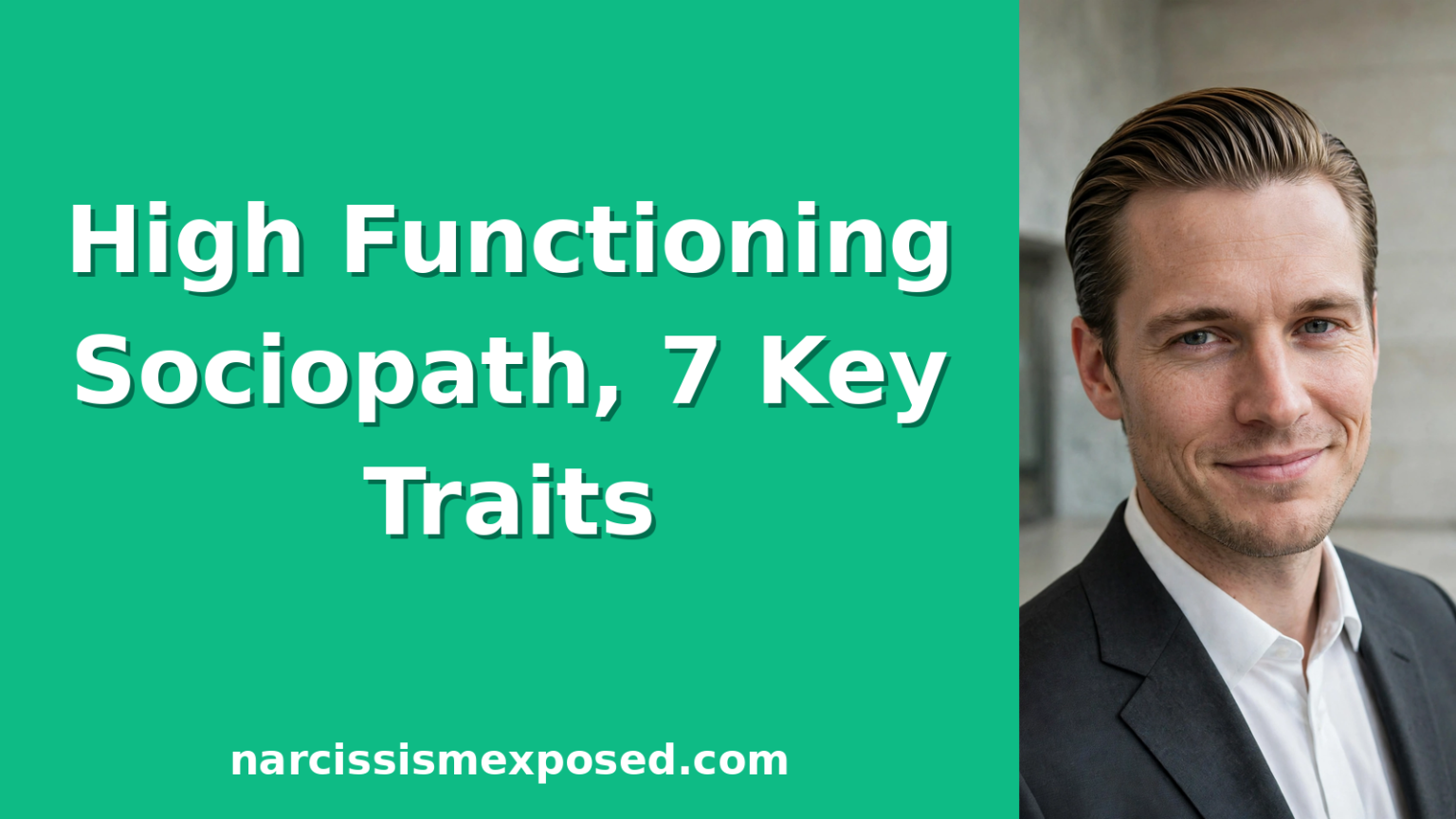
He is the most impressive person in the room. Everyone likes him, his boss trusts him, and his partner thought she had finally found someone steady, until the lies started to stack up and every apology turned out to be empty. This guide answers what is a high functioning sociopath, in plain language, and shows you the 7 traits that give them away.
- What Is a High Functioning Sociopath?
- Is High Functioning Sociopath a Real Diagnosis?
- What Are the 7 Key Traits of a High Functioning Sociopath?
- High Functioning vs Low Functioning, What Is the Difference?
- Sociopath vs Psychopath vs Narcissist, How Do They Differ?
- Can a High Functioning Sociopath Feel Empathy?
- Can a High Functioning Sociopath Love Someone?
- Can a High Functioning Sociopath Change?
- Is a High Functioning Sociopath Dangerous?
- How Do You Deal With a High Functioning Sociopath?
- Frequently Asked Questions
A high functioning sociopath is someone with antisocial personality disorder who holds down a job, keeps relationships going, and looks completely normal from the outside, while showing a persistent pattern of manipulation, deceit, and a lack of remorse underneath. The pattern has plain names you may already know, including gaslighting, love bombing, and DARVO, and this guide walks you through the 7 key traits, one by one, so you can see the pattern clearly instead of doubting yourself.
If the charm felt real but the behaviour kept hurting you, trust what you saw. The Gaslighting Recovery Bundle helps you name the manipulation, rebuild trust in your own judgement, and set boundaries that hold.
The short answer is this. A high functioning sociopath is a person with antisocial personality disorder, often called ASPD, whose traits are hidden behind social skill, career success, and charm. They understand what other people feel, but they do not feel it with them, and they use that understanding to get what they want without guilt or remorse.
Key Takeaways
– A high functioning sociopath has antisocial personality disorder, but the traits are masked by charm, intelligence, and a stable-looking life.
– The 7 key traits are superficial charm, a lack of genuine empathy, calculated manipulation, pathological lying, no real remorse, contempt for rules, and impulsivity that surfaces under pressure.
– “High functioning” is not a formal diagnosis. Clinicians diagnose ASPD, and the label describes how well someone hides it.
– They can read your emotions with great accuracy. What is missing is the feeling, not the understanding.
– You cannot fix them, but you can protect yourself with firm boundaries, written records, and distance where possible.
What Is a High Functioning Sociopath?
A high functioning sociopath is someone who meets the pattern of antisocial personality disorder, yet functions well in everyday life. They keep a job, they may be married with children, and they can be warm and funny at a dinner party. Behind that capable surface sits a persistent disregard for other people’s rights and feelings, expressed through lying, manipulation, and a striking absence of remorse.
The word “sociopath” itself is informal. It does not appear as a diagnosis in the diagnostic manual clinicians use, which is the Diagnostic and Statistical Manual of Mental Disorders (DSM-5) on the American Psychiatric Association website. The formal diagnosis is antisocial personality disorder, or ASPD. When people say “high functioning sociopath”, they mean someone with ASPD traits who has learned to hide them well enough to succeed socially and professionally.
That hiding is the whole point. A person with more obvious antisocial behaviour gets caught early, loses jobs, and clashes with the law. A high functioning one studies how normal people behave, copies the responses that earn trust, and uses them as tools. The charm is real in its effect and empty underneath it.
Is High Functioning Sociopath a Real Diagnosis?
No, it is not a formal diagnosis, and that matters. Clinicians diagnose antisocial personality disorder, not “high functioning sociopathy”. The phrase is a descriptive shorthand that describes how much the traits disrupt the person’s own life, not a separate condition in the manual.
For an ASPD diagnosis, a person must be at least 18 years old, show a pattern of conduct problems before age 15, and show at least three of seven behaviours from the diagnostic criteria: repeated unlawful acts, consistent deceitfulness, impulsivity, irritability and aggression, reckless disregard for safety, chronic irresponsibility, and a lack of remorse. A high functioning person may score heavily on deceitfulness, lack of remorse, and irresponsibility while never breaking the law in a way that gets them arrested.
ASPD is not common. The literature reports it in about 1 to 4 percent of the general population, with men diagnosed more often than women, according to the ranges reported by Psychology Today and its overview of antisocial personality disorder. But numbers do not tell you whether the person in front of you is safe. A single person with these traits can do enormous damage to the people closest to them, and that damage is what this guide helps you recognise.
What Are the 7 Key Traits of a High Functioning Sociopath?
These are the 7 traits to watch for. One trait on its own proves nothing, because plenty of difficult people are charming or selfish sometimes. The warning sign is the pattern, the same traits repeating over months and years, with no real change after they cause harm.
1. Superficial Charm That Feels Engineered
The charm arrives fast and feels wonderful. They remember details about you, they ask the right questions, they say exactly what you hoped someone would say. Colleagues call them magnetic, and new partners feel chosen, special, and finally understood.
What it sounds like: “I have never met anyone like you. You get me in a way nobody else does.” Then, weeks later, the same warmth is switched off the moment you question them. The charm is a performance that wins trust quickly, and the script starts to show once they no longer need to impress you.
2. A Lack of Genuine Empathy
This is the core trait. They can read your emotions with impressive accuracy, but they do not feel them alongside you. Your distress is information to them, not something that moves them. That split is called cognitive empathy without affective empathy, and it explains why they can be so perceptive and so cold at the same time.
A fuller picture of what missing empathy looks like day to day is covered in our guide to lack of empathy and what it reveals about a person. Watch for the moment when your pain is met with a flat stare, a shrug, or a quick change of subject, followed by a perfectly worded apology that changes nothing.
3. Calculated Manipulation
Manipulation is not a mistake for this person, it is a method. They flatter, guilt trip, twist your words, and recruit other people to their side of a story. They study what makes you agree, what makes you doubt yourself, and what makes you stay, and then they use it.
What it looks like in real life: they promise to fix the problem, then quietly do the opposite. They tell your friends a different version of events, so that when you finally speak up, you sound confused and they sound reasonable. Over time you start checking your own memory before you trust it, and that is exactly the point.
4. Pathological Lying Without Discomfort
Most people show some tension when they lie. A high functioning sociopath often does not. The lie comes out with the same calm voice, steady eye contact, and easy detail as the truth. Small lies protect bigger ones, and the story changes smoothly whenever a new fact appears.
What it sounds like: “I never said that. You must be remembering it wrong.” When you produce proof, the story shifts without an apology. “Fine, I said it, but you took it the wrong way.” The lie is never the problem in their telling. Your reaction to it is.
5. No Real Remorse, Only Performance Apologies
After a clear harm, the apology can sound perfect. The right words, the right tone, even what looks like emotion. Then the behaviour repeats, unchanged. That is the test that matters, not the apology, but what happens next.
Real remorse changes behaviour. Performance remorse manages your perception for a few days and then quietly reverses itself. If you have heard the same apology five times for the same harm, you are not watching someone learn. You are watching someone perform.
6. Contempt for Rules and Other People’s Rights
They understand rules well enough to work around them, but they do not experience rules as binding. Procedures get bent when nobody is watching. Agreements are kept only while they are useful. Authority figures are obstacles to manage, or tools to use, never legitimate limits.
This does not always mean crime. A high functioning sociopath may never be arrested. The rule breaking shows up in the grey areas instead: expenses fudged, colleagues blamed, promises broken, boundaries crossed in ways that are hard to prove and easy to deny.
7. Impulsivity That Surfaces Under Pressure
On a normal day they can be patient, strategic, and careful. Under pressure, the control slips. A threat to their image, a public challenge, or a plan that fails can trigger sudden rage, reckless spending, a cruel comment, or a decision that risks a stable career for a short term win.
Partners and long term colleagues are the people most likely to see these cracks, and also the people most likely to be disbelieved when they describe them. Everyone else only ever meets the polished version.
High Functioning vs Low Functioning, What Is the Difference?
The difference is not the disorder, it is the disguise. Both sit on the same spectrum of antisocial personality disorder, but they look very different from the outside.
| Feature | High Functioning | Low Functioning |
|---|---|---|
| Social presentation | Charming, polished, socially fluent | Abrasive, erratic, socially disruptive |
| Employment | Stable or upwardly mobile career | Frequent job loss and gaps |
| Legal record | Rarely or never arrested | Repeated trouble with the law |
| Impulse control | Moderate, can delay gratification strategically | Poor, acts on urges with little thought |
| Relationships | Maintained superficially for years | Turbulent, frequently destroyed |
| Manipulation style | Sophisticated, gaslighting and calculated charm | Blunt, threats and open aggression |
| Harm to others | Financial, emotional, reputational | Physical harm more common alongside emotional harm |
The high functioning version is often more damaging in the long run, precisely because the harm stays hidden for so long and gets blamed on circumstances, misunderstandings, or on you.
Sociopath vs Psychopath vs Narcissist, How Do They Differ?
These labels overlap and confuse people, so here is the plain version. All three fall under or beside antisocial and narcissistic patterns, but they are driven by different needs.
| Feature | Sociopath (ASPD) | Psychopath (ASPD subtype) | Narcissist (NPD) |
|---|---|---|---|
| Core drive | Personal gain, disregard for rules | Control and stimulation, cold calculation | Admiration and validation |
| Empathy | Severely limited, especially felt empathy | Severely limited, shallow emotions | Variable, often self focused |
| Remorse | Absent or performed | Absent | Inconsistent, appears when reputation is at stake |
| Manipulation | Calculated and goal driven | Predatory and strategic | Driven by the need to be admired |
| Aggression | Reactive or cold, depending on the moment | Cold and planned | Reactive, triggered by criticism |
| Diagnosis | Antisocial personality disorder | Antisocial personality disorder | Narcissistic personality disorder |
The overlap is real, and many people show traits from more than one pattern. The question that matters most is not which label fits perfectly, but whether the person’s behaviour keeps harming you. For a closer look at the narcissist overlap, read are narcissists sociopaths and the truth behind the overlap.
Can a High Functioning Sociopath Feel Empathy?
They can understand emotions, but they do not feel them the way most people do. This is the distinction that explains almost everything else about them.
Cognitive empathy is the ability to recognise what someone else is feeling. Affective empathy is the ability to feel something in response, the discomfort that stops most people from causing harm. In a high functioning sociopath, cognitive empathy is often intact or even sharp, while affective empathy is severely limited. They know you are hurting. The knowledge simply does not restrain them.
That is why their apologies can sound so convincing and why their cruelty can look so deliberate. They are not confused about your feelings. They are unmoved by them. And that is also why teaching them to “see it from your side” rarely works, they already see it, they just do not care in the way you expect them to.
Can a High Functioning Sociopath Love Someone?
This is the question that keeps people awake at night, and the honest answer is complicated. They can form attachments, but those attachments tend to be transactional rather than mutual.
The short answer is that their version of love often looks like possession, usefulness, or admiration rather than care. They may be intensely attentive at the start, a phase that looks like love bombing, and then grow cold once the relationship stops serving them. What feels like love to you may be, for them, a useful arrangement that they protect only while it benefits them.
That does not mean every warm moment was fake. It means the warmth was conditional in a way you could not see. If their care disappears the moment you set a boundary, say no, or stop being useful, that tells you more than any declaration of love ever will.
Can a High Functioning Sociopath Change?
Change is rare, and honesty about that protects you more than false hope does. The traits are deeply ingrained, rooted in temperament and early experience, and most people with these traits do not seek help because they do not see their behaviour as a problem.
Therapy can help some people manage specific behaviours. The StatPearls clinical summary of antisocial personality disorder on the National Center for Biotechnology Information website notes that cognitive behavioural therapy and similar approaches can help with anger, impulsivity, and some harmful patterns, but there is no approved medicine for ASPD itself and no cure. Progress depends heavily on the person’s own motivation, which is usually low.
Do not build your life around the hope that they will change. Build it around what you can control: your boundaries, your evidence, your support, and your exit plan if you need one.
Is a High Functioning Sociopath Dangerous?
They can be, but danger is not always physical. The harm is often financial, emotional, and reputational: money drained, careers damaged, friendships turned against you, and years spent doubting your own mind.
Physical danger is possible too, especially when their control is threatened or when drink, drugs, or rage are involved. If you feel unsafe, trust that feeling. Keep records, tell someone you trust what is happening, and seek qualified local support to plan your next steps safely. You do not need a diagnosis to justify protecting yourself, a pattern of harm is enough.
How Do You Deal With a High Functioning Sociopath?
Dealing with them is about protection, not persuasion. You cannot argue them into empathy, and you cannot love them into remorse. What you can do is make yourself a harder target and a clearer witness.
First, stop trying to win the argument. When they twist your words, the pattern has a name, and naming it helps. Gaslighting is the tactic of denying your reality until you doubt it, and our guide to gaslighting and its 15 warning signs shows you how to spot it in the moment. When they flip blame onto you after you raise a concern, that is DARVO, deny, attack, and reverse victim and offender, and our guide on DARVO, what it is and how to respond gives you word for word replies.
Use the 7 Sign Pattern Test
Score one point for each sign you have seen repeatedly over at least six months. Three or more points means the pattern is serious enough to act on, whether or not anyone ever gets a formal diagnosis.
- Charm that switches off the moment you disagree.
- Lies told calmly, even when proof exists.
- Apologies that never change the behaviour.
- Rules and agreements treated as optional.
- Your feelings acknowledged but never acted on.
- Blame flipped onto you whenever you raise a concern.
- Rage or recklessness when their image is threatened.
Scripts That Hold the Line
Say this when they deny something you know happened: “I remember what was said, and I am not going to debate my memory. Here is what I need going forward.” Then state the need once, plainly, and stop. Do not explain it five times, because each explanation is another opening to twist.
Say this when they flip the blame: “We are talking about what happened, not about me raising it. I will come back to this when we can stay on the subject.” Then leave the conversation. A person who respects you will return to the subject. A person who does not will punish you for raising it, and that punishment is information.
Say this when they make a deal you know they will break: “I am not making agreements that only I keep. I will judge this by actions, not promises.” Then write down what was agreed, with the date, so the next denial meets a record instead of your memory alone.
Your 7 Day Clarity Plan
Day 1, write down the last five incidents in plain language, with dates and what was said. Day 2, tell one trusted person the full story, out loud. Day 3, gather any messages, emails, or records that prove the pattern. Day 4, decide your non negotiable boundary and write it in one sentence. Day 5, say the boundary once, calmly, and record the response. Day 6, check your support, a therapist, a trusted friend, or a support group, and book the help. Day 7, review your notes and decide your next step from the evidence, not from their latest apology.
Frequently Asked Questions
What is a high functioning sociopath?
A high functioning sociopath is a person with antisocial personality disorder whose traits are hidden behind charm, intelligence, and a stable looking life. They hold jobs and relationships while showing a pattern of manipulation, deceit, and a lack of remorse.
What are the 7 traits of a high functioning sociopath?
The 7 traits are superficial charm, a lack of genuine empathy, calculated manipulation, pathological lying, no real remorse, contempt for rules, and impulsivity that surfaces under pressure. One trait alone proves nothing, the pattern across time is what matters.
How can you tell if someone is a high functioning sociopath?
Look for a repeated pattern over months or years: charm that switches off when challenged, calm lies even with proof, apologies that never change behaviour, and blame flipped onto you. Use the 7 sign pattern test in this guide and trust the evidence, not the latest apology.
What is the difference between a high functioning sociopath and a psychopath?
Both fall under antisocial personality disorder, so there is no formal clinical split. In common use, psychopathy describes colder, more planned and predatory behaviour with shallower emotions, while sociopathy describes behaviour shaped more by environment and impulse. The practical difference matters less than whether the person keeps harming you.
Can a high functioning sociopath love someone?
They can form attachments, but those attachments tend to be transactional, based on usefulness or admiration rather than mutual care. If their warmth disappears the moment you set a boundary or stop being useful, that tells you what the attachment really was.
Can a high functioning sociopath change?
Real change is rare. Therapy can help some people manage specific behaviours like anger and impulsivity, but there is no cure and no approved medicine for ASPD. Progress depends on the person’s own motivation, which is usually low, so protect yourself rather than waiting for change.
Is a high functioning sociopath dangerous?
They can be dangerous, and the harm is often financial, emotional, or reputational rather than physical. Money drained, careers damaged, and years spent doubting your own mind are real harm. If you feel unsafe, trust that feeling and seek qualified local support to plan safely.
Can a high functioning sociopath feel empathy?
They can understand what you feel, which is cognitive empathy, but they do not feel it with you, which is affective empathy. They know you are hurting, the knowledge simply does not restrain them, which is why their apologies can sound convincing while nothing changes.
What causes a high functioning sociopath?
No single cause is known. Research points to a mix of inherited temperament and early environment, including childhood abuse, neglect, or unstable homes. Genetics may raise the risk, but they do not excuse the behaviour or make change impossible to resist.
Do high functioning sociopaths know what they are doing?
In most cases, yes. They understand social rules well enough to work around them, they plan their manipulation, and they adjust their story when caught. What is missing is not awareness, it is remorse, and that is why the behaviour repeats.
You do not need a diagnosis to trust what you lived through. If this pattern sounds familiar, the Gaslighting Recovery Bundle gives you the tools to name it, document it, and rebuild trust in your own judgement, $47 (was $97, Save $50). Instant download, 30-Day Money-Back Guarantee.
The person who hurt you will probably never admit what they did, and that is painful to accept. But clarity is not something they give you, it is something you take back for yourself, one boundary, one record, and one honest conversation at a time. Start with the 7 day plan above, keep your notes where only you can see them, and remember that a pattern you can see clearly is a pattern you can finally protect yourself from.