
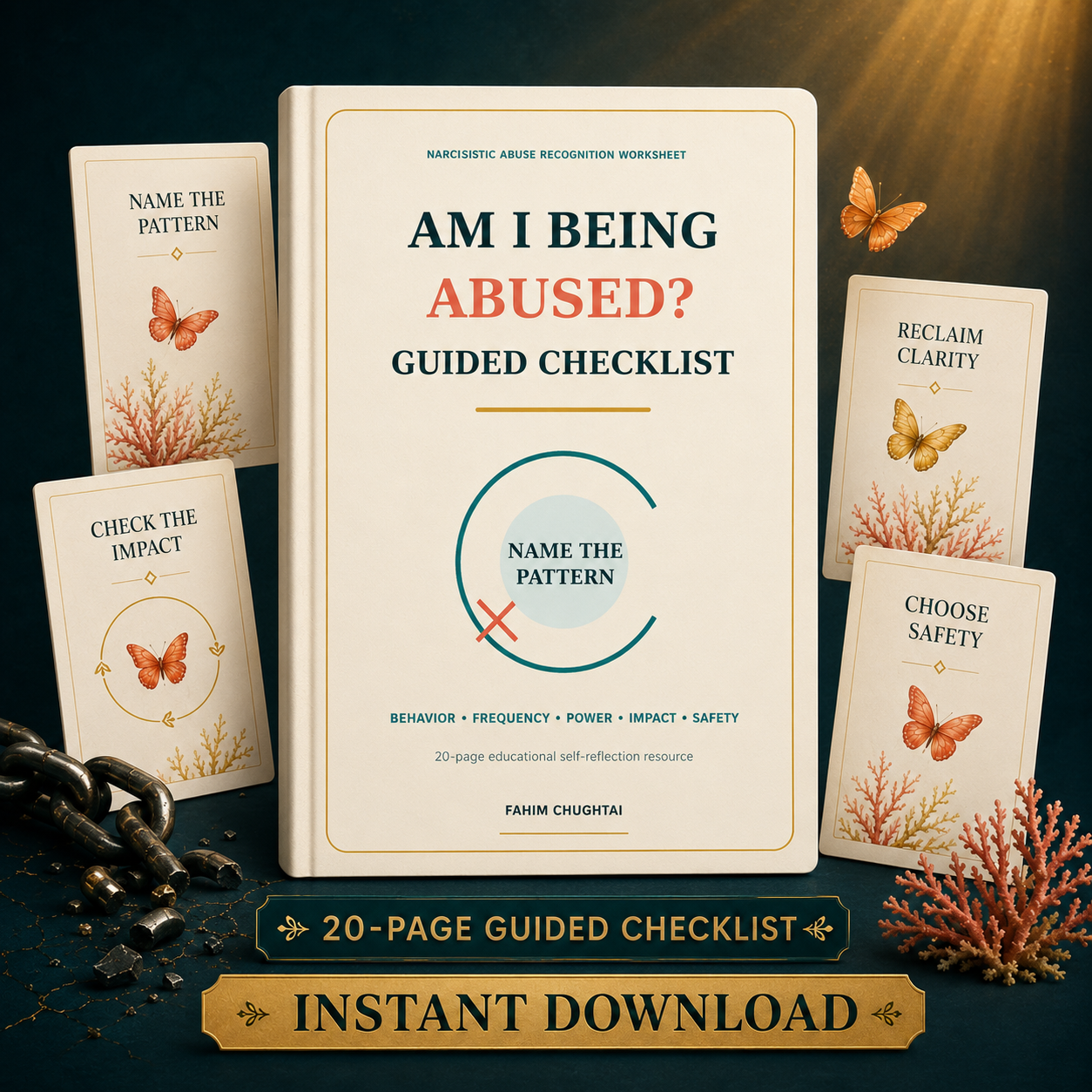
Am I being abused checklist — a 20-page guided worksheet to help you recognize whether what you are experiencing is ordinary conflict, an unhealthy relationship dynamic, or a repeated pattern of abuse.
Because one of the most common things survivors say is this: “I was not sure it counted.”
Not sure because there were good moments. Not sure because nothing seemed dramatic enough. Not sure because they kept telling you it was your fault, your sensitivity, your inability to handle normal relationships.
This checklist does not tell you what to conclude. It helps you examine observable behavior, frequency, power imbalance, retaliation, personal impact, and safety — so you can move from “maybe I am imagining it” to “this is what repeatedly happens, this is how it affects me, and this is the safest step I can take.”
WHAT IS INSIDE YOUR 20-PAGE CHECKLIST:
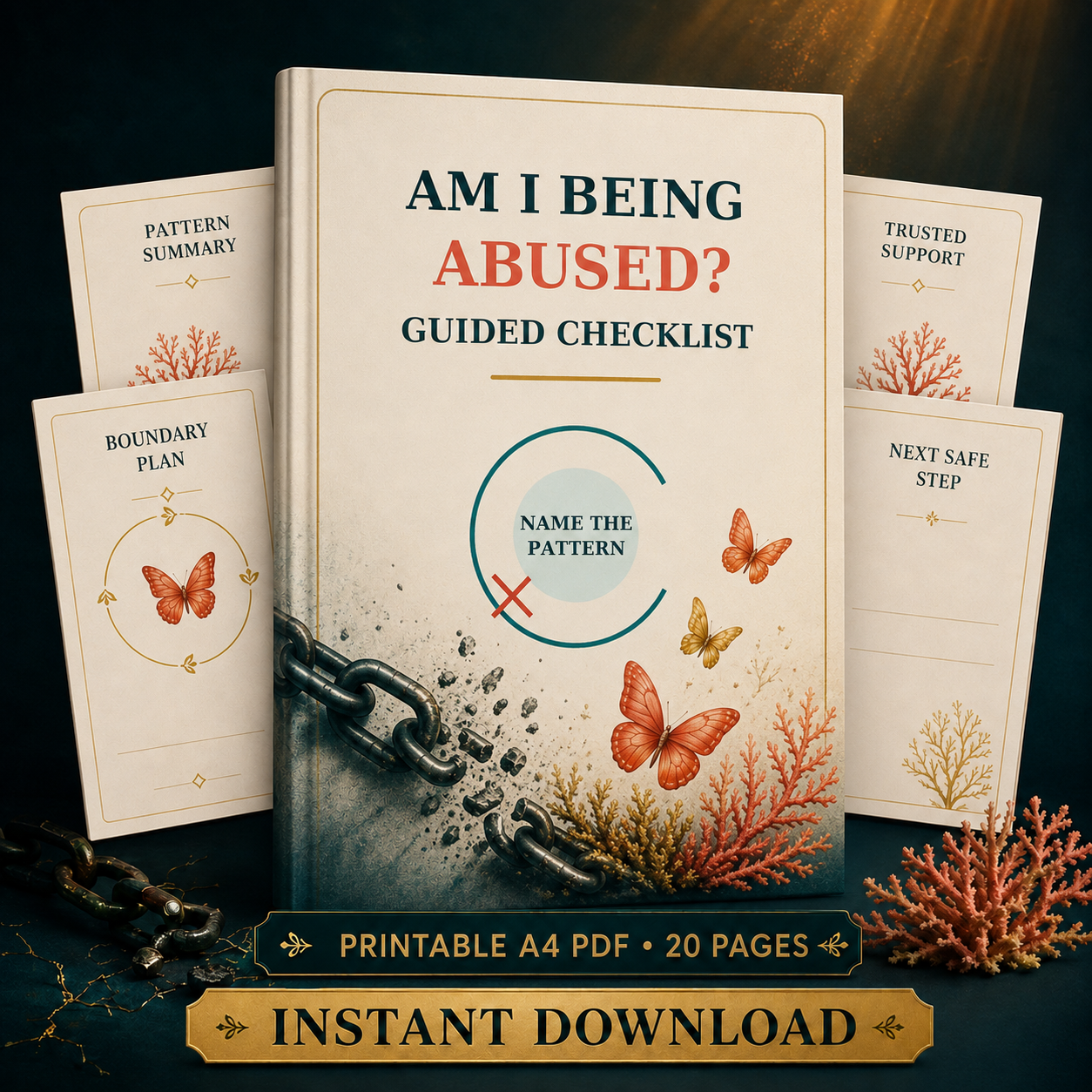
✓ 20 complete guided pages
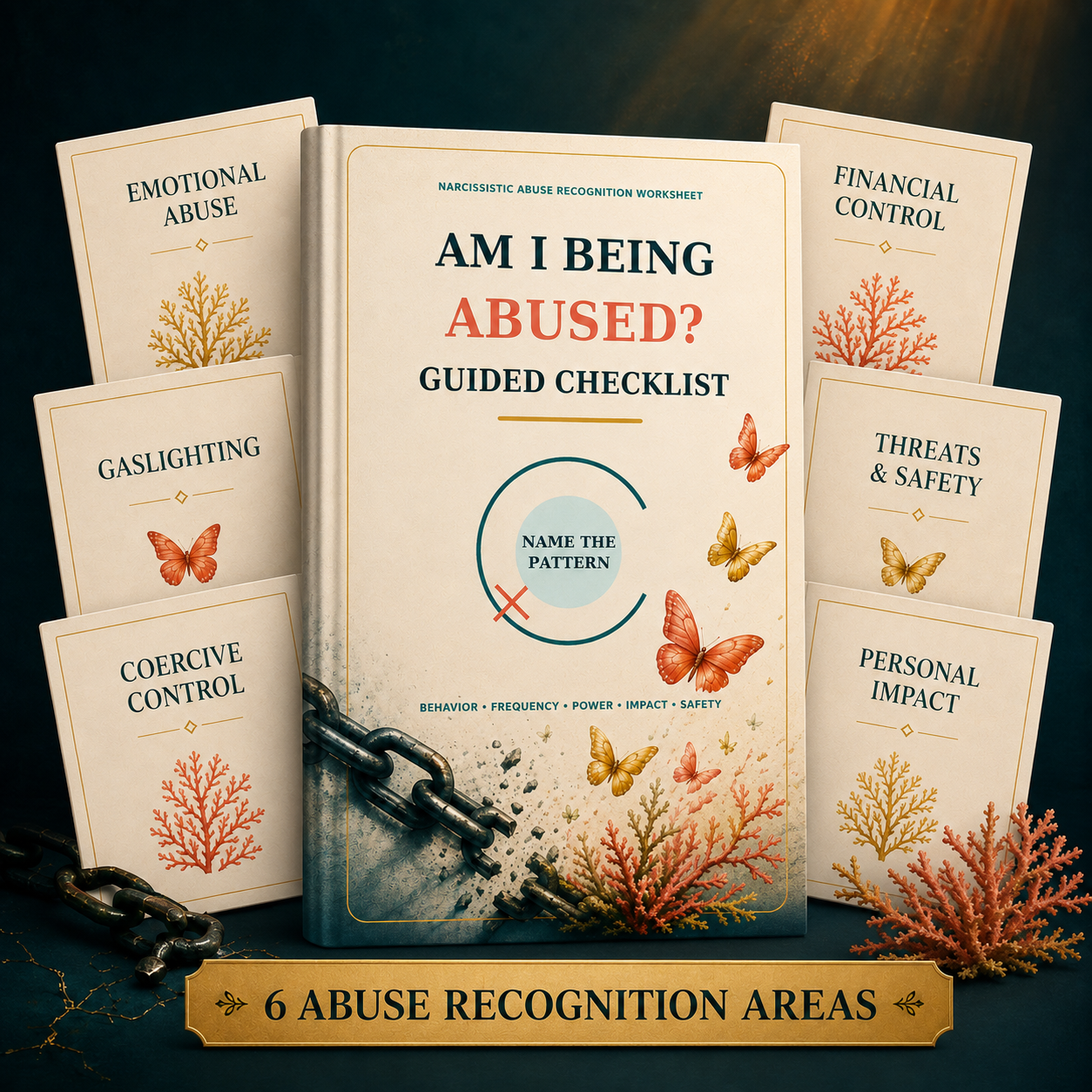
✓ Six pattern assessment areas
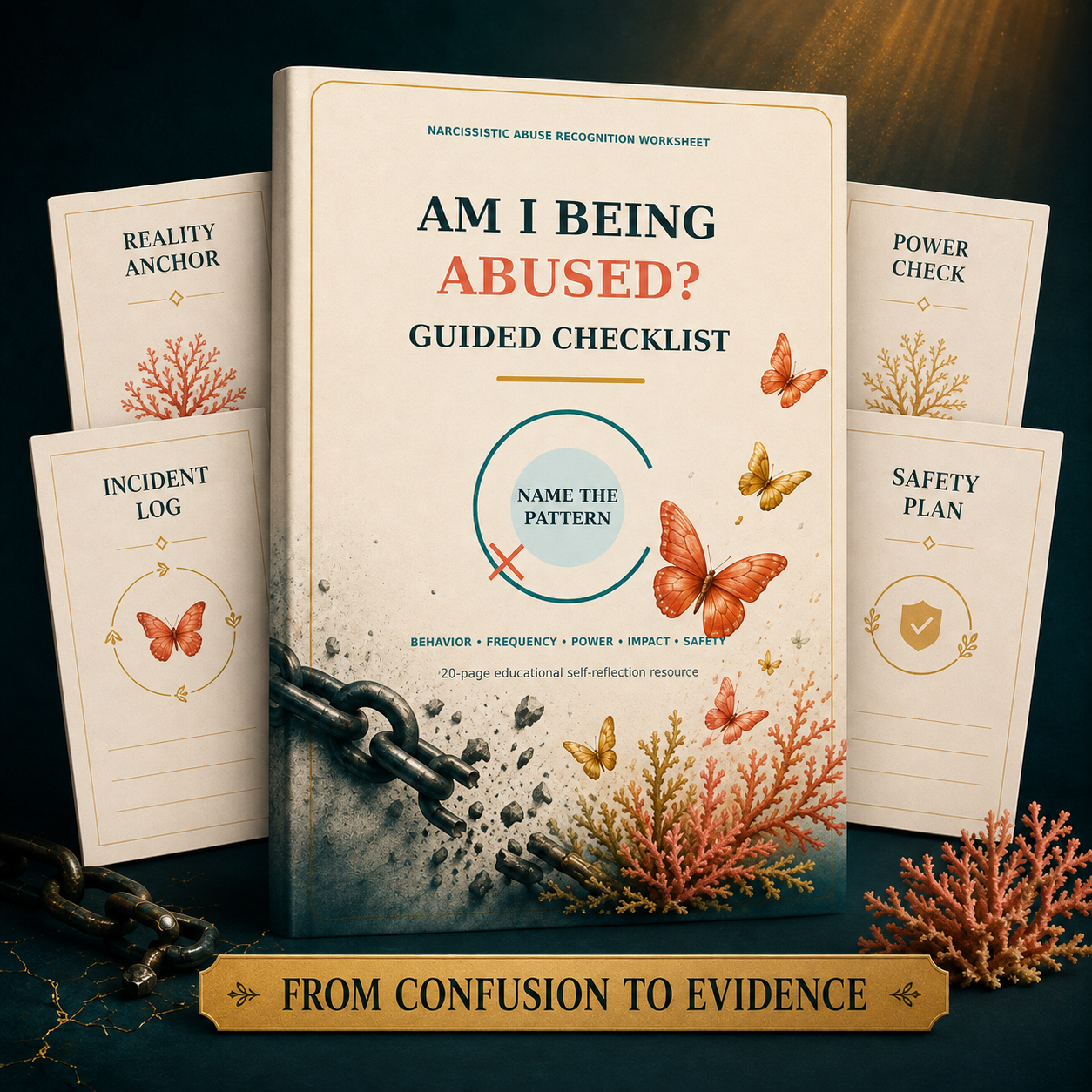
✓ Reality Anchor exercise
✓ Reusable Incident Pattern Log
✓ Power and retaliation check
✓ Support, boundaries and safety planning
✓ Emergency contact and safety preparation
✓ One realistic next step planner
✓ Instant digital download
12 AREAS THIS CHECKLIST COVERS:
Section 1 — Conflict, Unhealthy Behavior or Abuse
Understand the difference between ordinary conflict where both people retain a voice, unhealthy dynamics where harmful habits repeat but accountability may still be possible, and abuse where fear, coercion, humiliation, or punishment is used to maintain power.
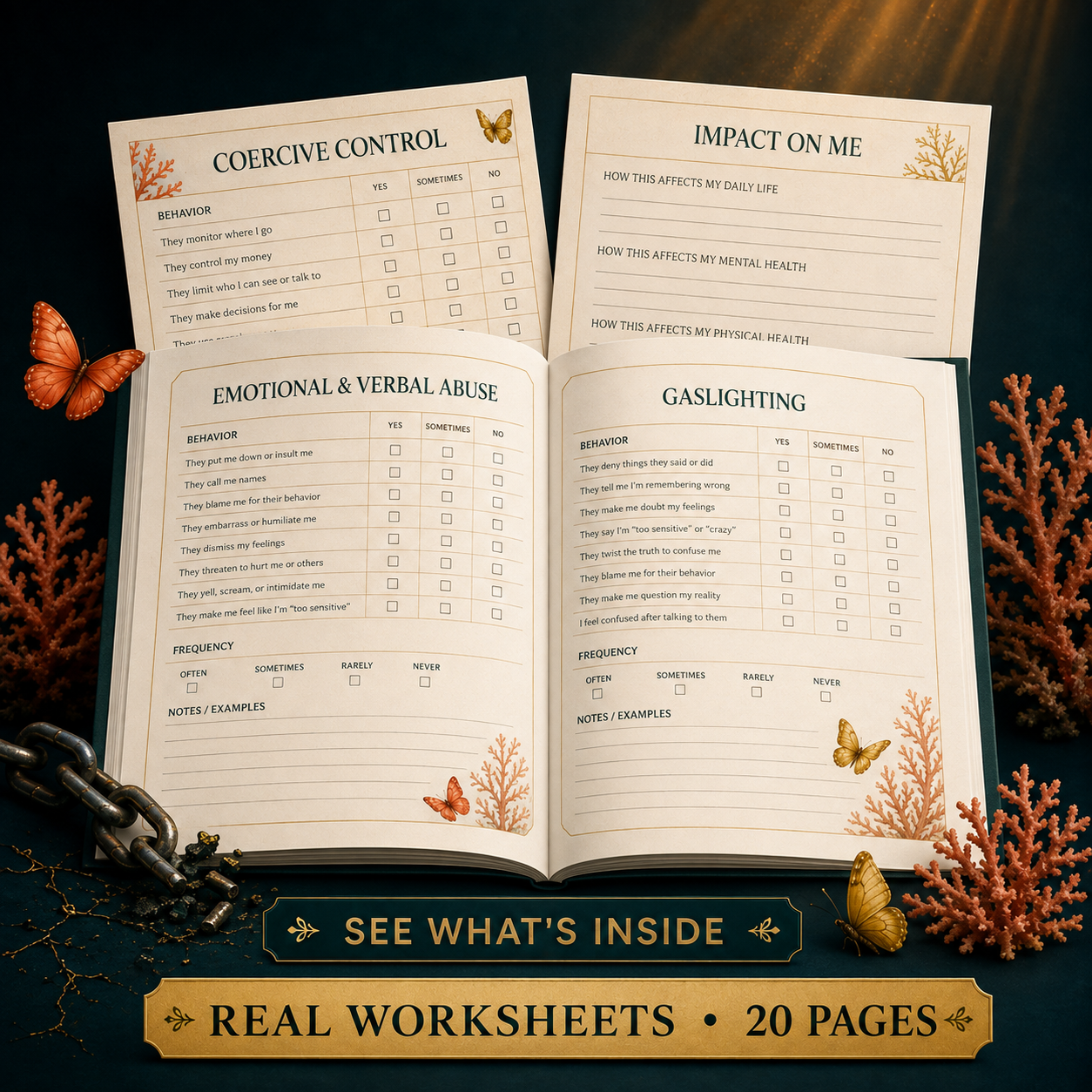
Section 2 — Emotional and Verbal Abuse
Check for patterns including insults, ridicule, contempt, public or private humiliation, blame shifting, using vulnerabilities against you, withdrawing affection as punishment, repeated promises without behavioral change, and feeling afraid to speak honestly.
Section 3 — Gaslighting and Reality Manipulation
Examine whether someone repeatedly denies events that happened, changes their story when evidence appears, calls you unstable or too sensitive, rewrites agreements, and leaves you confused and unable to trust your own memory.
Section 4 — Coercive Control and Isolation
Assess restrictions involving friends and family, clothing, time or movement, privacy, passwords and location tracking, hobbies, work or education, the ability to say no, and the ability to leave a conversation safely.
Section 5 — Financial and Digital Control
Covers withholding or monitoring money, restricting access to accounts and documents, sabotaging work or education, creating financial dependence, checking private messages without consent, and online monitoring or harassment.
Section 6 — Threats and Physical Safety
Carefully screens for higher-risk behaviors including blocking exits, breaking or throwing objects, threatening you, children, pets, or livelihood, stalking, forced sexual contact, physical restraint, and threats involving weapons or self-harm. Any indication of immediate danger should be treated as a safety concern.
Section 7 — Impact Assessment
Consider what the relationship is doing to your wellbeing including constant tension or exhaustion, self-doubt and confusion, automatic apologizing, hiding harmless information, loss of identity or confidence, fear of asking for help, and feeling trapped.
Section 8 — Pattern and Impact Summary
Organize results across six areas to identify which patterns appear most frequently and which are having the greatest effect on your daily life.
Section 9 — Reality Anchor Exercise
Separate one incident into what directly happened, what you said or did, what the other person later claimed, what evidence exists, and what impact the incident had. Reduces reliance on labels and brings attention back to observable facts.
Section 10 — Incident Pattern Log
A reusable log to record dates, behaviors, responses, and impact across multiple incidents over time.
Section 11 — Power and Retaliation Check
Practical questions about who controls money, transport, or important documents, who can leave a conversation, who can maintain privacy, what happens when someone disagrees, and who experiences the consequences.
Section 12 — Support, Boundaries and Safety
Identify trusted people, create a private check-in or code-word plan, prepare a low-risk boundary, recognize when confrontation may be unsafe, and consider emergency contacts, documents, medication, transport, children, and pets.
THIS CHECKLIST IS FOR YOU IF:
- You are not sure whether what you are experiencing counts as abuse
- You have been told your reactions are the problem
- You feel confused, exhausted, or like you are walking on eggshells
- You want to examine the pattern before making a decision
- You need a private structured tool to organize your experiences
- You are recovering from narcissistic abuse or emotional manipulation
- You want to prepare notes before speaking to a therapist or advocate
IMPORTANT SAFETY NOTE:
If any section raises immediate safety concerns, please contact local emergency services or a qualified domestic abuse organization in your country before completing the rest of this worksheet.
INSTANT DIGITAL DOWNLOAD — PDF format. 20 pages. No physical item will be shipped. Save to a private and secure location before completing.
Created by Fahim Chughtai — founder of NarcissismExposed.com, 7 years supporting survivors of narcissistic abuse and toxic relationships.