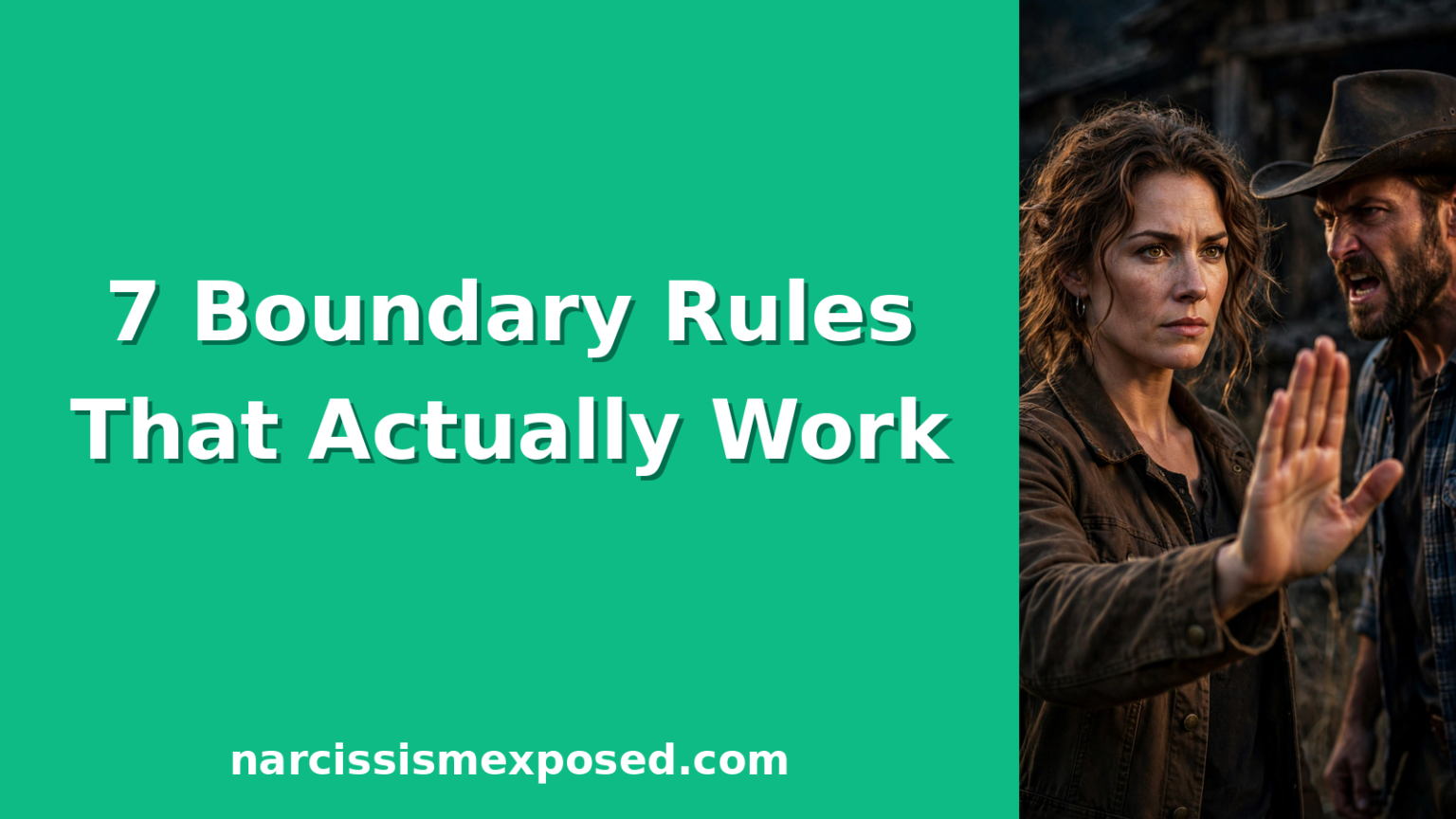
You have tried telling them to stop. You have tried crying, explaining, and begging. None of it worked. Here is why: boundaries with a narcissist are not about convincing them of anything. They are about deciding what you will do, and then doing it. Every single time.
- What Boundaries With A Narcissist Actually Are
- 1. Make The Boundary About Your Behavior
- 2. Say It Once, Then Stop Explaining
- 3. Attach A Consequence You Will Actually Enforce
- 4. Never Set A Boundary In The Middle Of A Fight
- 5. Keep Your Delivery Boring And Repeatable
- 6. Expect It To Get Worse Before It Gets Better
- 7. Judge The Boundary By Your Actions, Not Their Reaction
- Start Holding Boundaries With A Narcissist This Week
- Frequently Asked Questions
Most boundary advice fails because it assumes a reasonable person on the other side. A narcissist is not reasonable about your needs. They treat every request as the opening offer in a negotiation they intend to win. So these 7 rules work differently. They do not depend on the narcissist’s cooperation, understanding, or approval. They depend only on you. That is what makes them actually work.
What Boundaries With A Narcissist Actually Are
Before the rules, get this definition locked in. A boundary is not a rule for them. It is a promise to yourself about what you will do when a line is crossed. “Do not yell at me” is a request. “If you yell, I will leave the room” is a boundary. See the difference? One needs their permission. The other needs only your follow-through. Healthy boundaries always start with your own behavior, and that is doubly true with a narcissist.
1. Make The Boundary About Your Behavior
A boundary is what you will do, not what they must do. “Do not raise your voice at me” is a request, and requests can be debated, mocked, or ignored. “If you raise your voice, I will leave the room” is a boundary. It needs nobody’s permission to work. Narcissists treat requests as the opening offer in a negotiation, so stop making offers. Frame every boundary as your own action. I will hang up. I will not answer after nine. I will leave the event. They do not have to agree with it, understand it, or like it. The boundary works the moment you follow through, whether they approve or not.
2. Say It Once, Then Stop Explaining
Every explanation is an invitation to negotiate. The moment you start justifying a boundary, a narcissist hears a debate they intend to win. “I need you to call before visiting, because last time you just showed up and…” gives them three things to argue about before you have even finished the sentence. State the boundary plainly, one time. “Please call before you come over.” Then stop talking. If they push, repeat the exact same sentence instead of adding new reasons. It will feel rude. It is not rude. You do not owe anyone a closing argument for protecting your own peace, and the silence after your statement is not an opening. It is the period.
3. Attach A Consequence You Will Actually Enforce
A boundary without a consequence is just a wish. Here is the uncomfortable truth: the boundary is not the sentence you say. It is what happens when the line is crossed. “Do not speak to me that way” means nothing if the conversation continues exactly as before. Decide the consequence in advance, and make it something you can truly carry out. The call ends. The visit ends. The topic is dropped until tomorrow. Start with consequences that cost you little, so you can practice following through without flinching. Each time you enforce one, the next boundary gets easier. Each time you do not, you teach them that your words are decoration.
4. Never Set A Boundary In The Middle Of A Fight
Decide when you are calm. Enforce when you are tested. Announcing a new rule while someone is screaming is like building a fence during a stampede. It will not hold, and you will be exhausted. Boundaries declared in anger come out sounding like threats, and threats invite a power struggle you cannot win with a narcissist. Do the thinking when you are calm. What do I need, and what will I do if it happens? Then, when the moment arrives, you do not decide. You execute. “I am ending this call now. We can try again tomorrow.” Short, boring, final. The calm you prepared in advance becomes the strength you draw on under pressure.
5. Keep Your Delivery Boring And Repeatable
The broken record beats the brilliant argument. Narcissists feed on emotional reactions. Your tears, your shouting, your twenty-minute explanation are all proof they still steer the ship. So become the most boring person in the argument. Choose one calm sentence and repeat it like a broken record. “I am not discussing this tonight.” Same words, same tone, every single time. No new angles, no clever comebacks, no rising to the bait about your tone, your mother, or something from years ago. Boredom is a superpower here. When there is no drama left to harvest, the performance loses its audience and eventually its energy. This is also the heart of the grey rock method, which starves a narcissist of the reactions they run on.
6. Expect It To Get Worse Before It Gets Better
The escalation means it is working. Do not fold. When a boundary first holds, most narcissists do not respect it. They test it harder. The guilt trips get heavier, the rage gets louder, the silent treatment stretches longer. This is called an extinction burst. The old tactics are dying, so they get deployed at maximum volume one last time. It feels like proof the boundary failed. It is actually proof the boundary is working. If you fold now, you teach them that escalation is the price of your surrender, and the price will only rise. Ride it out, keep enforcing, and watch the storm run out of fuel. Understanding narcissistic patterns helps you see this escalation for what it is, a tactic, not a tragedy.
7. Judge The Boundary By Your Actions, Not Their Reaction
Success is that you held it, not that they liked it. If you are waiting for a narcissist to say “you are right, that boundary was fair,” you will wait forever. Their approval was never the measure. The only question that matters is this: did I do what I said I would do? If you left the room when the yelling started, the boundary worked, even if they called you dramatic about it for a week. Track your follow-through, not their transformation. Boundaries will not turn a narcissist into a considerate person. They will turn you into someone who protects herself whether or not anyone applauds. And when they realize control is gone, expect the ugly truths in what happens when a narcissist realizes you refuse to be controlled.
Start Holding Boundaries With A Narcissist This Week
Boundaries with a narcissist will never feel natural at first. You will feel guilty, dramatic, and selfish. Those feelings are the old programming talking, not the truth. The truth is simpler: you are allowed to decide what happens to you, in your home, in your conversations, in your life. Start with one boundary this week. Enforce it exactly once. That single kept promise to yourself is worth more than a hundred perfect boundaries you never used, and it is the first brick in a life that finally feels like yours. If you want a structured way to practice, the Survival Workbook walks you through holding the line when it matters most.
Frequently Asked Questions
Why don't normal boundaries work with a narcissist?
Because most boundary advice assumes a reasonable person on the other side. A narcissist treats every request as the opening offer in a negotiation they intend to win. These rules work because they depend only on your behavior, not on the narcissist's cooperation, understanding, or approval.
What is the difference between a request and a boundary?
'Do not yell at me' is a request, and requests can be debated, mocked, or ignored. 'If you yell, I will leave the room' is a boundary, because it only needs your follow-through. Frame every boundary as your own action: I will hang up, I will not answer after nine, I will leave the event.
Why should I stop explaining my boundary?
Because every explanation is an invitation to negotiate, and justifying gives them things to argue about before you have even finished the sentence. State the boundary plainly one time, then repeat the exact same sentence if they push. The silence after your statement is not an opening; it is the period.
What if things get worse after I set a boundary?
That escalation is called an extinction burst: the old tactics get deployed at maximum volume one last time because they are dying. It feels like proof the boundary failed, but it is actually proof the boundary is working. If you fold now, you teach them that escalation is the price of your surrender, and the price will only rise.
How do I know if my boundary is working?
Judge it by your actions, not their reaction. If you left the room when the yelling started, the boundary worked, even if they called you dramatic about it for a week. Boundaries will not turn a narcissist into a considerate person; they will turn you into someone who protects herself whether or not anyone applauds.