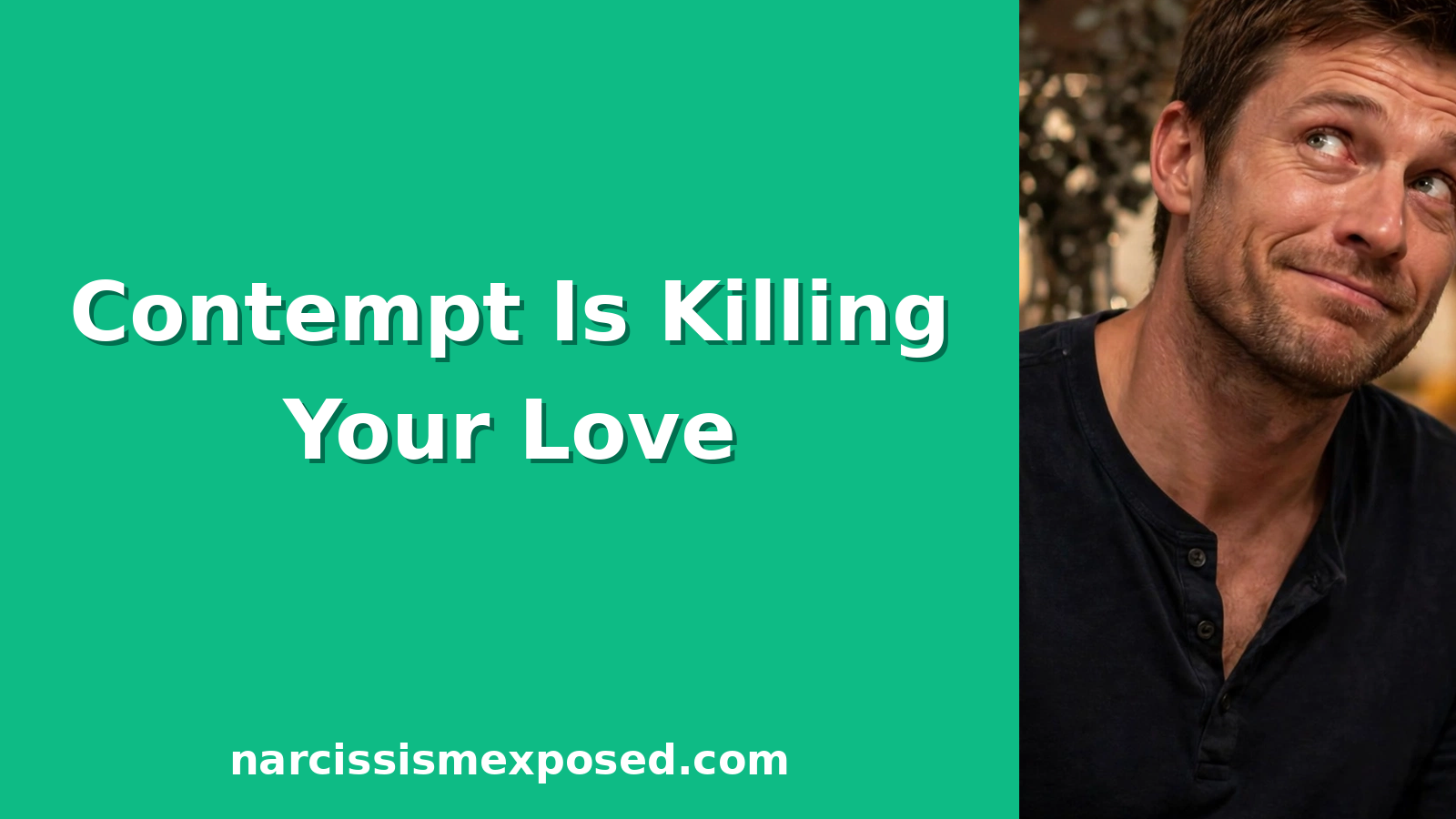
You tell your partner about something that happened at work, and before you finish the sentence, their eyes roll up to the ceiling. They sigh, smirk, and say, “Wow, what a surprise,” in a voice that makes you feel about two inches tall. You were not asking for much. You were asking to be heard. That small moment, the eye roll, the smirk, the voice dripping with disgust, is one of the clearest signs of contempt in a relationship, and it matters far more than most people realise. This article gives you all 15 signs, with real examples, so you can name what is happening and decide what to do about it.
- What Is Contempt In A Relationship
- Contempt vs Criticism vs Anger
- Why Contempt Is The Most Dangerous Of The Four Horsemen
- The 15 Signs Of Contempt In A Relationship
- Subtle Signs Of Contempt In A Relationship
- What Causes Contempt In A Relationship
- What Contempt Does To The Person Receiving It
- How To Respond When Your Partner Shows Contempt
- Can A Relationship Survive Contempt
- When To Seek Help And When To Leave
- Myths Vs Facts About Contempt
- Frequently Asked Questions
The short answer is this. Signs of contempt in a relationship include eye rolling, sneering, hostile sarcasm, mockery, name calling, a condescending tone, belittling you in front of others, dismissing your feelings as dramatic, bringing up old mistakes to win arguments, and treating you as if you are beneath them. Contempt is different from anger or criticism because it attacks who you are, not what you did. Relationship researcher Dr. John Gottman identified contempt as the strongest predictor of divorce in his research, and this article will show you how to spot it, what causes it, and when it can be repaired.
Key Takeaways
- Contempt is disgust mixed with superiority. It says, “I am better than you, and you are lesser than me.”
- The most common signs are eye rolling, sarcasm that stings, mockery, name calling, and a condescending tone.
- Contempt is different from criticism. Criticism targets a behaviour. Contempt targets your character.
- Gottman identified contempt as the strongest predictor of divorce in his research, and the most destructive of his four horsemen.
- In a narcissistic relationship, contempt is often a deliberate weapon used during devaluation to keep you small.
- A relationship can survive contempt only if both partners take responsibility and rebuild respect. If one partner uses contempt as control, repair is not possible on your own.
What Is Contempt In A Relationship
Contempt is a feeling of disgust mixed with a sense of superiority toward another person. In a relationship, it shows up as disrespect, mockery, and a message that runs underneath every word. That message is simple. “I am better than you, and you are lesser than me.” It is not the same as being annoyed, frustrated, or even angry. Anger says, “You did something that hurt me.” Contempt says, “You are the problem, and you always will be.”
The word contempt comes from the idea of looking down on someone, and the body language matches the word. The eye roll, the sneer, the one sided smirk, the sigh that says your words are not worth hearing. Psychologists describe contempt as a moral emotion, a mix of anger and disgust with a judgment of superiority on top. Anger tracks a violation of your boundaries. Disgust tracks something that feels repulsive. Contempt tracks a judgment that the other person is inferior, unworthy of respect, or beneath you. That is why it cuts so deep. Anger can pass. Contempt rewrites the story of who your partner thinks you are.

Contempt rarely arrives on its own. It usually grows out of resentment that was never addressed. A complaint that was never heard becomes criticism. Criticism that is never resolved becomes a story about character. “You forgot the milk” becomes “You never think about anyone but yourself” becomes “You are useless.” By the time contempt is a regular feature of a relationship, one or both partners have stopped seeing the other as a flawed human being who is trying. They see a defective character, and every new mistake becomes more evidence for a verdict that was already reached.
That shift is the heart of the problem. When your partner feels contempt for you, they are not trying to solve a problem with you. They are trying to establish that they are above you. The goal is not repair. The goal is dominance, and that is what makes contempt so different from ordinary conflict. Healthy couples argue about what happened. Couples living with contempt argue about who the other person is, and that argument has no end, because no apology can fix a verdict about character.
Contempt vs Criticism vs Anger
One of the most common questions people ask is how contempt is different from criticism or anger, and the answer matters, because the three need very different responses. Criticism can be fixed with a better conversation. Anger can pass once the issue is resolved. Contempt poisons the conversation itself, because it removes respect, and without respect there is no safe place to talk at all.
| Behaviour | What it targets | What it sounds like | What it does |
|---|---|---|---|
| Complaint | A specific behaviour | “I am upset you did not do the dishes.” | Names a problem that can be fixed |
| Criticism | A behaviour, framed as character | “You never help. You are so lazy.” | Attacks character, but can still be repaired |
| Anger | A specific incident | “I am furious you forgot our anniversary.” | Flares up, then fades when the issue is addressed |
| Contempt | The whole person | “Of course you forgot. You cannot handle anything.” | Attacks worth, destroys respect, predicts breakdown |
| Disgust | The person as repulsive | A sneer, a look of revulsion, turning away | Signals the person is beneath consideration |
Read the contempt row again. “Of course you forgot. You cannot handle anything.” The complaint about a forgotten anniversary is gone. What is left is a verdict about who you are, delivered with disgust. That is the line. If a partner’s words make you feel like a bad person rather than a person who made a mistake, you are probably looking at contempt, not criticism.
Anger is also worth separating clearly, because many people confuse the two. Anger is a primary emotion. It rises fast, it is loud, and it usually fades once the trigger is dealt with. You can be furious with someone you deeply respect. Contempt is slower, colder, and more settled. It does not flare and fade. It sits in the background and colours every interaction, so that even a neutral comment gets answered with a sigh or a smirk. Anger says, “That hurt me.” Contempt says, “You disgust me.” One can be worked through. The other makes working through anything almost impossible, because the person on the receiving end stops bringing problems up at all.
Why Contempt Is The Most Dangerous Of The Four Horsemen
Dr. John Gottman, a relationship researcher who studied couples for over four decades, identified four communication patterns that predict relationship breakdown. He called them the four horsemen, criticism, contempt, defensiveness, and stonewalling. Of the four, he found contempt to be the most destructive, and the single strongest predictor of divorce. In one of his studies, published in 1992, he was able to predict which couples would eventually divorce with 93.6 percent accuracy, largely based on the presence of contempt and the other horsemen behaviours in their interactions.
The four horsemen work as a chain. Criticism opens the door. One partner attacks character instead of naming a behaviour. Contempt follows, adding disgust and superiority to the criticism. The partner on the receiving end gets defensive, counterattacking or playing the victim. Eventually, one or both partners shut down completely, which is stonewalling. The Gottman Institute guide to contempt puts it plainly. Contempt is the worst of the four horsemen, it is the most destructive negative behaviour in relationships, and in Dr. Gottman’s four decades of research he found it to be the number one predictor of divorce.
Contempt is the most dangerous horseman for a simple reason. Criticism, defensiveness, and stonewalling all damage communication. Contempt damages the foundation underneath communication, which is respect. Once respect is gone, there is no goodwill left to repair with. Every attempt at a conversation starts from a position where one person has already decided the other is not worth listening to. That is why Gottman described contempt as poisonous. It does not just hurt feelings in the moment. It destroys the emotional safety that makes a relationship survivable.
The damage is not only emotional. Gottman’s research found that couples who regularly showed contempt toward each other were more likely to suffer from infectious illnesses like colds and flu than couples who did not. Other research on hostile marital interactions has found slower wound healing and weaker immune function in couples whose disagreements featured more hostile behaviour. Living under contempt keeps your stress response switched on, day after day, and your body pays for it. That is not a metaphor. It is a measurable health cost, and it is one more reason to take contempt seriously instead of dismissing it as a bad habit.
The 15 Signs Of Contempt In A Relationship
The signs below are grouped so you can recognise them in real life, not just in a textbook. Some are loud. Some are so quiet you might have been explaining them away for years. Read them slowly. If several of them sound familiar, that is information, not an accusation. A single eye roll on a bad day is not contempt. A pattern of eye rolls, sarcasm, mockery, and disgust, repeated over months, is.
Sign 1, Eye Rolling, Sneering, And The Contempt Face
The direct answer is that the eye roll is the single most recognisable sign of contempt, and it is almost never an accident. When your partner rolls their eyes while you are talking, they are telling you, without words, that what you are saying is stupid, boring, or beneath them. The sneer is its close cousin, one corner of the mouth lifting into a smirk while the rest of the face stays cold. Researchers who study facial expressions have found that the one sided lip raise is recognised as contempt across very different cultures, even by people who have never met each other. It is a universal human signal, and your nervous system reads it instantly, even before your conscious mind catches up.
Watch for the pattern, not the single incident. Everyone has rolled their eyes at a partner once, usually over something small, and then apologised or laughed it off. Contempt looks different. The eye roll happens during serious conversations, when you are upset, when you are asking for help, when you are sharing something that matters to you. It happens again and again, and when you mention it, your partner denies it or says you are imagining things. You are not imagining things. Your body knows what that face means, which is why your stomach drops when you see it.
A real example. You tell your partner you had a hard day and your boss embarrassed you in front of the team. Your partner looks at the ceiling, exhales loudly, and says, “Here we go again.” Nothing was said about the actual problem. The message was about you, that your feelings are tedious, that your pain is an inconvenience, that you are too much. Over time, you stop telling them about your hard days at all. That silence is not peace. It is what contempt creates.
Sign 2, Sarcasm That Stings Instead Of Play
The direct answer is that sarcasm becomes contempt when it is used to wound rather than to connect. Playful teasing has a clear test. Both people laugh, both people feel safe, and either person can stop it at any time. Contemptuous sarcasm fails all three tests. Only one person laughs. The other person feels smaller. And when the hurt person objects, they are told they cannot take a joke.
Listen for the phrases. “Wow, great job remembering that.” “Oh, you finally decided to help, how generous.” “Brilliant idea, as always.” The words on the surface sound like praise. The tone underneath says the opposite. Hostile humour is one of the most common forms of contempt precisely because it gives the speaker a defence. If you call it out, they can say you are overreacting, that it was only a joke, that you have no sense of humour. That defence is part of the contempt. It tells you that your hurt feelings are the problem, not the comment that caused them.
A real example. You cook dinner after a long day, and your partner tastes it and says, “Well, at least you tried,” with a laugh that does not reach their eyes. You feel the sting, but you say nothing, because last time you said something, they said you were too sensitive. So you learn to swallow it. Months later, you notice you have stopped cooking altogether, stopped trying new things, stopped offering. That shrinking is not laziness. It is the predictable result of being mocked for trying.
Sign 3, Mockery And Mimicking Your Voice Or Mannerisms
The direct answer is that mocking you is contempt in its most deliberate form. Mimicking your voice in a high pitched tone, repeating your words back to you in an exaggerated accent, copying the way you cry or the way you ask for help, these are not jokes. They are performances designed to make you feel ridiculous, and they work because they turn your vulnerability into entertainment.
Mockery is different from sarcasm because it is personal in a specific way. Sarcasm attacks what you said. Mockery attacks how you are. When your partner imitates the way you sound when you are upset, they are not disagreeing with your point. They are telling you that your feelings themselves are absurd. That is why mockery hurts long after the moment passes. You do not just remember the argument. You remember the sound of your own pain being turned into a joke, and you learn not to show that pain again.
A real example. You say, in a shaky voice, “I feel like you do not listen to me.” Your partner repeats it back in a trembling, exaggerated voice, “I feel like you do not listen to me,” and laughs. You will never say that sentence again in that relationship, and that is exactly the point. Mockery trains you to hide your needs, and a relationship where you cannot show your needs is not a relationship. It is a performance you are losing.
Sign 4, Name Calling And Insults Disguised As Honesty
The direct answer is that name calling is contempt with the mask off. Stupid, pathetic, useless, crazy, dramatic, lazy, a child, a burden. These words are not descriptions of a behaviour. They are labels stuck to your identity, and once a label sticks, it shapes how you see yourself. A partner who calls you names during arguments is not losing control of their temper. They are telling you what they think of you, and they are doing it in the moment when you are least able to defend yourself.
Watch for the disguise. “I am just being honest.” “Someone has to tell you the truth.” “I am not insulting you, I am describing you.” Honesty that only ever flows in one direction, and only ever makes one person smaller, is not honesty. It is contempt wearing honesty’s clothes. Real honesty names a specific behaviour and a specific need. “I felt hurt when you cancelled our plans without telling me” is honest. “You are a selfish person” is contempt, and it is designed to end the conversation, not to start one.
A real example. During an argument about money, your partner says, “You are hopeless with money, just like your mother.” Two people have just been insulted in one sentence, and the argument about the budget is over, because now you are defending your character and your family instead of solving a problem. That is how contempt works. It moves the fight from the issue to the person, where it can never be resolved.
Sign 5, A Condescending Tone, Like Talking To A Child
The direct answer is that a condescending tone is contempt you can hear. The voice slows down, as if explaining something to a small child. The words are simple. The patience is fake. “Let me explain this slowly, so you can understand.” “Do I need to draw you a picture?” “I will say it again, very clearly, since you clearly did not get it the first time.” The content might be reasonable. The tone says you are not an equal.
Tone is one of the hardest signs to explain to other people, because the words alone often sound fine on paper. That is why people on the receiving end of contempt so often doubt themselves. They replay the conversation and think, “Well, what they said was not that bad.” But their body remembers the tone, the way the voice dropped, the way the words were stretched out, the way the other person looked at them like a teacher looking at a slow student. Trust that memory. Tone is information, and a consistently condescending tone is one of the most reliable signs of contempt there is.
A real example. You ask a question about a bill, and your partner sighs and says, “I have explained this to you three times already. Are you even listening, or do you just enjoy wasting my time?” You were asking a question. You were treated like a problem. Over time, you stop asking questions, and then you stop understanding the finances, and then you are told you are irresponsible for not understanding them. The circle closes, and contempt built every part of it.
Sign 6, Belittling You In Front Of Other People
The direct answer is that public contempt is a sign the pattern has become bold. Correcting you in front of friends, mocking your story at a dinner table, laughing at your opinion in front of family, telling a joke at your expense while other people watch, these are all contempt, and they are worse than private contempt, because they add humiliation to the injury. The audience is part of the point. Your partner is showing other people that you are beneath them, and showing you that they are willing to do it where everyone can see.
Watch for the pattern of the public put down followed by the private denial. At the dinner, they say, “Do not listen to her, she has no idea what she is talking about,” and everyone laughs awkwardly. At home, when you say it hurt, they say, “It was just a joke, everyone thought it was funny, you are embarrassing yourself by making a big deal of it.” The denial is part of the contempt. It tells you that your public humiliation does not count, and that your reaction to it is the real embarrassment.
A real example. At a family gathering, you tell a story about something funny that happened at work. Your partner interrupts, corrects a small detail, and says, “That is not how it happened at all. You always exaggerate. Let me tell it properly.” They retell the story, making you sound foolish, and everyone laughs. You sit quietly for the rest of the evening. You have learned that speaking up in public means being corrected in public, so you stop speaking up. That is not a personality change. That is contempt doing its work.
Sign 7, Dismissing Your Feelings As Dramatic Or Crazy
The direct answer is that dismissing your feelings is contempt aimed at your inner life. “You are being so dramatic.” “You are overreacting.” “You are too sensitive.” “You are making a big deal out of nothing.” Each of these sentences does the same thing. It tells you that your emotional response is wrong, excessive, or laughable, and that the correct response would be to feel less, want less, and need less.
This sign is closely related to gaslighting, and the two often travel together. When your feelings are dismissed often enough, you start to dismiss them yourself. You feel upset, and then you feel ashamed for feeling upset. You need something, and then you tell yourself you are needy for needing it. That is the goal of contempt, whether the person doing it understands that or not. It trains you to police your own feelings so they do not have to. Our guide on how to respond to gaslighting gives you short replies that hold your reality when your feelings are being denied or rewritten.
A real example. You tell your partner you felt hurt when they ignored you all evening at a party. They say, “You are imagining things. I was talking to people. You are so insecure, it is exhausting.” You know what you felt. You watched them turn away every time you tried to join the conversation. But now you are defending your sanity instead of talking about the evening, and by the end of the conversation you are apologising for being insecure. That is contempt plus dismissal, and it is one of the most damaging combinations in any relationship.
If you recognised several of these signs in your relationship, and the pattern has lasted for months, you do not need to wait for it to get worse before you get support. The Trauma Bond Breaker Bundle gives you a clear plan to break the emotional pull that keeps you stuck, steady your thinking, and start seeing the pattern for what it is instead of through the fog they created.
Sign 8, Bringing Up Old Mistakes To Win Arguments
The direct answer is that weaponising the past is contempt dressed as memory. Every couple has a history, and every history has mistakes in it. In a healthy relationship, a mistake that has been apologised for and repaired stays in the past. In a contemptuous relationship, it is kept in a file, ready to be pulled out whenever an argument needs winning. “This is just like the time you ruined Christmas.” “You always do this, remember last year?” “You are the same person who forgot my birthday in 2023.” The argument stops being about today and becomes a trial of your entire character.
Keeping score is the engine underneath this sign. When your partner keeps a mental list of your failures, they are not trying to solve problems. They are building a case. Each new mistake is added to the file as more evidence for a verdict they have already reached. That is why apologies never seem to work. You apologise, you change, you do better, and the file stays open anyway, because the file was never about fixing anything. It was about keeping you in the wrong.
A real example. You raise a current issue, that your partner has been working late every night for two weeks and you feel alone. Your partner replies, “Oh, so now I am a bad partner? Like when I forgot your birthday? Or when I was late to your mother’s dinner? You never let anything go.” The original issue, loneliness, has vanished. You are now defending yourself against a list of old charges, and you will lose, because the list never ends. That is contempt using memory as a weapon.
Sign 9, Acting Morally Or Intellectually Superior To You
The direct answer is that superiority is the core of contempt, and it shows up as a constant, quiet claim to be the better person in the relationship. “I am the only adult here.” “Thank goodness one of us has a brain.” “I carry this whole relationship.” “If it were not for me, you would fall apart.” These sentences are not complaints about a specific task. They are claims about rank, and they place your partner above you and you below them.
Superiority can be moral, intellectual, or practical. Moral superiority sounds like, “I would never treat someone the way you treat me.” Intellectual superiority sounds like, “You would not understand, it is complicated.” Practical superiority sounds like, “I do everything around here, you do nothing.” In every version, the message is the same. One person is competent, decent, and long suffering. The other is incompetent, selfish, and lucky to be tolerated. Once that story takes hold, every interaction confirms it, because the superior partner interprets everything through it.
A real example. You both work full time, but your partner tells friends, “I basically run the household single handedly. If I did not do everything, nothing would get done.” You do the shopping, the school runs, and the laundry, but none of it counts, because the story has already been written. You are the lazy one. They are the hero. And when you point out what you actually do, you are told you are keeping score, which is exactly what they are doing, only with a different story attached.
Sign 10, The Look Of Disgust, Sneering, And Turning Away
The direct answer is that the look of contempt is a physical signal, and it is one of the easiest signs to recognise once you know what to look for. The upper lip raises on one side. The nose wrinkles slightly. The eyes narrow. The chin lifts. The body turns away while you are speaking. It is the face of disgust, the same face a person makes when they taste something rotten, and it is being aimed at you, a person they once loved.
Psychologist Susan Heitler, writing in Psychology Today, described contempt as arrogant disregard, dismissal, and denigration of another person’s concerns, and noted that empathy and contempt are polar opposites. She also pointed out the physical signs, eye rolling, an upper lip raised on one side, and a sarcastic tone of voice, as signals that someone is not listening to you, or is listening only to deprecate you. The Psychology Today article on how contempt destroys relationships explains why this matters. Contempt does not just hurt in the moment. It dumps toxicity into the relationship, signals rejection, and invites hopelessness, because the person receiving it starts to believe their negative attributes are permanent and cannot change.
A real example. You share something you are proud of, a promotion, a finished project, a goal you reached. Your partner looks at you, gives a small, cold smirk, and says, “Well, it is about time.” The smirk does more damage than the words. It tells you that your achievement does not count, that your pride is misplaced, that you are still not enough. You stop sharing good news, because sharing it and being met with disgust hurts more than keeping it to yourself. That is contempt closing down the last open door in the relationship.
Sign 11, Withholding Affection And Stonewalling After Conflict
The direct answer is that silent treatment after a disagreement is often contempt in its quietest form. Stonewalling, the fourth of Gottman’s four horsemen, usually appears as a direct response to contempt. When the negativity becomes overwhelming, one partner shuts down entirely, refusing to engage, making themselves busy, or physically leaving the conversation. The person doing it may look calm on the outside, but they are usually in a state of physiological overload. To the other partner, it feels like being told they do not matter enough to warrant a response.
There is an important difference between taking a break to cool down and stonewalling. A healthy break is announced, it has a time limit, and the person comes back to finish the conversation. “I am overwhelmed. Can we take a break and come back to this in 30 minutes?” Stonewalling has no announcement, no time limit, and no return. It is silence used as punishment, and it is often paired with contempt, because the silent partner has already decided the conversation is not worth having. Our guide on love bombing then silent treatment explains how this pattern works when it is used as a control tool rather than a moment of overwhelm.
A real example. After an argument, your partner stops speaking to you for three days. They sleep in the spare room, eat separately, and answer your questions with one word answers or silence. On the fourth day, they act as if nothing happened, and when you try to talk about the argument, they say, “That is over, why are you bringing it up again?” You have learned that raising a problem means days of silence, so you stop raising problems. The relationship looks calm from the outside. Inside, it is empty.
Sign 12, Keeping Score And Enjoying Your Failures
The direct answer is that quiet satisfaction at your partner’s failure is one of the darkest signs of contempt. It is subtle, and it is easy to miss, because it often hides behind a neutral face. Your partner hears that you were passed over for a promotion, and there is a flicker of something that is not sympathy. You trip over your words in front of their friends, and they smile. You forget something important, and they look pleased, because it confirms the story they have been telling themselves about you. That flicker is contempt. It says, “See, I was right about you all along.”
Keeping score feeds this sign directly. When a partner keeps a running tally of your mistakes, every failure becomes a point on the board, and every success is quietly discounted. The scoreboard is never shown to you, because showing it would reveal how the game is rigged. You are being judged against a standard you cannot see, by a judge who has already decided the verdict. The pleasure at your failure is the tell. A partner who loves you feels pain when you fail. A partner who feels contempt for you feels vindicated.
A real example. You tell your partner you did badly in a job interview. Instead of comfort, you get, “Well, what did you expect? You never prepare properly.” There is no curiosity about what happened, no offer of help, no kindness. There is only a verdict, delivered with a small, satisfied nod. You stop telling them about interviews, about applications, about anything that might go wrong, because their response to your failure hurts more than the failure itself.
Sign 13, No Admiration Left, Only Criticism
The direct answer is that contempt takes hold when admiration dies. Gottman called the antidote to contempt a culture of fondness and admiration, deliberately noticing and expressing what you value about your partner. When that culture is gone, what is left is a relationship where nothing you do is ever good enough, where your efforts are invisible, and where the only comments you hear are corrections. That absence is a sign in itself, and it is one of the most reliable ones.
Think about the ratio. Gottman’s research points to a benchmark of roughly five positive interactions for every negative one in stable relationships. When the ratio drops below that, negativity starts to feel like the default, and contempt moves in. You do not need to count interactions to use this. Ask a simpler question. When was the last time your partner thanked you, complimented you, or noticed something you did well, without being prompted? If you cannot remember, or if the answer is measured in months, contempt has likely replaced admiration, and the relationship is running on empty.
A real example. You cook, clean, work, pay bills, and look after the children, and the only feedback you get is about the one thing you forgot. You buy a gift, and it is the wrong one. You dress up, and they do not notice. You work late to finish a project, and they complain you are never home. Nothing you do registers as enough, because the story in their head says you are not enough, and the story filters out any evidence to the contrary. That is contempt, and it is exhausting to live inside.
Sign 14, You Dread Talking To Them And Avoid Being Vulnerable
The direct answer is that dread is your body telling you the truth about contempt. If you rehearse conversations in your head before you have them, if you choose your words carefully because you know the wrong word will earn an eye roll, if you avoid bringing up important things because you already know how the conversation will end, you are living with contempt. Emotional safety is gone, and your nervous system knows it before your mind admits it.
Vulnerability is the first casualty. You stop telling your partner what you really think, what you really feel, what you really need, because every time you did, it was mocked, dismissed, or used against you later. You share less, and then you feel less close, and then you share even less, and the distance grows. That distance is not a mystery. It is the predictable result of contempt. People do not open up to someone who has taught them that opening up is unsafe.
A real example. You have something important to tell your partner, that you are unhappy at work and thinking of changing careers. You rehearse it for three days. You wait for the right moment. You finally say it, and they laugh and say, “You, change careers? You cannot even decide what to have for dinner.” You never bring it up again. You make the decision alone, or you do not make it at all. Either way, the relationship has lost something essential, a partner you can be honest with, and contempt took it.
Sign 15, Contempt As A Narcissistic Weapon During Devaluation
The direct answer is that in a narcissistic relationship, contempt is not an accident or a bad habit. It is a tool. Narcissistic relationships often follow a recognisable arc. First comes idealisation, intense attention, flattery, and you are my soulmate talk very early on. Then comes devaluation. Once you are invested, the warmth starts to disappear, small criticisms creep in, jokes at your expense, comparisons to other people, eye rolls when you speak. Then comes control, gaslighting, triangulation, isolation. Then comes discard. Contempt is the engine of the devaluation phase, and its job is to keep you small, doubtful, and dependent.
This is the sign the other articles miss completely, and it is the one that matters most for readers of this site. A narcissistic partner does not feel contempt by accident. They use it to establish superiority and to train you to accept a lower position. The eye roll teaches you to stop talking. The mockery teaches you to stop feeling. The public put down teaches you to stop shining. The disgust teaches you to believe you are lucky they stay at all. Each sign on its own looks like rudeness. Together, they form a system, and the system has a purpose, which is control.
If you recognise this pattern, read our guide on narcissistic behavior in relationships to see the full picture, and our guide on whether you are trauma bonded rather than in love, because contempt plus intermittent kindness is one of the strongest glues that holds a trauma bond together. The kindness keeps you hoping. The contempt keeps you small. That combination is not love. It is a cycle, and naming it is the first step out of it.
A real example. In the first months, your partner told you that you were the most intelligent person they had ever met. Two years later, they roll their eyes when you speak, correct you in front of friends, and tell you that nobody else would put up with you. Nothing about your intelligence changed. What changed is the phase of the relationship. Idealisation built the bond. Contempt is now being used to maintain control inside it. If that sounds familiar, trust what you are seeing. The person who once admired you has not become honest. They have changed tactics.
Subtle Signs Of Contempt In A Relationship
Not all contempt is loud, and the quiet versions are often the hardest to name. If the 15 signs above felt obvious, these are the ones people miss for years, because each one on its own looks like nothing much. Together, they form a pattern that is just as damaging as the loud version.
The direct answer is that subtle contempt hides in small dismissals. A sigh when you start talking. A look at the phone while you are mid sentence. A flat “mm-hmm” that means “I stopped listening three minutes ago.” A joke about your interests that is just sharp enough to sting and just vague enough to deny. A habit of answering your questions with questions, so you end up defending yourself instead of getting an answer. A pattern of forgetting the things that matter to you, birthdays, appointments, promises, while remembering everything that matters to them.
Watch for the backhanded compliment, a classic subtle sign. “You look nice today, for once.” “That was actually a good idea, I am surprised.” “You are finally wearing something decent.” Each one contains a compliment and an insult in the same sentence, and the insult is the part that stays with you. Another subtle sign is the correction of tiny details in your stories. You say the restaurant was on Fifth Street, and your partner interrupts to say it was on Sixth, in front of everyone, as if the detail mattered more than the story. It did not. What mattered was the correction itself, a small public reminder of who is in charge of the facts.
Another subtle sign is indifference. Contempt does not always look like disgust. Sometimes it looks like nothing at all. Your partner stops asking about your day. They stop reacting to your news, good or bad. They stop touching you, stop making eye contact, stop laughing at your jokes. The relationship goes quiet, not because you have run out of things to say, but because one person has stopped listening. Indifference is contempt without the energy, and it is just as lonely to live with.
What Causes Contempt In A Relationship
The direct answer is that contempt is almost always the end result of resentment that was never addressed. It rarely appears overnight. It grows slowly, from unspoken frustrations, unmet needs, and conflicts that were buried instead of resolved. A partner who feels chronically unheard starts to keep score. A partner who feels taken for granted starts to narrate the other person’s failures. A partner who feels powerless in the relationship starts to use contempt to feel powerful again. None of this excuses contempt, but understanding where it comes from helps you see whether it can change.
Several dynamics accelerate the process. Unresolved resentment is the most common. When issues go unaddressed, frustration turns into sarcasm, withdrawal, or passive aggression. Loss of admiration is another. Without regular acknowledgment, partners stop seeing each other’s effort or worth, and the story in their head shifts from “my partner is trying” to “my partner is useless.” Emotional burnout plays a role too. Chronic stress and exhaustion make it easy to snap and to view your partner as part of the problem rather than as a teammate. Learned behaviour matters as well. If contempt was modelled in your family home, sarcasm, mockery, and eye rolling can surface automatically in your own relationship, because that is what conflict looked like growing up.
In a narcissistic relationship, the cause is different, and it is important to name the difference honestly. Contempt there is not the result of unresolved resentment. It is a deliberate strategy. The narcissistic partner uses contempt to establish dominance, to keep you off balance, and to make sure you never feel secure enough to leave. The cause is not a communication problem. It is a control problem, and communication tools will not fix a control problem. That distinction decides everything about what to do next, which is why this article spends time on it instead of pretending all contempt is the same.
What Contempt Does To The Person Receiving It
The direct answer is that contempt does damage that goes far beyond hurt feelings. It erodes your sense of self, your confidence, your health, and your ability to trust your own judgment. The effects build slowly, which is why so many people do not notice them until they are deep into the pattern, and why the damage is so hard to explain to other people. Each incident looks small. The accumulation is enormous.
First, it creates shame. When someone you love looks at you with disgust, over and over, you start to believe there is something disgusting about you. You start to monitor yourself constantly, checking your words before you say them, checking your face in the mirror, checking whether you are too much or not enough. Shame is different from guilt. Guilt says, “I did something bad.” Shame says, “I am something bad.” Contempt is designed to produce shame, and shame is what keeps people stuck, because a person who feels ashamed does not ask for help. They hide.
Second, it creates hypervigilance. You start walking on eggshells, watching your partner’s face for the first sign of the eye roll, the sigh, the smirk. You learn to read micro expressions the way other people read weather forecasts, because your safety depends on it. That constant alertness is exhausting, and it does not switch off when the argument ends. It follows you into work, into friendships, into sleep. Over time, it can look like anxiety, because in a sense it is anxiety, a nervous system that has learned that the person closest to you is also the person most likely to hurt you.
Third, it erodes your sense of self. When your thoughts, feelings, and opinions are dismissed often enough, you start to dismiss them yourself. You stop trusting your memory, your judgment, and your instincts. You ask other people what they think before you trust what you think. That erosion has a name on this site, self erosion, and our guide on self erosion in toxic relationships explains how it happens and how to heal it. If you have noticed yourself becoming smaller, quieter, and less sure of who you are since this relationship began, that is not a coincidence. It is the predictable result of living under contempt.
Fourth, it damages your health. As noted earlier, Gottman’s research found that couples who regularly showed contempt were more likely to suffer infectious illnesses. Other research on hostile marital interactions has found slower wound healing, weaker immune function, higher markers of systemic inflammation, and elevated risk for heart disease. Chronic contempt keeps your stress hormones elevated, and elevated stress hormones over months and years wear down your body. If you have been getting sick more often, sleeping badly, or feeling physically run down since the contempt started, take that seriously. Your body is keeping a record that your mind has been trying to ignore.
How To Respond When Your Partner Shows Contempt
The direct answer is that your response depends on whether both partners are willing to change. If your partner is open, honest, and willing to take responsibility, contempt can be repaired, slowly, with consistent effort. If your partner denies it, blames you, or uses it deliberately, no communication technique will fix it, and your job is to protect yourself, not to repair the relationship alone.
If you are in a situation where repair is possible, start with naming the pattern calmly and specifically. Not “You are contemptuous,” which is a character attack of your own, but “When you rolled your eyes while I was talking, I felt dismissed, and I need us to talk without that.” Use “I” statements that speak from your experience. Describe what happened, how it felt, and what you need instead. Do it when you are both calm, not in the middle of an argument, when nobody can hear anything. Gottman’s short term antidote is exactly this, describe your own feelings and needs instead of attacking your partner’s character.
Build a culture of appreciation deliberately, even when it feels artificial at first. Name one thing you notice and appreciate about your partner every day, specifically, not generally. “Thank you for making dinner even though you were tired” is different from “Thanks.” The Gottman Institute examples of contempt and its antidotes show how this works in practice, replacing “Wow, great job remembering that” with “I know things get forgotten. Could you take it out now?” Small, specific, respectful. That is the whole method, repeated daily until it becomes the new default.
If you are the one showing contempt, the honest work starts with noticing your own internal narration. When your partner makes a mistake, what is your first thought? If it is “Of course they did, they cannot handle anything,” you have already rewritten their character in your head, and your behaviour will follow. Catch the thought. Ask yourself what you actually need, and say that instead. “I am feeling overwhelmed by the housework, and I need help. Can we figure out a plan together?” That sentence does the work that contempt cannot do. It names a real need, and it invites your partner to meet it.
Set a boundary around contempt itself, clearly and once. “I will not continue a conversation where I am mocked or called names. If that happens, I am going to step away and we can try again in an hour.” Then do what you said, every time, calmly. A boundary that is stated once and enforced consistently is worth more than a hundred arguments about tone. Do not explain, justify, or argue about the boundary. A boundary is not a negotiation. It is information about what you will do.
Can A Relationship Survive Contempt
The direct answer is yes, but only under specific conditions, and it is important to be honest about what those conditions are. A relationship can survive contempt if both partners recognise the pattern, both take responsibility for their part in it, and both commit to changing how they communicate, consistently, over months, not days. Couples therapy with a therapist trained in the Gottman Method or Emotionally Focused Therapy can help, because it gives both partners a supervised space to practise new patterns instead of falling back into old ones. Many couples do come back from contempt, especially when it is caught early and both people are willing to do the work.
A relationship cannot survive contempt if only one partner is doing the work. You cannot repair a pattern alone that takes two people to maintain. If your partner denies the contempt, blames you for it, refuses therapy, or agrees to change and then carries on exactly as before, you are not in a repair process. You are in a waiting process, and waiting does not fix contempt. It lets it deepen, because every month you stay teaches your partner that contempt has no consequences.
There is a harder truth for readers in narcissistic relationships. If contempt is being used as a deliberate tool of control, as part of devaluation, then couples therapy is not the answer, and it can sometimes make things worse, because it gives the controlling partner new language to use against you. In that situation, the question is not how to repair the relationship. The question is how to protect yourself and how to leave safely if leaving is what you need. If you are in danger, or if your partner has threatened you, contact local support services or law enforcement. Your safety comes before any explanation, and before any hope that they will change.
When To Seek Help And When To Leave
The direct answer is to seek help as soon as you recognise the pattern, and to consider leaving when the pattern does not change despite real effort. Some signals that it is time to bring in outside help are that you have tried changing the pattern on your own and it keeps reverting, one or both partners feel emotionally unsafe during disagreements, stonewalling has become the default response to conflict, or you genuinely struggle to recall what you appreciate about your partner. None of these mean the relationship is doomed, but they do mean the problem has outgrown what most couples can fix through conversation alone.
Consider leaving, or at least planning an exit, when contempt is paired with other forms of abuse, when your partner refuses all responsibility, when you have lost your sense of self and cannot find it again inside the relationship, or when your physical or mental health is deteriorating. Leaving a relationship where contempt is entrenched is not giving up. It is recognising that respect is a requirement, not a luxury, and that a relationship without respect is not a relationship. It is an arrangement where one person is slowly erased.
If you are planning to leave, plan carefully. Tell people you trust. Think about your safety, your finances, and your documents before you announce anything. Keep copies of important documents outside the home. Keep a written record of what has happened, with dates, because your memory will be challenged and your notes will not be. If the situation involves children, get advice from a professional who understands high conflict separation before you make any move. Leaving is a process, not a single moment, and doing it carefully is part of protecting yourself.
Myths Vs Facts About Contempt
The movie version of a bad relationship teaches you to look for shouting and slammed doors. Contempt is quieter than that, and the myths around it keep people trapped. Here are the ones that matter most.
Myth, contempt is just a bad habit, like interrupting. Fact, contempt is a pattern of disrespect that attacks character, and Gottman’s research found it to be the strongest predictor of divorce. A habit is something you do without thinking. Contempt is a judgment about who your partner is, and it shapes everything else.
Myth, if there is no shouting, there is no contempt. Fact, some of the worst contempt is silent. The eye roll, the smirk, the sigh, the turned back, the three days of silence, these are all contempt, and they can do more damage than shouting, because they are harder to name and harder to defend against.
Myth, contempt means the relationship is over. Fact, contempt is serious, but it is not a guaranteed ending. If both partners take responsibility and rebuild respect, many couples recover. What ends a relationship is not contempt alone. It is contempt plus refusal to change.
Myth, only men show contempt. Fact, contempt is shown by people of all genders, and it looks different depending on the person. Women are more likely to use relational contempt, social sabotage, reputation attacks, and the weaponising of vulnerability, while men are more likely to use overt mockery and raised voices. The pattern is the same. The methods adapt to the tools available.
Myth, you can spot contempt by a single eye roll. Fact, a single eye roll on a bad day is human. Contempt is a pattern, repeated over weeks and months, across many situations, with the same message underneath. Judge the pattern, not the incident.
Myth, contempt is the same as honesty. Fact, honesty names a specific behaviour and a specific need. Contempt names a verdict about character. “I felt hurt when you cancelled our plans” is honest. “You are a selfish person” is contempt, and calling it honesty does not make it honest.
You do not need your partner to admit anything, apologise, or change before your life gets better. If you want exact words for the next hard conversation, a plan to protect your peace while you are still in contact, and a steady way to document what is happening, the Survival Workbook gives you all three, so one more cold smirk does not become one more year of doubting yourself.
Frequently Asked Questions
What is contempt in a relationship?
Contempt in a relationship is a pattern of treating your partner as beneath you, through sarcasm, mockery, eye rolling, sneering, name calling, and dismissive language. It is different from anger or criticism because it attacks who your partner is, not what they did. It communicates disgust and superiority, and relationship researcher Dr. John Gottman identified it as the strongest predictor of divorce in his research.
What does contempt in a relationship look like?
Contempt looks like eye rolling during serious conversations, sarcastic comments that sting, mocking your partner’s voice or feelings, name calling, a condescending tone, belittling your partner in front of others, and dismissing their feelings as dramatic. It also shows up quietly, as sighs, turned backs, withheld affection, and silence after arguments. The common thread is a message of superiority, that one partner is better than the other.
What are examples of contempt in a relationship?
Common examples include saying ‘Of course you forgot, you cannot handle anything’ instead of talking about the forgotten task, mimicking your partner’s upset voice to make them feel ridiculous, calling them stupid or pathetic during an argument, correcting them in front of friends to embarrass them, and responding to their hurt feelings with ‘You are being so dramatic.’ Each example targets character rather than behaviour, which is what makes it contempt rather than criticism.
What causes contempt in a relationship?
Contempt usually grows from resentment that was never addressed, unmet emotional needs, loss of admiration, emotional burnout, and learned behaviour from family patterns. In a narcissistic relationship, the cause is different. Contempt is used deliberately as a control tool during devaluation, to keep the other person small, doubtful, and dependent. The cause matters, because resentment can be repaired, while deliberate control cannot be fixed with communication tools alone.
What is the difference between contempt and criticism?
Criticism targets a behaviour, for example ‘You did not do the dishes.’ Contempt targets the person, for example ‘You are so lazy, I have to do everything myself.’ Criticism can lead to positive change when it is respectful. Contempt carries judgment and disgust, makes a partner feel shamed rather than heard, and does lasting damage to respect and emotional safety.
What is the difference between contempt and anger?
Anger is a primary emotion that flares up over a specific incident and fades once the issue is addressed. You can be furious with someone you deeply respect. Contempt is slower, colder, and more settled. It is a mix of anger and disgust plus a sense of superiority, and it colours every interaction rather than flaring and fading. Anger says, ‘That hurt me.’ Contempt says, ‘You disgust me.’
Can a relationship survive contempt?
Yes, but only if both partners recognise the pattern, both take responsibility, and both commit to changing how they communicate, consistently over months. Couples therapy with a therapist trained in the Gottman Method or Emotionally Focused Therapy can help. A relationship cannot survive contempt if only one partner is doing the work, or if one partner denies it, blames the other, or uses it deliberately as control.
How do you deal with contempt in a relationship?
Name the pattern calmly and specifically, using ‘I’ statements about what happened and how it felt. Set a clear boundary, for example that you will step away from a conversation where you are mocked or called names, and enforce it every time. Build a culture of appreciation with small, specific daily gestures. If the pattern does not change despite real effort, or if contempt is paired with other abuse, seek professional help and consider whether the relationship is safe to stay in.
Is contempt a form of emotional abuse?
Contempt on its own is a destructive communication pattern, and when it is repeated, deliberate, and used to control, diminish, or frighten a partner, it is a form of emotional abuse. The key factors are pattern, intent, and effect. Occasional contempt that both partners own and repair is a relationship problem. Contempt used systematically to keep a partner small, silent, and afraid is abuse, and it should be treated as such.
What are subtle signs of contempt in a relationship?
Subtle signs include sighs when you start talking, looking at a phone while you speak, backhanded compliments like ‘You look nice today, for once,’ correcting tiny details in your stories in front of others, forgetting the things that matter to you, and a slow withdrawal of attention, touch, and interest. Indifference is also a subtle sign. When a partner stops reacting to your news, good or bad, contempt may have replaced respect with nothing at all.
Why does my partner roll their eyes at me?
Eye rolling usually signals that your partner finds what you are saying stupid, boring, or beneath them. It is one of the most reliable physical markers of contempt. A single eye roll on a bad day is human, but repeated eye rolling during serious conversations, when you are upset, or when you are asking for help is a pattern worth taking seriously. If you mention it and your partner denies it or says you are imagining things, trust what you saw. Your body reads that signal for a reason.
Can contempt be repaired?
Contempt can be repaired when both partners are willing to take responsibility and rebuild respect, through honest conversations, a culture of appreciation, and often couples therapy. The repair takes months of consistent effort, not a single apology. Contempt cannot be repaired by one partner alone, and it cannot be repaired when it is used deliberately as a control tool. In that case, the honest step is to protect yourself and to get support for leaving safely if that is what you need.