You said something out loud, clearly, in your own kitchen, and ten minutes later the person standing next to you looked you in the eye and said it never happened. You apologised for a fight you did not start, then lay awake wondering if you were the difficult one after all. If that foggy, upside down feeling has become familiar, you are probably searching for what is gaslight, and whether what is happening to you has a name. It does. The name is gaslighting, and this article explains it in plain language, with the definition, the origin, the techniques, the exact phrases, and the steps that help you trust your own mind again.
- Key Takeaways
- What Is Gaslighting In Simple Terms?
- Why Is Gaslighting Called Gaslighting?
- How Does Gaslighting Work?
- What Are The 9 Gaslighting Techniques?
- What Does Gaslighting Sound Like?
- What Are The Signs You Are Being Gaslit?
- Gaslighting vs Normal Disagreement: How To Tell The Difference
- Where Does Gaslighting Happen?
- Why Do People Gaslight?
- What Does Gaslighting Do To You?
- How To Respond To Gaslighting In The Moment
- How To Prove It To Yourself
- How To Rebuild Trust In Your Own Mind
- Myths vs Facts About Gaslighting
- Frequently Asked Questions
The short answer is this. Gaslighting is a form of psychological manipulation in which one person repeatedly denies, distorts, or dismisses your reality until you doubt your own memory, perception, and judgment. It is not one lie or one bad argument. It is a pattern, repeated over time, that slowly replaces your version of events with theirs.
Key Takeaways
- Gaslighting is a pattern of psychological manipulation that makes you doubt your memory, your feelings, and your sense of what is real.
- The word comes from the 1938 play Gas Light, in which a husband dims the gas lamps and denies it, to make his wife believe she is losing her mind.
- The core techniques are denial, countering, trivialising, withholding, diverting, and forgetting, often wrapped in love bombing and isolation.
- Gaslighting is not a normal disagreement, a bad memory, or a single lie. The difference is repetition, intent to control, and the self doubt it creates.
- The way out starts with writing down what happened, checking your reality with people outside the relationship, and setting short, firm boundaries.
What Is Gaslighting In Simple Terms?
Gaslighting, in simple terms, is when someone makes you doubt your own reality on purpose, again and again, until you stop trusting yourself. They deny things they said, rewrite things that happened, and tell you that your feelings are wrong, too much, or imagined. Over time, you stop arguing about the facts and start wondering whether your mind can be trusted at all.
Every major dictionary now agrees on the core of the definition. Merriam-Webster defines gaslighting as psychological manipulation of a person, usually over an extended period, that causes the victim to question the validity of their own thoughts, perception of reality, or memories, and typically leads to confusion, loss of confidence and self esteem, and dependency on the perpetrator. That definition matters because it names the three things that separate gaslighting from ordinary conflict. It happens over time, it targets your perception itself, and it leaves you more dependent on the person doing it.
The Cleveland Clinic explains gaslighting in similar terms, describing it as a form of emotional manipulation that makes you feel as if your feelings are not valid, or that what you think is happening is not really happening. Psychologist Chivonna Childs, PhD, puts it plainly. Over time, you start to question your self worth, your self esteem, and your mental capacity. That slow erosion is the whole point of the tactic. A single lie tries to change what you believe about one event. Gaslighting tries to change what you believe about your own mind.

It helps to name the three parts of the pattern, because each one does a different kind of damage. First, there is the distortion, the false version of events. Second, there is the repetition, the same denial delivered calmly, again and again, until it starts to sound reasonable. Third, there is the effect, the self doubt that makes you check with the gaslighter before you trust yourself. When all three are present, you are not dealing with a misunderstanding. You are dealing with gaslighting.
Gaslighting is a form of emotional abuse, and it is also a form of psychological manipulation. The two descriptions are not in conflict. Manipulation describes the method, abuse describes the harm. Therapists who work with survivors use both words, because the method is deliberate and the harm is real. That does not mean every person who gaslights is a narcissist, and it does not mean every gaslighter planned the whole thing in advance. Some people learned the tactic in childhood, some use it as a defence when they feel cornered, and some use it coldly, to keep control. The effect on you is the same either way, and your response should be based on the pattern, not on guessing their motives.
Why Is Gaslighting Called Gaslighting?
The word gaslighting comes from a play, and the story of that play explains the tactic better than any definition ever could. In 1938, the British playwright Patrick Hamilton wrote Gas Light, a thriller about a husband named Jack Manningham who wants to convince his wife Bella that she is losing her mind. His motive is practical. He is searching her family jewels in the attic at night, and he needs her to doubt what she sees and hears so she never investigates.
The method is the key. Every night, Jack goes up to the attic and turns on the gas lamps there, which makes the gas lamps downstairs dim and flicker. When Bella notices the lights dimming and asks about it, Jack calmly tells her the lights are not dimming at all, that she imagined it, that she is tired, that she is confused. He hides objects and then accuses her of losing them. He moves things and insists she moved them. He contradicts her memory of small, checkable facts, always calmly, always with concern in his voice, always as if he is worried about her.
The play was adapted into films in 1940 and again in 1944, the 1944 version starring Ingrid Bergman and Charles Boyer, and the story entered the culture so deeply that the title became a verb. The Merriam-Webster dictionary traces the word to the 1938 play and the films based on it, and notes that the husband insists to his wife that the lights are not dimming and that she cannot trust her own perceptions. By the mid 20th century, gaslighting meant a kind of deception modelled on the play. In the current century, the word broadened to cover the act of grossly misleading someone, especially for personal advantage, and its use spread so widely that Merriam-Webster made gaslighting its 2022 Word of the Year.
That history gives you a simple test for the word. If someone is dimming the lights and telling you the lights are fine, that is gaslighting. If two people remember a shared event differently and both are willing to check the facts, that is not. The play is not a metaphor for lying in general. It is a metaphor for a specific kind of lying, the kind that targets your trust in your own senses, delivered by someone you are supposed to trust, repeated until you stop believing yourself.
How Does Gaslighting Work?
Gaslighting works in stages, and the stages matter because the early ones feel like love. That is why so many survivors say the same thing. It did not feel like abuse at the time. It felt confusing, and then it felt like my fault. Research on survivors, including a study of 65 gaslighting victims published in the journal Personal Relationships and reported by Psychology Today, found four behavioural patterns that showed up again and again, and they map neatly onto four stages.
Stage one is trust building, and it usually looks like love bombing. The gaslighter showers you with attention, affection, and intensity early on, moving fast, telling you that you are special, that they have never felt this way before. That rapid closeness is not accidental. It builds what researchers call epistemic trust, your willingness to treat this person as a reliable source of truth about yourself and the world. Healthy trust is built gradually, over time and shared experience. Gaslighting accelerates it, so that by the time the doubts begin, you already trust their version of reality more than your own.
Stage two is doubt planting. Small denials start to appear. You remember a conversation differently, and they say it never happened. You feel hurt, and they say you are too sensitive. You notice a change in their behaviour, and they say you are imagining it. Each denial on its own is small enough to let go. Together, they teach you a lesson. Your memory is unreliable, your feelings are excessive, and their calm certainty is the safer guide. This is the stage where you start apologising for things you are not sure you did, and checking your own memory before you speak.
Stage three is isolation. The gaslighter separates you from the people who could check your reality. They pick fights before family visits, they tell you your friends are jealous or toxic, they make you feel guilty for spending time with anyone else. Sometimes the isolation is loud and obvious. More often it is quiet. You simply stop mentioning things, because every conversation with an outside person becomes a new argument. Once you are isolated, their version of events has no competition, and the self doubt deepens fast.
Stage four is dependency. By now, you check with them before you trust yourself. You ask them what happened, what you meant, whether you are overreacting. Your confidence is low, your world is small, and leaving feels impossible, because the person who damaged your judgment is also the person you now rely on to make judgments. That dependency is the goal of the whole pattern, and it is why gaslighting is so hard to escape from the inside. The tool you would use to see it clearly, your own judgment, is the tool that has been damaged.
None of this happens in a single conversation. That is the point, and it is also the reason gaslighting is so often missed, by survivors, by friends, and even by professionals. Each incident looks small. The pattern is the abuse. If you only look at one event, you will miss it. If you look at six months of events, the shape becomes unmistakable.
What Are The 9 Gaslighting Techniques?
The techniques below are the working parts of gaslighting. Most gaslighters use several of them at once, and most survivors recognise more than one from their own life. Read them slowly, and notice which ones feel familiar.
1. Denial
Denial is the foundation of gaslighting, and it is the simplest technique of all. The gaslighter flatly denies that something happened, even when there is evidence. I never said that. That never happened. You are making it up. The denial is usually delivered calmly, which makes it more powerful than shouting. A calm denial sounds like the truth, and an emotional response sounds like instability, which is exactly the impression the gaslighter wants to create.
2. Countering
Countering means arguing against your memory with a confident, detailed alternative version. You remember them promising to pick up the children, and they produce a whole story about how you agreed to do it, with details, dates, and a tone of patient exasperation. The details do not need to be true. They only need to be confident. Countering works because most people trust confidence, and because arguing about the past is exhausting, so you give up and accept their version just to end the conversation.
3. Trivialising
Trivialising, also called minimising, shrinks your feelings until they look silly. You are overreacting. It was just a joke. Why are you making such a big deal out of nothing? The message is that your emotional response is the problem, not their behaviour. Over time, trivialising trains you to suppress your feelings before you even express them, because you already know how they will be received. That is why survivors often say they stopped bringing things up long before they stopped feeling hurt.
4. Withholding
Withholding means refusing to engage at all. The gaslighter pretends not to understand, changes the subject, walks out, or gives you the silent treatment when you raise a concern. I do not know what you are talking about. This conversation is pointless. You never get an answer, so you never get closure, and the unresolved feeling sits with you for days. Withholding is especially cruel because it looks like nothing happened, and that nothing is very hard to explain to anyone else.
5. Diverting
Diverting, also called deflecting, moves the focus from their behaviour to yours. You raise the fact that they lied, and suddenly the conversation is about something you did three months ago. You mention that they hurt you, and suddenly you are defending your tone, your timing, or your own past mistakes. Diverting is closely related to DARVO, a pattern in which the gaslighter denies, attacks, and reverses the roles of victim and offender, so that by the end of the conversation you are apologising to them. Our guide on DARVO explains that blame flip in full, with the exact scripts that stop it.
6. Forgetting
Forgetting is selective, convenient, and always one sided. The gaslighter forgets every promise, every hurtful comment, and every agreement, while remembering every mistake you ever made in perfect detail. I do not remember saying that. You must have dreamed it. The effect is the same as denial, but it is harder to challenge, because forgetfulness sounds innocent. It is not innocent when it only ever works in one direction.
7. Staging Events
Staging is the technique closest to the original play. The gaslighter creates a confusing situation and then denies it, so you doubt your senses. They move your keys and ask why you are always losing things. They change plans without telling you, then act surprised that you got it wrong. They send a message and delete it, then say you imagined it. Staging is less common than the verbal techniques, but when it happens, it is the most disorienting of all, because it attacks your trust in what you saw with your own eyes.
8. Love Bombing Then Devaluing
Love bombing followed by devaluing is a cycle, not a single technique. First comes intense affection, gifts, praise, and promises. Then, without warning, comes coldness, criticism, and withdrawal. The swing between the two keeps you off balance and chasing the warm version of the person. You start to believe that if you could just behave better, the loving version would come back. That belief keeps you invested, and it makes the gaslighting harder to name, because the person who hurts you is also the person who once made you feel more loved than anyone ever has.
9. Blame Shifting And Shaming
Blame shifting makes everything your fault. If you had not nagged me, I would not have shouted. If you were not so sensitive, we would not be fighting. Shame goes further, attacking who you are rather than what you did. You are crazy. You are broken. Nobody else would put up with you. Shame is the technique that does the longest lasting damage, because it does not just rewrite one event, it rewrites your identity. Once you believe you are the problem, you stop looking for the pattern, and that is exactly what the gaslighter needs.
What Does Gaslighting Sound Like?
Gaslighting has a vocabulary, and once you learn it, you start hearing it everywhere. The phrases below are the ones survivors report most often, grouped by what they are really doing. Keep the translation in mind, because the words sound reasonable on the surface, and the meaning underneath is the manipulation.
| What They Say | What It Really Means |
|---|---|
| That never happened | I am erasing the event so you cannot hold me to it |
| You are imagining things | Your perception is broken, mine is reliable |
| You are too sensitive | Your feelings are the problem, not my behaviour |
| You are overreacting | Your response is excessive, so the issue is closed |
| You are crazy | I am labelling you so others will not believe you |
| I never said that | I am denying my own words to make you doubt your memory |
| You have a terrible memory | I am the reliable witness here, not you |
| You are making things up | I am accusing you of the very thing I am doing |
| It was just a joke | I can say anything cruel as long as I call it humour |
| You are blowing this out of proportion | Your hurt is not allowed to be this big |
| Everyone thinks you are difficult | I am inventing a crowd to isolate you |
| You are the one with the problem | I am handing you my behaviour and calling it yours |
| I was only trying to help | My control was care, so you should be grateful |
| You should be sorry for what you did | I am flipping the apology so you apologise to me |
| Can you hear yourself right now | I am making you feel embarrassed for speaking at all |
One phrase on its own proves nothing. Everyone has said you are overreacting in a heated moment, and everyone has misremembered a conversation. The pattern is what matters. When the same phrases appear every time you raise a concern, when they always move the conversation away from their behaviour and toward your sanity, and when you leave every discussion feeling smaller and more confused than when it started, you are hearing gaslighting, not communication.
Listen, too, for the tone. Gaslighting is usually delivered calmly, with concern, sometimes even with a sad smile. That calm is part of the technique. If they shouted, you would know you were in a fight. When they stay calm and tell you that you are the unstable one, you start to believe them, because calm looks like sanity and your distress looks like the problem. Do not let the tone fool you. The content is what counts.
What Are The Signs You Are Being Gaslit?
The signs of gaslighting show up in two places, in what they do, and in what happens to you. Both lists matter, because the first tells you what to watch for, and the second tells you what it feels like from the inside.
The signs in their behaviour are consistent across relationships. They never admit fault, or they admit it in a way that blames you. They tell you your memory of events is wrong, again and again. They make you feel responsible for how they treat you. They rarely apologise, and when they do, the apology changes nothing. They call you crazy, wrong, overreacting, or too sensitive on a regular basis. They use your past, and your deepest insecurities, against you in arguments. They rewrite agreements after the fact, and they deny promises they clearly made.
The signs in you are just as important, and they are the ones most survivors recognise first. You feel on edge or nervous around them, or even just thinking about them. You constantly second guess your decisions and mistrust your judgment. You apologise even when you do not think you have done anything wrong. You do not feel worthy of their time and attention. You leave conversations feeling more confused than when they started. You lose interest in work, hobbies, and activities you used to enjoy. Other people have noticed changes in your mood or personality since this person came into your life. You find yourself recording conversations, writing things down, or taking screenshots, because you no longer trust your own memory to hold the facts.
If several of those sentences describe your daily life, take that seriously. You do not need to prove gaslighting in a courtroom to act on it. You need to notice the pattern, document it, and get outside perspective. A therapist who understands emotional abuse can help you sort what is real from what was planted, and a trusted friend who knew you before the relationship can tell you whether you have changed. Both kinds of outside voice matter, because gaslighting works by cutting you off from them.
If you recognised your own life in the phrases and signs above, you do not have to keep arguing about what is real. The Gaslighting Recovery Bundle gives you a clear plan to steady your thinking, rebuild trust in your own memory, and set boundaries that hold, even when the person gaslighting you refuses to admit anything.
Gaslighting vs Normal Disagreement: How To Tell The Difference
This is the question that keeps most people stuck, and it is also the question the experts warn about most. The term gaslighting has become so popular that it is now used for almost any disagreement, and that overuse makes real gaslighting harder to see. The Washington Post described it as therapy speak that had become a buzzword, and mental health experts have warned that slapping the label on every bad behaviour weakens it for the people who genuinely need it. So here is the honest comparison, side by side.
| Gaslighting | Normal Disagreement | |
|---|---|---|
| Memory | One person insists your memory is wrong, every time, even with evidence | Both people remember differently and are willing to check the facts |
| Feelings | Your feelings are dismissed as too much, crazy, or imagined | Your feelings are heard, even when the other person disagrees |
| Accountability | Fault is always yours, never theirs, no matter the facts | Both people can admit fault, sometimes in the same conversation |
| Pattern | The same denials repeat for weeks, months, or years | The conflict is about one issue, and it ends |
| Effect on you | You doubt your memory, your judgment, and your sanity | You may feel frustrated, but you still trust your own mind |
| Goal | Control, and making you dependent on their version of reality | Resolution, understanding, or at least a workable compromise |
| After the argument | You feel confused, guilty, and smaller | You may feel tired, but you know what happened and what you said |
| Outside voices | You are isolated from people who could check your reality | Friends and family are welcome to have their own view |
| Apologies | Rare, empty, or flipped so you end up apologising | Genuine, specific, and followed by changed behaviour |
| Power | One person consistently holds the power to define reality | Power shifts, and both people get heard over time |
Read the table as a whole, not as a single row. Any one row can appear in a normal relationship on a bad day. A bad day is not gaslighting. Gaslighting is when most of the rows point the same way, most of the time, over a long period, and the effect is always the same. You trust yourself less than you did before you met this person.
The same logic separates gaslighting from lying. Lying is saying something false. Gaslighting is saying something false, repeatedly, with the aim of making you doubt your own perception. A lie wants you to believe the wrong thing about one event. Gaslighting wants you to stop believing yourself about everything. Our guide on gaslighting vs lying breaks down all seven differences, including the ones that matter most when you are trying to decide which one you are dealing with.
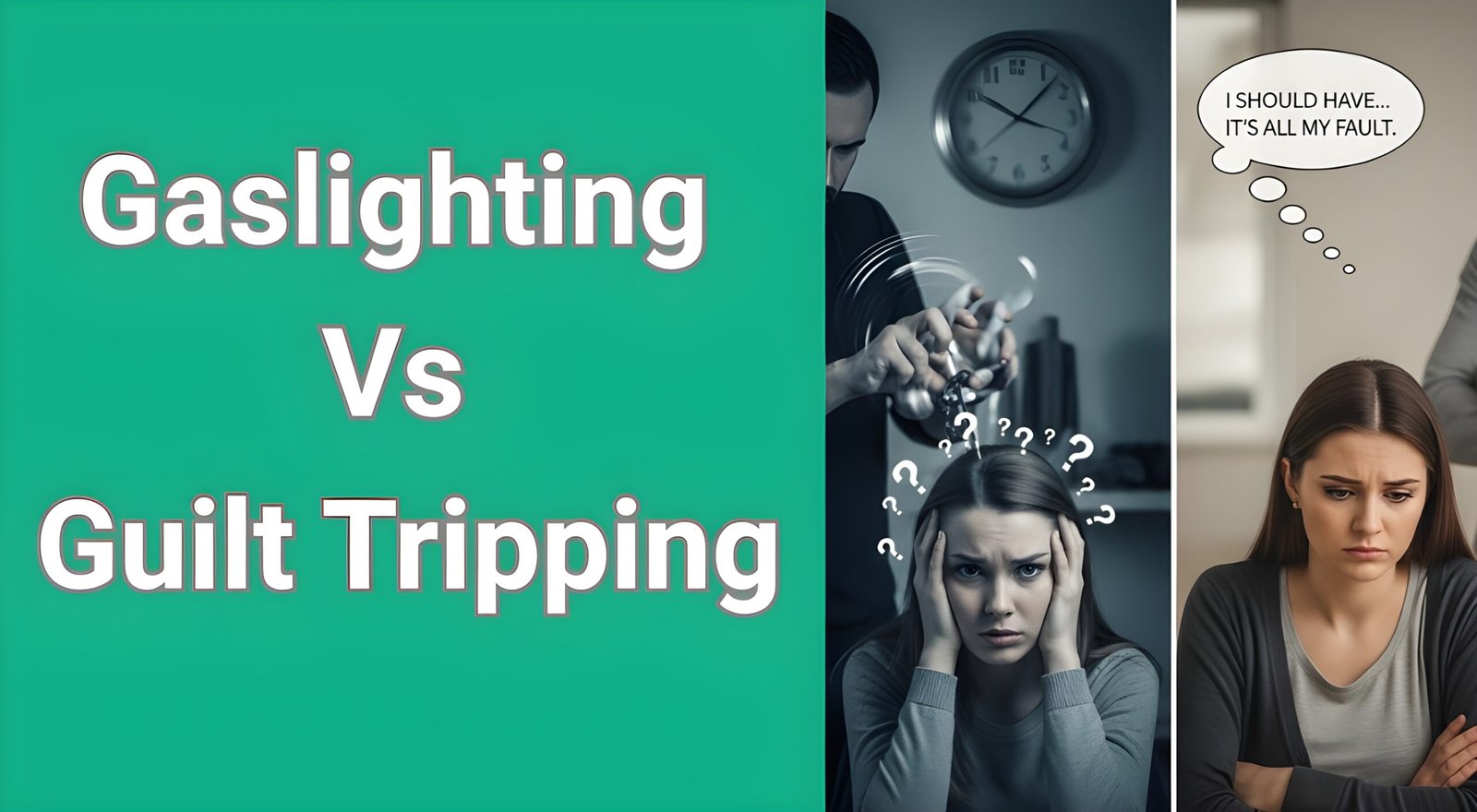
Gaslighting is also different from guilt tripping, though the two often appear together. Guilt tripping pressures you by making you feel bad, while gaslighting rewrites your reality so you cannot tell whether you should feel bad at all. Our comparison of gaslighting vs guilt tripping explains where one ends and the other begins, and why it matters for your response.
And gaslighting is not ghosting. Ghosting is disappearing without explanation, which is painful and disrespectful, but it does not rewrite your memory. Gaslighting is the opposite of disappearing. It is staying close, staying involved, and using that closeness to control what you believe. A person can ghost you and gaslight you in the same relationship, usually by disappearing, then returning with a false story about why they left, and making you doubt your memory of the whole thing. The two tactics are different, and they are both harmful, but they are not the same.
Where Does Gaslighting Happen?
Gaslighting is most often described in romantic relationships, but it happens anywhere there is a power imbalance and someone wants to keep it. The setting changes the tactics, but the pattern stays the same.
In a romantic relationship, gaslighting usually starts after the love bombing phase, when the partner has already earned your trust. They deny affairs, rewrite arguments, and tell you that your jealousy or your hurt is the real problem.
By a parent, gaslighting often starts in childhood and lasts for decades. A narcissistic parent tells a child that the abuse never happened, that the child is too sensitive, that the family was happy and the child is ungrateful for saying otherwise. Children raised this way often grow up unable to name what happened to them, because the person who hurt them also taught them how to remember it. Adult children of gaslighting parents frequently say the same thing. I knew something was wrong, but I could not prove it, even to myself.
At work, gaslighting looks like a boss who denies giving you an instruction, then blames you for not following it. A colleague who takes credit for your work, then tells you that you are imagining the whole thing. A manager who promises a promotion in private and denies it in public, then calls you paranoid for keeping notes. Workplace gaslighting is especially hard to prove, because the gaslighter usually has more power, more allies, and more control over the record. That is why documentation matters even more at work than it does at home. Keep emails, save messages, and write down what was agreed, with dates, in a place only you can access.
By a doctor or a medical professional, gaslighting is sometimes called medical gaslighting. It happens when a patient reports real symptoms and is told the symptoms are anxiety, stress, or imagination, without proper investigation. This is not the same as a doctor disagreeing with a diagnosis. It is a pattern of dismissing your experience of your own body, repeatedly, until you stop seeking help. If a doctor makes you feel foolish for describing your symptoms, get a second opinion. Your body is not a matter of opinion.
Self gaslighting is the version nobody warns you about, and it is the one that lasts longest after the gaslighter is gone. Self gaslighting means doing their work for them, after they have left. You tell yourself you overreacted. You decide your memory cannot be trusted. You minimise what happened, you excuse their behaviour, and you blame yourself for staying. This is not your fault. It is the echo of the pattern, and it fades when you start writing down what happened and checking it against outside evidence, instead of against the voice they planted in your head.
Why Do People Gaslight?
There is no single reason people gaslight, and the honest answer is that the reason matters less than the pattern. Still, understanding the motives helps you stop personalising the behaviour, and it helps you predict what will happen if you confront it.
The two motives researchers found most often are avoiding accountability and controlling the other person. Avoiding accountability means the gaslighter denies, distorts, and deflects so they never have to face what they did. This shows up most often around infidelity, money, and broken promises. Controlling the other person means dictating how they behave, who they see, what they wear, and what they are allowed to believe. Control is the deeper motive, because it makes all the other tactics possible. A person who controls your reality does not need to control your movements. You will police yourself.
Some people gaslight because they learned it at home. A child who grew up with a gaslighting parent learns that denying reality is how you win arguments, avoid punishment, and stay safe. That child may grow into an adult who gaslights without ever deciding to, because it is the only conflict style they know. This does not excuse the behaviour, and it does not mean you should tolerate it. It does mean that some gaslighters genuinely do not realise what they are doing, and that a calm, firm boundary can sometimes change the dynamic, if the person is willing to look at themselves.
Some people gaslight because of narcissistic traits. A person with a deep need for admiration and a fragile sense of self cannot tolerate being wrong, so they rewrite reality instead. A person with antisocial traits may gaslight coldly, as a tool, without any emotional discomfort at all. Personality disorders can only be diagnosed by a qualified professional after a thorough assessment, so do not diagnose the person in your life. Watch the pattern instead. The pattern is what you have to live with, whatever the label.
And some people gaslight as a defence mechanism, without thinking it through. When they feel cornered, shamed, or afraid, they lie, blame, and deny on reflex, the way some people raise their voice. The Cleveland Clinic notes that gaslighting can be a form of projection, particularly when the perpetrator is called out. They make you look to the left so you do not see what is happening on the right. That reflex does not make the harm smaller. It makes it harder to confront, because the gaslighter can honestly say they did not mean it, and mean it, while still doing it again the next day.
What Does Gaslighting Do To You?
Gaslighting does its damage slowly, and the damage is to your relationship with your own mind. The study of 65 survivors reported by Psychology Today identified three effects that showed up again and again. A diminished sense of self, with increased uncertainty. Increased guardedness, a constant watchfulness around other people. And increased mistrust of others, a difficulty believing that anyone, including yourself, is telling the truth.
Those three effects explain the symptoms survivors describe most often. Constant self doubt, and second guessing every decision, even small ones. Anxiety, especially around the gaslighter, and sometimes around everyone. Depression, as the world narrows and the things you used to enjoy stop feeling enjoyable. Confusion after every conversation, a fog that does not lift. Loss of confidence, in your memory, your judgment, and your worth. Isolation, as you pull away from friends and family, either because the gaslighter pushed you away or because you are embarrassed to explain what is happening. And a growing dependence on the gaslighter, because they are the only person whose version of events you still half trust.
Over a long period, gaslighting can leave effects that look like trauma, and in many cases they are trauma. The constant invalidation, the rewriting of your past, and the isolation all teach your nervous system the same lesson. The world is not safe, and your own senses cannot be trusted. That lesson does not disappear the day you leave. It takes deliberate work to unlearn, and that work is worth doing, because the alternative is carrying their voice in your head for years after they are gone.
Gaslighting also creates a trauma bond, the intense emotional attachment that forms through cycles of harm and kindness. The love bombing, the devaluing, the apology, and the return of warmth, that cycle bonds you to the person hurting you, and it makes leaving feel like losing the only good thing in your life. Our guide on the psychology of trauma bonding explains why that bond feels so much like love, and why breaking it takes more than a decision.
How To Respond To Gaslighting In The Moment
Responding to gaslighting in the moment is hard, because the tactic is designed to make you doubt yourself before you can answer. The goal is not to win the argument. The goal is to protect your reality, end the conversation cleanly, and get out of the fog before it deepens. These scripts work because they are short, calm, and about your actions, not their character.
Start by naming what is happening, briefly, without accusing. Say, that is not how I remember it, and I am not going to argue about my memory. Say, I know what I heard, and I am not discussing it further. Say, you are telling me my feelings are wrong, and I do not accept that. Naming the pattern out loud does two things. It breaks the spell for you, and it puts the gaslighter on notice that the tactic has been seen. The Cleveland Clinic advises calling out gaslighting behaviours as they occur, because naming them helps set boundaries and change the power dynamic.
Then stop explaining yourself. Every extra reason you give is a new opening to argue. Gaslighters feed on long explanations, because each one gives them something new to deny. Say your sentence once, calmly, and then stop. If they keep pushing, repeat the same sentence, word for word. I am not discussing this. I am not discussing this. Repetition is boring, and boring is powerful, because there is nothing new to attack.
Use short, specific replies that hold your reality. Try, I remember what was said, and I am keeping my own notes. Try, I am not going to debate what happened, I was there. Try, my feelings are not up for debate. Try, I am ending this conversation now, and I will come back to it when we can talk calmly. Each of these is a complete sentence, and each one ends the exchange instead of opening a new one. Our guide on how to respond to gaslighting gives you nine full scripts that disarm each technique, with the exact words to use when the gaslighter denies, deflects, or flips the blame.
Do not try to prove your memory in the moment. You will not win, because the gaslighter is not arguing in good faith. They are arguing to exhaust you, and the longer you stay, the foggier you get. If the conversation is escalating, leave the room. Go for a walk, call a friend, write down what happened while it is fresh. You can return to the issue later, with your notes in your hand, when you are calm. If the person becomes enraged, threatens you, or makes you feel unsafe, leave immediately and get support. Your safety comes before any conversation, and before any hope that they will listen.
One warning, from every therapist who works with this pattern. If the person gaslighting you is a narcissist who uses the tactic deliberately to control you, confronting them is usually futile. They are not interested in your perspective, and a confrontation gives them new material to use against you. In that case, the best response is not a better argument. It is distance, documentation, and a plan to protect yourself. The scripts above still help, because they let you exit the conversation with your reality intact, but do not expect them to change the person. Change is their job, and it is shown in consistent behaviour over months, not in promises made after a fight.
How To Prove It To Yourself
You do not need to prove gaslighting to the gaslighter. You need to prove it to yourself, because self doubt is the damage, and evidence is the repair. A simple documentation system does that work, and it takes five minutes a day.
Keep a private journal, on paper or in a password protected app, and write down what happened, with the date, the time, and the exact words used. Write it the same day, while the memory is fresh, and do not edit it later. Your notes are not for a courtroom. They are for the evening, three weeks from now, when the gaslighter tells you that a conversation never happened, and you open your journal and see it written in your own handwriting, with the date. That moment is worth more than any argument.
Save the evidence you already have. Screenshot messages before they can be deleted. Save emails, voicemails, and photos. Keep copies outside the home, and outside any shared account, in a place the gaslighter cannot reach. If the gaslighting happens at work, keep the same kind of record, and keep a copy outside your work devices. The point is not to build a case. The point is to have something solid to check your memory against, on the days when your memory feels like it is failing you.
Check your reality with people outside the relationship. Tell a trusted friend what happened, in plain words, and ask them what they think. Ask someone who knew you before this relationship whether you have changed, and how. Getting feedback from outside the relationship is essential, because gaslighting works by making you the only witness to your own life. One outside voice breaks that isolation. Two or three make it very hard for the false version to survive.
Finally, take the gaslighting test on this site if you want a structured check. A short quiz cannot diagnose abuse, and no quiz can replace a professional, but answering clear questions about the pattern can help you see it whole, instead of as a series of small incidents that each look harmless on their own.
How To Rebuild Trust In Your Own Mind
Recovery from gaslighting is possible, and the research backs that up. In the study reported by Psychology Today, most victims recovered relatively quickly after separating from the gaslighter, and the recovery was faster for people who spent time with others and rebuilt a connection with their own body and their own life. The damage was real, but it was not permanent, and the people who healed did specific things that you can do too.
First, name it plainly. Calling it drama, or a difficult personality, or a misunderstanding, keeps the wound hidden even from yourself. Naming it as gaslighting, as a pattern of manipulation that targeted your trust in your own mind, lets you see clearly enough to choose differently. The name is not a weapon. It is a lens.
Second, rebuild your reality checking as a daily practice. Keep the journal going, even after you leave, and read it back when doubt creeps in. Write down three things you know are true each morning, small things, what you ate, what you did, what you felt. Talk to people who knew you before the relationship, and ask them what they noticed. Your memory was attacked systematically, and rebuilding trust in it takes deliberate practice, not just time.
Third, rebuild your circle slowly, and choose calm over familiar. The familiar feeling, intensity, drama, and urgency, is often the very thing that drew you to the gaslighter in the first place. Calm can feel boring at first. Calm is what safety feels like, and it is worth learning to recognise. Spend time with people who believe you without needing a court case of evidence, and notice how different that feels in your body.
Fourth, work with a therapist who understands emotional abuse and narcissistic patterns. A good therapist does not just listen. They help you sort what is real from what was planted, they help you practise boundaries, and they help you rebuild trust in your own judgment. If the gaslighting happened in a family or a workplace you cannot leave yet, a therapist can help you build a protection plan for staying, with clear limits and a clear exit route.
Fifth, expect grief that does not make sense to other people. You may grieve a partner, a parent, or a job that never actually existed in the form you believed in, because the person you trusted was performing, or because the version of them you loved only existed in brief, intense bursts. That grief is real, and it deserves the same respect as any other loss. You are not grieving the gaslighter. You are grieving the person you thought they were, and the years you spent doubting yourself for them.
Myths vs Facts About Gaslighting
The word has become so popular that the myths around it are now almost as harmful as the tactic itself. Here are the ones that keep people trapped, and the facts that set them free.
Myth, gaslighting is just lying. Fact, lying is saying something false. Gaslighting is a repeated pattern that targets your trust in your own perception, and it leaves you dependent on the gaslighter to define reality. A lie is about one event. Gaslighting is about your mind.
Myth, gaslighting only happens in romantic relationships. Fact, it happens in families, at work, in medical settings, in friendships, and in politics. Anywhere there is a power imbalance and someone wants to keep it, gaslighting can appear.
Myth, if you are smart, you cannot be gaslit. Fact, intelligence does not protect you. Gaslighting targets trust, not intellect, and it works best on people who are thoughtful, self reflective, and willing to consider that they might be wrong. Those are strengths, not weaknesses, and the gaslighter exploits them.
Myth, gaslighters always know they are doing it. Fact, some gaslight deliberately, and some learned the tactic so young that it feels like normal communication to them. The effect on you is the same either way, and your response should be based on the pattern, not on their intentions.
Myth, one incident counts as gaslighting. Fact, gaslighting is a pattern, repeated over time. One denial, one minimised feeling, or one forgotten promise is not gaslighting on its own. It becomes gaslighting when it repeats, when it always moves in the same direction, and when it leaves you doubting yourself.
Myth, you can spot a gaslighter by their eyes, or by one tell. Fact, there is no reliable look, no single phrase, and no quick test. Patterns of behaviour over time are what matter, not a stare, and not a single conversation.
Myth, confronting a gaslighter will make them stop. Fact, a calm boundary can change the dynamic with someone who gaslights without realising it. With a deliberate gaslighter, confrontation usually gives them new material, and the only reliable protection is distance, documentation, and support.
Myth, if you leave, the damage is done forever. Fact, most survivors recover, and many say they came out with a clearer sense of who they are and what they will never accept again. Recovery takes work, and it takes time, but it is absolutely possible, and it starts with the simple act of trusting your own notes over their version of events.
You do not need them to admit anything, apologise, or change before your life gets better. If you want exact words for the next hard conversation, a plan to protect your peace while you are still in contact, and a steady way to document what is happening, the Survival Workbook gives you all three, so one more calm denial does not become one more year of doubting yourself.
Frequently Asked Questions
What is gaslighting in simple terms?
Gaslighting, in simple terms, is when someone makes you doubt your own reality on purpose, again and again, until you stop trusting yourself. They deny things they said, rewrite things that happened, and tell you that your feelings are wrong, too much, or imagined. It is a pattern of psychological manipulation, not a single lie or a single bad argument.
What is gaslighting and why is it called that?
Gaslighting is named after the 1938 play Gas Light by Patrick Hamilton, in which a husband dims the gas lamps in the house and then denies that the lights changed, to make his wife believe she is losing her mind. The play was made into films in 1940 and 1944, and the title became the word for the tactic. The name stuck because the story captures the method exactly, denying what you can see with your own eyes.
What is gaslighting in a relationship?
Gaslighting in a relationship is a pattern in which one partner repeatedly denies, distorts, or dismisses the other partner’s reality, until the partner doubts their memory, their feelings, and their judgment. It usually starts after an intense, loving phase, and it is often combined with isolation, so the gaslit partner has nobody else to check reality with. It is a form of emotional abuse, and it is one of the most common tactics used by narcissistic partners.
What is gaslighting and what is an example?
A clear example of gaslighting is a partner who promises to pick up the children, forgets, and then says you never asked them to, that you are imagining the conversation, and that your memory has always been unreliable. Another example is a parent who hits a child and later says it never happened, that the child is making it up, and that the child is too sensitive. The key is not the single event. It is the denial, repeated over time, until you doubt your own memory.
What is gaslighting and what is not?
Gaslighting is a repeated pattern of denying and distorting your reality to control you and make you doubt yourself. It is not a normal disagreement, where both people remember differently and are willing to check the facts. It is not a single lie, a bad memory, a difference of opinion, or a heated argument. The difference is repetition, the target being your perception itself, and the self doubt it creates over time.
How does gaslighting work?
Gaslighting works in stages. First comes trust building, often through love bombing, which makes you treat the gaslighter as a reliable source of truth. Then comes doubt planting, small denials that teach you your memory and feelings cannot be trusted. Then comes isolation, cutting you off from people who could check your reality. Finally comes dependency, where you check with the gaslighter before you trust yourself. Each stage on its own looks small, and together they replace your version of events with theirs.
What does gaslighting look like?
Gaslighting looks like a partner who calmly denies things you both know happened, a parent who rewrites your childhood, or a boss who denies giving you an instruction and then blames you for not following it. From the outside, it often looks like nothing at all, because it is delivered calmly and in private. From the inside, it looks like constant confusion, apologising for things you are not sure you did, and checking your memory before you speak.
What does gaslighting yourself mean?
Gaslighting yourself means doing the gaslighter’s work for them after they are gone. You tell yourself you overreacted, you decide your memory cannot be trusted, you minimise what happened, and you blame yourself for staying. It is the echo of the pattern, not a character flaw, and it fades when you start writing down what happened and checking it against outside evidence, instead of against the voice they planted in your head.
What is gaslighting in the workplace?
Gaslighting in the workplace is when a boss or colleague repeatedly denies facts, rewrites agreements, or dismisses your experience, until you doubt your own competence and memory at work. Common examples are a manager who denies giving you an instruction and then blames you for not following it, or a colleague who takes credit for your work and tells you that you are imagining the whole thing. Documentation matters even more at work, so keep emails, save messages, and write down what was agreed, with dates.
What is gaslighting and how do you respond?
Respond to gaslighting by naming it briefly, then stopping the argument. Say, that is not how I remember it, and I am not going to argue about my memory. Say it once, calmly, and do not explain yourself further, because every extra reason is a new opening to argue. Write down what happened with the date and the exact words, check your reality with people outside the relationship, and leave the conversation if it escalates. If the person is deliberately gaslighting you to control you, the best response is distance and a protection plan, not a better argument.
Why is gaslighting so harmful?
Gaslighting is so harmful because it attacks your trust in your own mind, which is the tool you need to recognise the abuse and leave it. Over time, it causes constant self doubt, anxiety, depression, confusion, loss of confidence, isolation, and dependence on the person hurting you. Unlike a single insult or a single lie, which you can name and move past, gaslighting makes you doubt whether the harm happened at all, and that doubt keeps you trapped far longer than the individual incidents would on their own.
What is the difference between gaslighting and ghosting?
Ghosting is disappearing from a relationship without explanation, which is painful and disrespectful, but it does not rewrite your memory. Gaslighting is staying close and using that closeness to control what you believe, by denying events, distorting facts, and dismissing your feelings until you doubt your own perception. A person can do both in the same relationship, usually by disappearing and then returning with a false story about why they left, but the two tactics are different, and they cause different kinds of harm.