
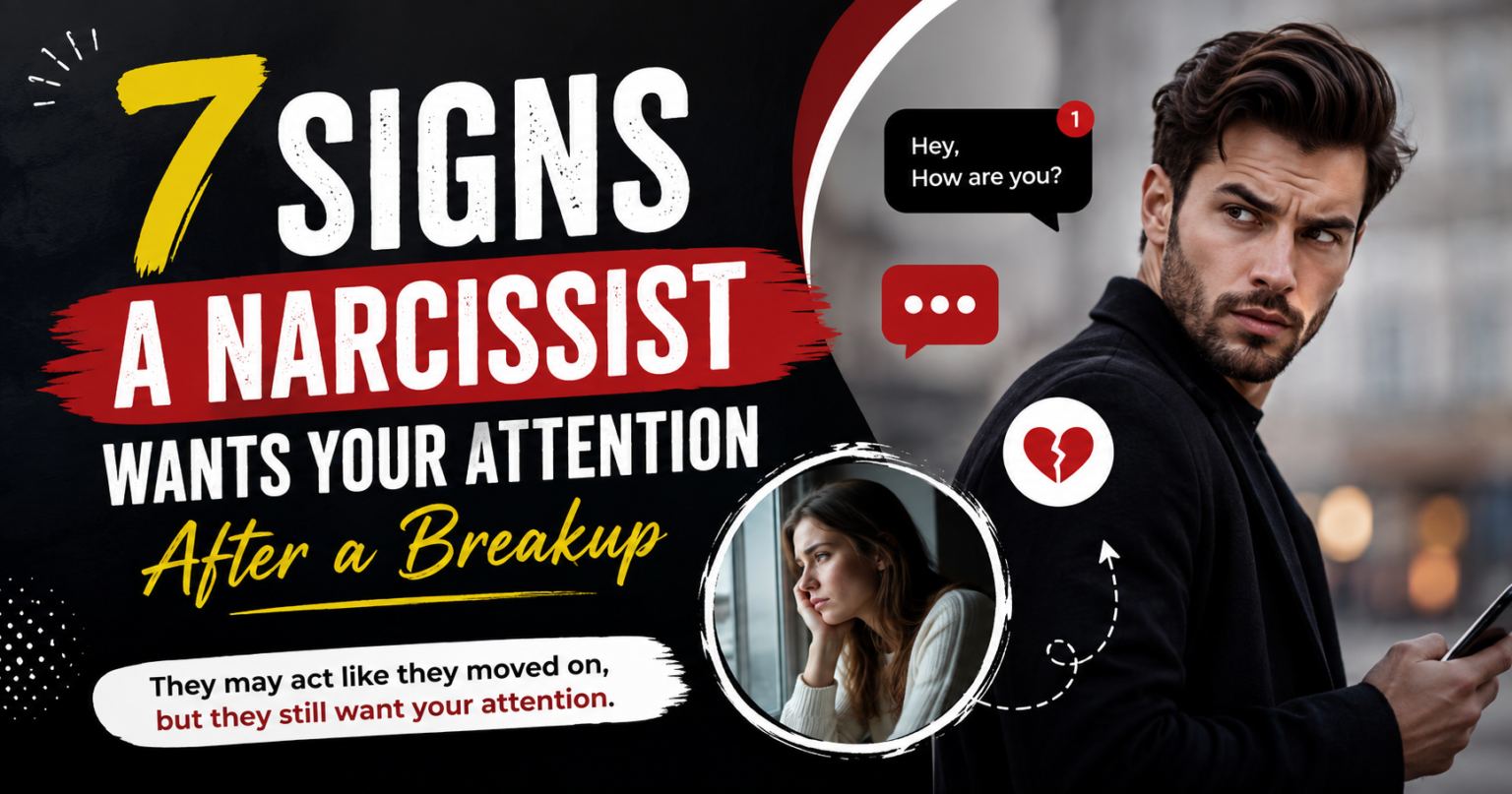
Your ex hasn’t been in touch for weeks — and then, out of nowhere, a message appears. “Hey, was just thinking about you.” Your stomach flips. Does this mean they’ve changed? That they miss you? Learning to read the signs a narcissist wants your attention after a breakup is how you answer that question without falling back into the same trap. Here’s the truth most survivors need to hear: when a narcissist resurfaces, it’s rarely about love and almost always about attention, control, or a bruised ego.
- 1. They Suddenly Reappear Out of Nowhere
- 2. They Love-Bomb You With Nostalgia and Promises to Change
- 3. They Manufacture a Crisis to Pull You Back In
- 4. They’re Suddenly All Over Your Social Media
- 5. They Send “Flying Monkeys” to Check On You
- 6. They Try to Make You Jealous
- 7. They Pick Fights or Provoke You
- Frequently Asked Questions
- Conclusion
That craving even has a name — narcissistic supply — and their reappearance is often a tactic called hoovering. If you’ve been staring at your phone wondering whether their behaviour is genuine or just another mind game, you are not overthinking it, and you are not alone.
This guide walks through seven clear signs that your narcissistic ex is angling for your attention, explains what’s really driving each one, and shows you exactly what to do instead of reacting. By the end, you’ll be able to see the pattern clearly — and protect the peace you’ve fought for.
1. They Suddenly Reappear Out of Nowhere
One of the clearest signs a narcissist wants your attention is the reappearance that comes just as you’re finding your footing. Weeks of silence, and then — a text, a call, a “just checking in.” It rarely feels random to you, and it isn’t random to them. This is hoovering: reaching back to vacuum you into their orbit right when they sense you slipping away.
The message is usually low-stakes and deniable on purpose: “Saw something that reminded me of you.” “Happy birthday, hope you’re well.” “Can I get my charger back?” Small enough that ignoring it feels dramatic, warm enough to reopen the door.
Why it happens: narcissists need a steady stream of attention — narcissistic supply — and when a fresher source runs dry or they simply get bored, an old partner is an easy refill. Your reaction, any reaction, confirms they still have access to you.
What to do instead: treat the timing as information, not temptation. A reappearance after silence is a pattern, not a change of heart. Don’t reply to “test” the waters; even a one-word answer resets their access. If you feel the pull, screenshot the message, name it out loud (“this is hoovering”), and tell a trusted friend instead of responding.
Recognising the reappearance for what it is takes away its power. You’re not cold for staying silent — you’re finally reading the script correctly.
2. They Love-Bomb You With Nostalgia and Promises to Change
When a simple “hi” doesn’t reel you in, the intensity climbs — and sudden, sweeping affection is a major sign a narcissist wants your attention. This is love bombing in reverse: the flood of warmth, nostalgia, and grand promises they once used to win you, now redeployed to win you back.
It sounds like “I’ve been in therapy, I finally understand what I did.” “No one gets me like you do.” “Remember our trip? I’ve never felt that way since.” Sometimes it arrives as gifts, long heartfelt letters, or tearful late-night calls.
Here’s the mechanism that makes it so hard to resist: intermittent reinforcement. Because their affection was always unpredictable, the occasional burst of tenderness hits like a jackpot — and your nervous system, still trauma-bonded, lights up with hope. The promises feel real because you desperately want them to be.
What to do instead: measure words against a track record, not against how the message makes you feel. Real change is quiet, consistent, and doesn’t require your return to prove itself. Ask yourself: has anything actually changed, or has the charm simply switched back on? Write down the reasons you left and keep them somewhere you’ll see them when the nostalgia hits.
The version of them promising the world is the same version who broke it. Hope is not evidence — and you deserve more than a rerun.
3. They Manufacture a Crisis to Pull You Back In
If charm fails, drama often follows — and a sudden emergency aimed squarely at you is a telling sign a narcissist wants your attention. When warmth doesn’t work, a crisis almost always does, because it weaponises your empathy against your boundaries.
The emergencies are conveniently urgent and conveniently involve you: “I’m in the hospital.” “I’m not okay, I don’t know who else to call.” “Something happened to the dog.” Sometimes it’s a vague, alarming message designed to make you break no contact out of fear.
Why it works: you’re a caring person, and narcissists know it. A crisis reframes your silence as cruelty and makes responding feel like the only decent choice. Even if the emergency is partly real, the purpose of telling you is to re-establish contact and pull you back into a caretaking role you already left.
What to do instead: care about them from a distance without becoming the responder. If you genuinely fear for their safety, contact a mutual friend, a family member, or emergency services — anyone but you. That keeps your compassion intact while protecting your boundary. You are allowed to be a kind person who is no longer their person.
Your empathy is a strength, not a leash. Letting someone else answer the call is not heartless — it’s healthy.
Their Comeback Is A Test, Pass It
4. They’re Suddenly All Over Your Social Media
Attention doesn’t always arrive as a message — sometimes it’s a footprint. A narcissist quietly reappearing across your online life is a subtle but common sign they want back on your radar. Viewing every story, liking a photo from three years ago, re-following after unfollowing: it’s designed to be noticed.
You might see them watch every single story within minutes, resurface an old post, add you back on an account you thought they’d left, or start engaging with your friends’ content. It’s breadcrumbing — just enough presence to stay in your thoughts without saying a word.
Why they do it: it keeps a foot in the door while risking nothing. There’s no message to answer, no rejection to absorb — just a nudge to make sure you’re still thinking about them. And often, they’re monitoring you too, checking whether you seem happy, sad, or single.
What to do instead: remove the stage. Block or restrict them everywhere, including secondary accounts, so there’s nothing to perform for and nothing to monitor. If blocking isn’t possible, make your accounts private and stop treating a “view” as a message worth decoding. Their digital hovering only means something if you let it.
You don’t owe an audience to someone who left. Curating your online peace is part of protecting the real thing.
5. They Send “Flying Monkeys” to Check On You
When you’ve gone quiet and blocked the direct routes, a narcissist often recruits go-betweens — and hearing from their friends or family “just to check in” is a clear sign they want your attention. These messengers are known as flying monkeys, and they carry information in both directions.
A mutual friend suddenly asks how you’re really doing. Their sibling mentions your ex “misses you.” Someone casually drops that your ex is “a mess” or, alternatively, “doing amazing.” The relay is rarely accidental.
Why it works: it lets your ex reach you without technically breaking your boundary, and it gathers intelligence on your emotional state. It also plays on your relationships, making you feel watched and subtly pressured to respond “to be polite.”
What to do instead: be warm to the person, firm about the message. You can say kindly, “I’d rather not talk about my ex — let’s catch up on you.” You don’t have to relay anything back, defend yourself, or send a message through them. Some flying monkeys are innocent; either way, you close the channel gently and completely.
You get to decide what information reaches your ex — and the answer can simply be nothing. Protecting that silence isn’t rude; it’s boundaries in action.
6. They Try to Make You Jealous
Not all bids for attention look like affection — some look like a performance aimed straight at you. Flaunting a new relationship, a glamorous life, or sudden happiness is a classic sign a narcissist wants your attention, specifically the jealous, wounded kind.
Why Their Attention Still Feels Good
You’ll notice it in loud, oddly-timed displays: a new partner paraded across social media days after the breakup, staged “I’ve never been happier” posts, or ensuring you hear how quickly they’ve “moved on.” This is triangulation — pulling a third person in to provoke a reaction from you.
Why it happens: a narcissist can’t easily tolerate the idea that you’re unaffected, so they engineer proof that they’re fine and you should be jealous. Ironically, the effort to make you feel replaced usually reveals how much your attention still matters to them. A truly indifferent person doesn’t perform indifference this hard.
What to do instead: read the performance as evidence, not injury. The louder the display, the more it’s aimed at you — which means it’s about their needs, not your worth. Mute or block so you’re not the audience. And remind yourself: a fast replacement isn’t love found, it’s the same cycle starting over with someone new.
You are not replaceable, and their highlight reel isn’t reality. Their need to be seen is not a measure of your value.
7. They Pick Fights or Provoke You
Finally, remember that attention doesn’t have to be positive to satisfy a narcissist — and sudden hostility can be as much a bid for your attention as a love letter. Provocative, cruel, or accusatory messages are a sign they’d rather have your anger than your absence.
It shows up as picking a fight over something trivial, sending a nasty message to bait a defence, dredging up an old argument, or accusing you of things to force a reply. Any response — even a furious one — reopens the connection.
Why it works: to a narcissist, your indifference is the real threat, not your anger. A screaming match still proves they can move you. Provocation also flips the script, casting you as the “crazy” or “aggressive” one — a familiar gaslighting move that can make you doubt your own calm.
What to do instead: refuse to hand over the reaction. Don’t defend, explain, or set the record straight — that’s the supply they’re fishing for. If contact is truly unavoidable (co-parenting, logistics), use gray rock: brief, flat, factual, emotionless. Otherwise, silence is your strongest answer.
The moment you stop reacting, you take away the only thing they were really after. Your calm isn’t just self-protection — it’s the clearest sign that you’re finally free.
Frequently Asked Questions
Delayed contact is usually hoovering. When a newer source of attention fades or they get bored, an ex becomes an easy refill for narcissistic supply. The timing often lines up with you seeming happier or more distant — a signal they’re losing access, not rediscovering love.
They may miss what you provided — admiration, support, stability — more than they miss you as a person. That craving for supply can look like longing, but it isn’t the empathic, whole-person missing you deserve. Their reaching out is about their needs, not genuine connection.
Hoovering is when a narcissist tries to “vacuum” you back after a breakup. Recognise it by the pattern: sudden warmth, nostalgia, apologies, manufactured crises, or provocation that appears right when you’re pulling away. If a message is designed to get a reaction, it’s likely hoovering.
It’s low-risk attention. Viewing stories, liking old posts, or re-following keeps a foot in the door without a message to answer, while letting them monitor your mood. Blocking or going private removes both the audience they want and the surveillance they’re doing.
Hoovering Or Genuine Change? Know For Sure
Conclusion
Once you can name the signs a narcissist wants your attention after a breakup, they lose their grip on you. The sudden reappearance, the love-bombing promises, the manufactured crisis, the social-media hovering, the flying monkeys, the jealousy games, the provoked fights — every one is a bid for supply, not proof of love or change.
Seeing the pattern is what turns confusion into clarity and hope into healthy caution. What you’re feeling — the flicker of “maybe this time” — is the trauma bond, not a truth to act on. You are not overreacting, and you are not alone. Each bid you don’t answer weakens the pull and strengthens your peace. Keep choosing no contact, keep trusting what you’ve learned, and be as protective of your calm as you are compassionate toward others. If you’re deciding whether to respond right now, take that as your sign to pause — and reach out to a safe person instead.