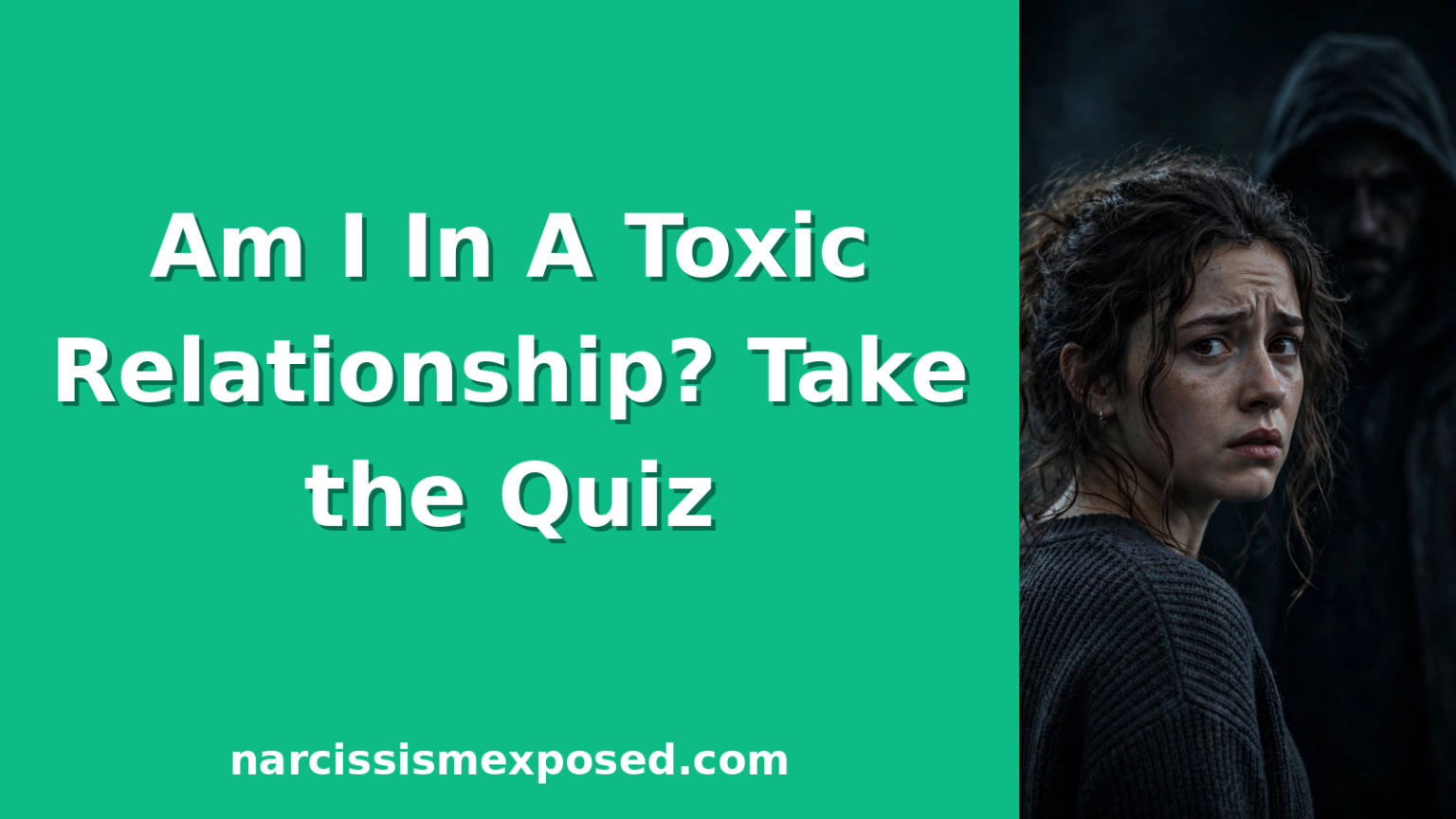
If you have found yourself typing am i in a toxic relationship quiz into a search bar late at night, you are not looking for a label to stick on your partner. You are looking for clarity about a feeling you cannot shake: that something in your relationship is slowly costing you your peace, your confidence, and your sense of self. That instinct deserves to be taken seriously.
Take the "Am I in a Toxic Relationship? Quiz" quiz below
This page contains an honest, educational am i in a toxic relationship quiz: ten questions about observable patterns in your relationship, answered on a frequency scale, scored out of 30. It takes about three minutes. It is not a medical diagnosis, and no online quiz can replace a conversation with a qualified mental health professional. What it can do is help you see the pattern clearly, which is often the hardest part when you are living inside it.
Read the short guide below first. It explains what the quiz measures, how toxic differs from merely difficult, the ten signs to check in yourself, and what your score means. Then take the quiz, and afterwards come back for practical next steps matched to your result.
What This Quiz Measures
The quiz is built around ten observable patterns of relationship toxicity. These are not vague feelings or one-off bad days. They are repeating behaviours: feeling worse after interacting with your partner instead of supported, criticism and belittling, walking on eggshells, control over your decisions or friendships, fear of expressing honest feelings, arguments that cycle without ever resolving, a one-sided pattern of giving, apologies that never lead to change, isolation from the people who love you, and a growing sense that you have lost yourself.
Each question uses the same frequency scale: Never (0), Rarely (1), Sometimes (2), or Often (3). Your answers add up to a score out of 30, and that score falls into one of three bands: 0 to 10 suggests a mostly healthy dynamic, 11 to 20 suggests toxic patterns are present and worth addressing, and 21 to 30 suggests a deeply toxic relationship that is actively harming you. The frequency scale matters because toxicity lives in repetition. Almost every couple has a bad week. Toxicity is what happens when the bad week never really ends.
Toxic vs Difficult: The Real Difference
Every relationship goes through hard seasons. Illness, money stress, grief, a new baby, job loss: any of these can make even a loving partnership tense and fragile for a while. Difficult is normal. Difficult is two people struggling against a shared problem. What makes a relationship toxic is not the presence of difficulty but the absence of resolution. In a toxic dynamic, the same argument repeats on a loop, the same promises are made and broken, and your best efforts to communicate never seem to move anything forward.
A second difference is direction. In a difficult relationship, you may feel tired but you still feel like yourself. In a toxic one, you gradually erode. Researchers and clinicians describe this slow loss of identity, confidence, and autonomy that develops under sustained emotional pressure, and many survivors describe it as the most painful part of all. You stop trusting your own judgement. You shrink your world to avoid conflict. You forget what you wanted before the relationship taught you to want only peace.
A third difference is how your concerns are handled. In a difficult but healthy relationship, naming a problem leads, eventually, to repair. In a toxic dynamic, naming a problem leads to denial, deflection, or gaslighting, where you end up apologising for having raised the issue at all. If you recognise that pattern, the quiz below will help you measure it honestly.
Finally, trust the cumulative picture rather than any single incident. One cruel comment during a stressful week does not define a relationship. But a pattern of cruelty followed by apology followed by no change, repeated for months or years, is data. The ten signs below give you a framework for reading that data clearly instead of dismissing it.
10 Signs of a Toxic Relationship to Check
Read each sign and notice, honestly, how often it shows up in your relationship.
- You consistently feel worse after interacting with your partner, instead of supported.
- Your partner criticises or belittles you, even about small things.
- You walk on eggshells, constantly managing their mood to avoid a reaction.
- Your partner tries to control your decisions, your plans, or your friendships.
- You are afraid to express your feelings or opinions honestly.
- Your arguments repeat the same cycle without ever truly resolving.
- The giving is one-sided: you pour in effort while your partner mainly takes.
- Your partner apologises but never actually changes the behaviour.
- You feel isolated from friends or family because of the relationship.
- You feel you have lost yourself, your confidence, or your sense of who you are.
A Note Before You Start
Answer each question based on the real, overall pattern of your relationship, not on the good days alone. Almost every troubled relationship has good days, even good weeks, and those memories are real. But clarity comes from the average, not the exception. If the good days are the islands and the bad days are the ocean, answer for the ocean.
There are no trick questions and no judgement in your score. The quiz is a mirror, not a verdict. Its only job is to show you what is actually happening so you can decide, with a clear head, what you want to do about it.
Take the Quiz
Ten questions, about three minutes. Answer honestly on the frequency scale, and your score out of 30 will be calculated automatically with a full explanation of your band.
Am I in a Toxic Relationship? Quiz
Answer honestly. There are no right or wrong answers.
Start by entering your details. Your result is personalised for you.
Your details stay private. We never share your information.
Interpreting Your Results: What Your Score Means
Your score is a number out of 30, and it sits in one of three bands. Think of the score as a measure of how frequent and entrenched the toxic patterns are, not as a grade you passed or failed.
A score of 0 to 10 suggests a mostly healthy dynamic. Your relationship has friction, as all relationships do, but the core patterns are supportive. You feel like yourself, conflict gets resolved, and apologies lead to real change. If you scored here, the quiz has still done something useful: it has given you a baseline, so you can notice early if things ever shift.
A score of 11 to 20 suggests toxic patterns are present. Some of the ten signs are showing up regularly enough to affect your wellbeing. This is the band where many people land when they first take the quiz, and it is also the band where change is most possible: the patterns are established but not yet total. What matters now is whether the pattern is moving toward repair or toward escalation. Pay close attention to whether your partner responds to concerns with genuine effort or with deflection. Many people find it helpful to learn how toxic relationships quietly erode the self so they can spot the early signs in their own daily life.
A score of 21 to 30 suggests a deeply toxic relationship. The patterns are frequent and wide-ranging, and they are actively costing you your confidence, your relationships outside the partnership, and your sense of who you are. This does not mean you are broken or that the situation is your fault. It means the dynamic itself is harming you and that you deserve support. If you scored here, please read the next section carefully, and consider that the strongest step you can take is not another attempt to fix the relationship alone, but getting an outside perspective from someone who understands these dynamics. You may also recognise a deeper attachment pattern: many people in this band discover the difference between love and a trauma bond, which keeps you bonded to the very dynamic that hurts you.
What to Do With Your Result
Whatever band you landed in, the most important question is not your score but your direction: is the pattern changing or repeating? Scores in the 11 to 20 range sometimes improve when both partners commit to honest communication, couples counselling, and real accountability. But improvement requires evidence, not promises. Watch for sustained behaviour change over weeks and months, not a good weekend after a bad fight.
Start with boundaries. A boundary is not an ultimatum or a punishment; it is a clear statement of what you will and will not accept, plus what you will do if it happens again. For example: if you are shouted at, you will calmly leave the room and return when the conversation can be respectful. Notice what happens when you hold the line. A partner who respects you will struggle with it but adapt. A partner entrenched in toxic patterns will escalate, guilt-trip, or punish you for having the boundary at all. That reaction is data too.
Get support outside the relationship. Isolation is one of toxicity’s most powerful tools, and reconnecting with friends, family, or a therapist breaks its grip. You do not have to announce that you are questioning the relationship. You can simply start talking honestly to one trusted person, or to a counsellor experienced in emotional abuse dynamics. If your body has been carrying the stress for a long time, learning about the link between trauma bonds and the nervous system can help you understand why leaving, or even imagining leaving, feels so physically difficult.
Finally, get clarity from someone who maps these dynamics for a living. If you want a personalised breakdown of your exact situation, what the patterns mean, and a practical plan for your next steps, the Narcissistic Abuse Clarity Report gives you a detailed written analysis of your relationship dynamics plus three recovery workbooks. Many people describe the moment of reading their report as the first time they felt truly seen and understood about what they were going through.
Frequently Asked Questions
Can a relationship be toxic even if my partner is not a narcissist?
Yes. Toxicity describes a pattern of behaviour, not a diagnosis. A relationship can be toxic because of poor communication, unresolved trauma, addiction, chronic disrespect, or many other causes, without either partner meeting the criteria for narcissistic personality disorder. If you want to understand what clinical narcissism actually involves, read this plain-language guide to what a narcissist is, but do not feel you need that label for your experience to be valid.
Does a high score mean I should leave my partner?
No quiz can make that decision for you, and this one does not try to. A high score means the patterns in your relationship are seriously harming you and deserve urgent attention, whether that means couples work, individual therapy, a trial separation, or leaving. The right next step depends on your safety, your circumstances, and what happens when you set boundaries. If you ever feel unsafe, contact a domestic abuse helpline in your country immediately.
What if my partner had a difficult childhood? Does that excuse the behaviour?
Understanding why someone behaves badly can build compassion, but it does not make the behaviour acceptable, and it does not obligate you to endure it. Many people with painful pasts choose to work on themselves and treat their partners well. An explanation is not an excuse, and your wellbeing matters regardless of what shaped your partner.
Can a toxic relationship ever become healthy?
Sometimes, when both partners genuinely acknowledge the patterns, take responsibility, and commit to sustained change, often with professional help. The key word is both. One person cannot repair a two-person dynamic alone, and real change is measured in consistent behaviour over time, not in tearful promises after a crisis. If the same cycle keeps repeating despite your best efforts, that is important information.
I scored in the middle band and now I feel confused. What should I do?
Confusion is a completely normal response, and it is actually a sign that the quiz did its job: it surfaced something you had been minimising. Sit with the result for a few days. Journal about which questions you answered Sometimes or Often. Talk to one trusted person or a counsellor. And notice what happens inside you when you imagine nothing changing for another year. Your honest answer to that question often tells you what you need to know.