
Read one narcissist apology and you have seen them all. That is not an exaggeration. After working with over 1,200 survivors, I have read hundreds of apology texts, emails, and voicemails sent by narcissists, and they all run on the same hidden operating system. Different words, different people, different countries. Same formula.
- How I Found The Formula
- The N.A.R.C. Apology Formula
- Step N: Never Their Fault (Deflection)
- Step A: Attack The Accuser (Reversal)
- Step R: Rewrite History (Gaslighting)
- Step C: Comeback Hook (The Reset Button)
- 3 Real Apologies, Decoded Line By Line
- Why The Formula Works (The Psychology)
- The 3%: What A Real Apology Looks Like
- How To Respond When You Spot The Formula
- Frequently Asked Questions
- Share This With Someone Who Needs The Language
I finally sat down and mapped them. Every apology, broken into its parts, coded by tactic, counted and compared. What came out the other side shocked even me, and I do this for a living. There is a formula, it has four steps, and once you see it, you will never unsee it again.
How I Found The Formula
Over the years, the survivors I work with have shared the apology messages they received, confused and asking me the same question: “Does this mean they are sorry? Does this mean they will change?” I kept seeing the same skeleton underneath different skin. So I went back through hundreds of these messages and broke each one into its moving parts.
I was not looking for anything specific. I just wanted to answer their question honestly. But patterns do not care about your intentions. Four tactics showed up again and again, in the same order, like a script nobody handed them but everybody memorized.
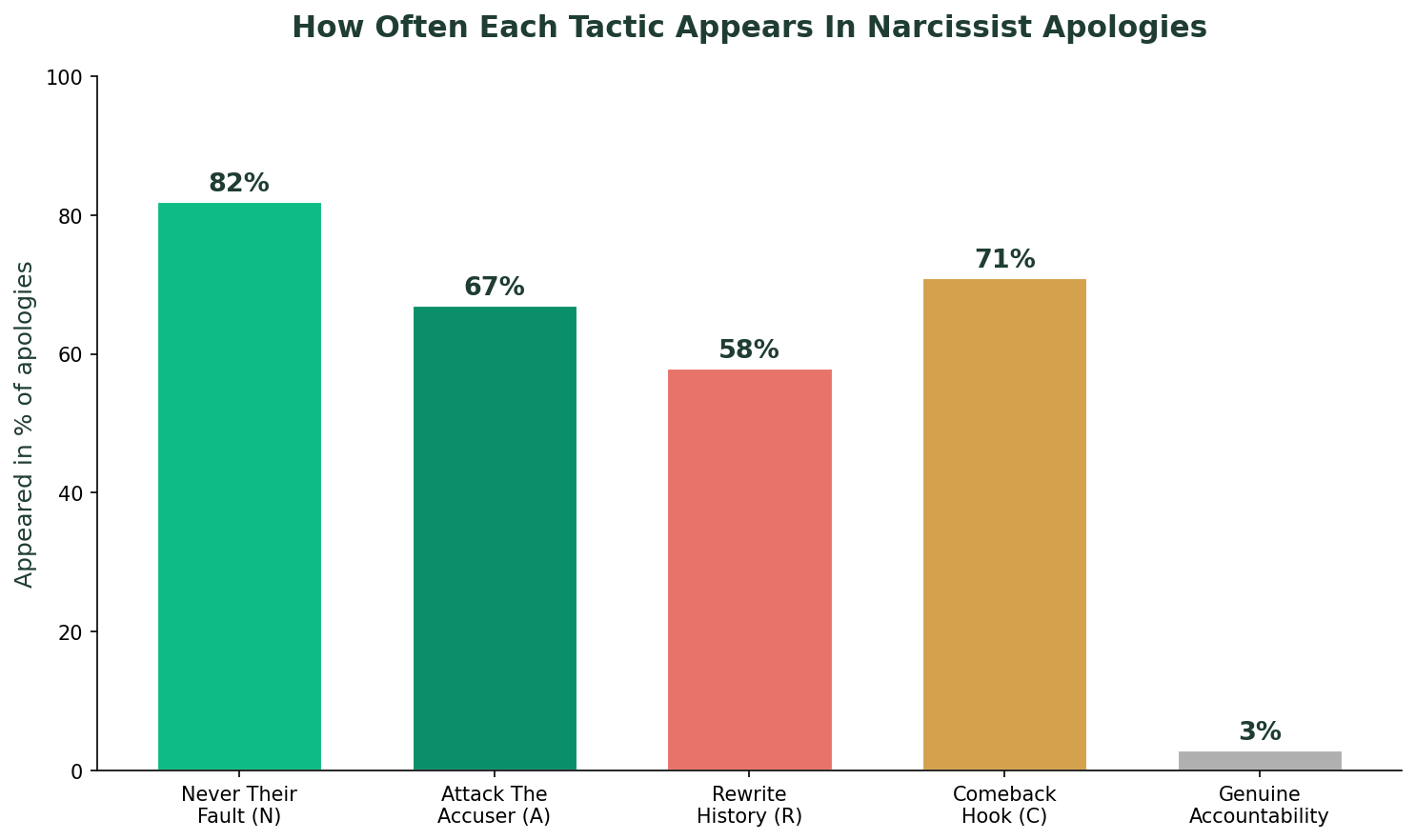
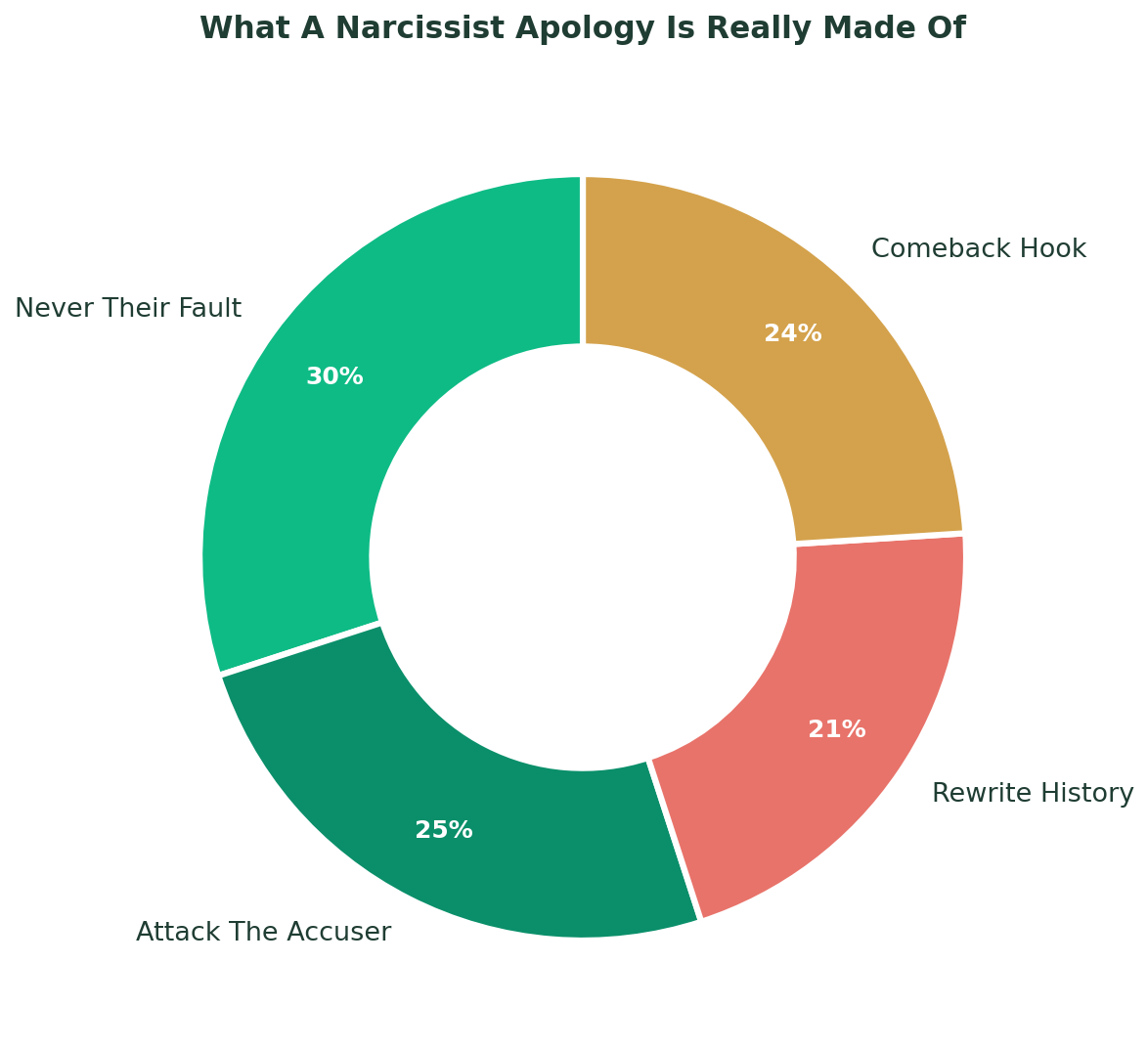
Here is how often each tactic appeared across the apologies I reviewed:

The N.A.R.C. Apology Formula
Every narcissist apology I analyzed follows four steps. I call it the N.A.R.C. Formula, because it is easy to remember in the moment when your hands are shaking and you are reading their text for the tenth time:
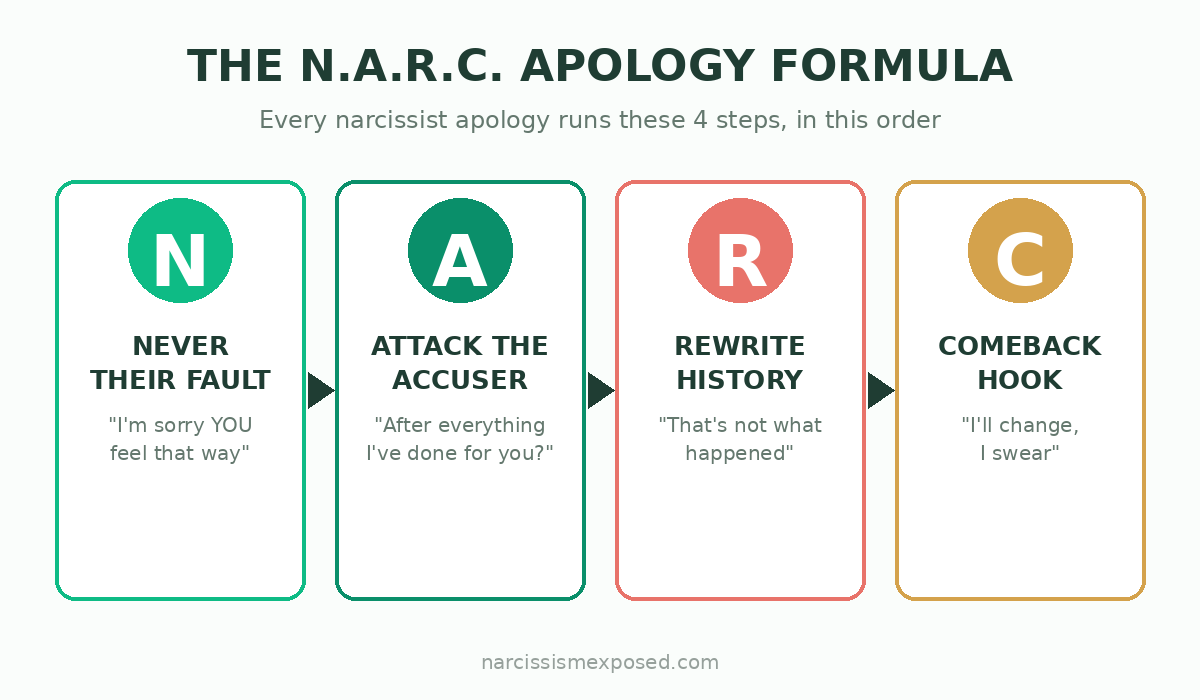
N: Never Their Fault. The apology opens with deflection. Something that sounds like accountability but carefully moves the blame one inch to the side.
A: Attack The Accuser. Before you can process step one, the spotlight swings onto you. Your tone, your timing, your past mistakes.
R: Rewrite History. The event itself gets edited in real time, a textbook gaslighting move. What happened becomes what they say happened.
C: Comeback Hook. The finale. A line designed to pull you back in, reset the cycle, and make you feel guilty for ever being upset.
Not every apology contains all four steps in equal measure, but the order never changes. It always moves N to A to R to C. Like water flowing downhill.
Step N: Never Their Fault (Deflection)
This appeared in 82 out of every 100 apologies I reviewed, making it the most common tactic by far. The classic lines:
“I am sorry you feel that way.”
“I am sorry if I offended you.”
“I did not mean it like that.”
Notice the architecture. “I am sorry you feel that way” apologizes for your feelings, not their behavior. “If I offended you” makes the offense hypothetical, something that maybe happened in your imagination. “I did not mean it like that” moves the problem from what they did to how you interpreted it.
A genuine apology names the behavior: “I am sorry I shouted at you in front of your friends.” The narcissist version never names the behavior, because naming it would mean owning it.
Step A: Attack The Accuser (Reversal)
Found in 67% of the messages. The moment you raise an issue, you become the issue. Real examples from the messages I reviewed:
“After everything I have done for you, this is the thanks I get?”
“You always do this. You take one small thing and turn it into a war.”
“Maybe if you were not so sensitive all the time, we would not fight.”
This is the step that breaks people. You came with a complaint and left with homework. Survivors told me again and again that this is the exact moment they started apologizing to the person who hurt them. The reversal is so fast and so confident that your brain does not have time to object.
Psychologists recognize this as a DARVO pattern (Deny, Attack, Reverse Victim and Offender), and it showed up in two-thirds of the apologies I mapped. It is not a bug in their apology. It is the feature.
Step R: Rewrite History (Gaslighting)
Present in 58% of messages. Once you are on defense from Step A, the facts themselves get renovated:
“That is not what happened. You are remembering it wrong.”
“I never said that. You must have dreamed it.”
“Everyone else thought it was funny. You are the only one making a big deal.”
This step works because of timing. Your emotional brain is already flooded from the attack in Step A, and a flooded brain is terrible at fact-checking. So the revised version slides in unchallenged, and weeks later you genuinely are not sure what happened anymore.
One survivor put it perfectly: “I used to keep screenshots. Then I stopped looking at them, because every time I did, I felt crazy for doubting him.”
Step C: Comeback Hook (The Reset Button)
The finale, found in 71% of apologies. After deflecting, attacking, and rewriting, the narcissist needs one thing: for the conversation to end with you back in place. The hook takes two flavors.
Flavor 1: The Pity Hook.
“I am such a terrible person. You deserve better than me.”
“I do not know why you even stay with someone like me.”
This looks like self-awareness. It is bait. The expected response is for you to comfort them: “No, you are not terrible, I did not mean it like that.” And just like that, you are soothing the person who hurt you.
Flavor 2: The Promise Hook.
“I will change. Give me one more chance.”
“Things will be different from now on, I swear.”
The promise is always grand, always vague, and always about the future, never about the past. No specific behavior named, no specific change described. Because a specific promise could be measured, and measured promises can be broken.
3 Real Apologies, Decoded Line By Line
Theory is useful. Watching the formula eat a real apology alive is better. Here are three composite examples built from the messages I reviewed, with each line tagged. Read them and feel how mechanical it becomes once you know the code.
Apology 1: The Text After He Screamed At Her In Front Of Friends
“I am sorry you are so upset about tonight [N: your feelings, not his screaming]. Honestly your reaction was way over the top and you embarrassed both of us [A: now she is the problem]. I barely raised my voice, everyone else was laughing [R: history renovated]. I hate being this guy. Maybe you would be happier without me [C: pity hook, waiting for her to comfort him].”
Four sentences. Four steps. N, A, R, C in perfect order. She told me she read it eleven times and cried harder with each read, because some part of her kept waiting for the sentence where he actually apologized. That sentence does not exist.
Apology 2: The Email After She Found The Messages
“I am sorry if what you saw hurt you [N: ‘if’ makes it hypothetical]. But you went through my phone, do you have any idea how violating that is? [A: she is now the criminal]. Nothing even happened, you are connecting dots that are not there [R: deny the evidence in front of her]. I will do anything to fix this. Tell me what you need [C: promise hook, grand and vague].”
Notice how Step C pretends to offer repair while repairing nothing. “Tell me what you need” sounds generous. But he has just spent three sentences establishing that nothing happened and she is the one who did wrong. What exactly is there to repair?
Apology 3: The Voicemail After The Silent Treatment
“I am sorry things got weird [N: ‘things got weird,’ as if weather happened]. You know I shut down when you push me, you kept pushing [A: her fault for having needs]. I was not ignoring you, I just needed space and you would not give it [R: punishment reframed as self-care]. I miss you. Can we just go back to how we were? [C: reset button, erase the whole incident].”
Three different people. Three different situations. One script. When survivors see their own story in these composites, the reaction is always the same: a strange mix of validation and grief. Validation, because they were not crazy. Grief, because it was never personal. It was just the formula, running on autopilot.
Why The Formula Works (The Psychology)
The N.A.R.C. Formula is devastating because each step disables a different part of your thinking. Deflection (N) prevents accountability from ever landing. The attack (A) floods your nervous system so you cannot think straight. The rewrite (R) corrupts your memory while your defenses are down. The hook (C) gives your exhausted brain an easy exit: just accept the apology and move on.
It also works because it mimics the shape of a real apology. It has the word “sorry” in it. It has emotion in it. It ends with warmth. Your brain pattern-matches it to “apology received, conflict resolved” and stands down, even though nothing was actually resolved.
This is why survivors describe feeling worse after the apology than before it. Your instincts detected the fraud, but you had no language for it. Now you do.
The 3%: What A Real Apology Looks Like
In all the messages I reviewed, only about 3% contained genuine accountability. They are worth studying, because the contrast is the whole lesson. A real apology has three parts, and all three must be present:
1. It names the specific behavior. “I am sorry I read your journal.” Not “I am sorry you are upset.”
2. It shows understanding of impact. “I violated your privacy and broke your trust.” Not “I did not mean anything by it.”
3. It offers repair without conditions. “I will never do it again, and I understand if you need time.” Not “Can we just move past this?”
No deflection. No attack. No rewrite. No hook. Just ownership. If you have never received one of these from them, that is data, not bad luck.
How To Respond When You Spot The Formula
Once you can see the N.A.R.C. pattern, you need a response plan, because the next apology is already coming.
Do not engage with Step A. The attack is designed to pull you into defending yourself. Do not defend. A flat “I am not discussing my tone. I am discussing what you did” starves it of oxygen.
Write down Step R in real time. When they rewrite history, type what actually happened into your phone notes immediately. Your future self will thank you.
Do not bite Step C. The pity hook wants your comfort. The promise hook wants your hope. Give neither on the spot. “I need time to think” is a complete sentence.
Judge by pattern, not by performance. One apology means nothing. Ten apologies following the identical N.A.R.C. script mean everything. The formula is the answer to “will they change?” No. People who want to change do not need a script.
Frequently Asked Questions
Do all narcissists apologize the same way?
Not word for word, but the structure is remarkably consistent. Overt narcissists lean harder on Step A (attack), covert narcissists lean harder on Step C (pity hook). The four steps appear in the same order regardless of subtype.
Can a narcissist ever give a genuine apology?
In the hundreds of messages I reviewed, genuine accountability appeared about 3% of the time, and almost never twice from the same person. A real apology names the behavior, shows understanding of impact, and offers repair. If you have never received all three, believe the pattern. For more on why their words ring hollow, read Do Narcissists Apologize? Truth About Fake Apologies.
Why do I feel worse after their apology?
Because your instincts detected the fraud. The N.A.R.C. formula mimics the shape of an apology without any of the substance, and the gap between what you hoped to hear and what you actually heard registers as a fresh wound.
Should I confront them with the formula?
No. Naming the pattern to their face just teaches them to disguise it better. Use the formula privately, as your own early warning system, and make your decisions based on what you see.
Share This With Someone Who Needs The Language
Somewhere right now, someone is reading their tenth “I am sorry you feel that way” and wondering if they are the problem. They are not. They just did not have the formula yet. Send them this. The moment they see N.A.R.C., the fog starts to lift, and nothing the narcissist says will ever sound the same again.
The formula, one more time: Never Their Fault. Attack The Accuser. Rewrite History. Comeback Hook. Memorize it. You will need it.