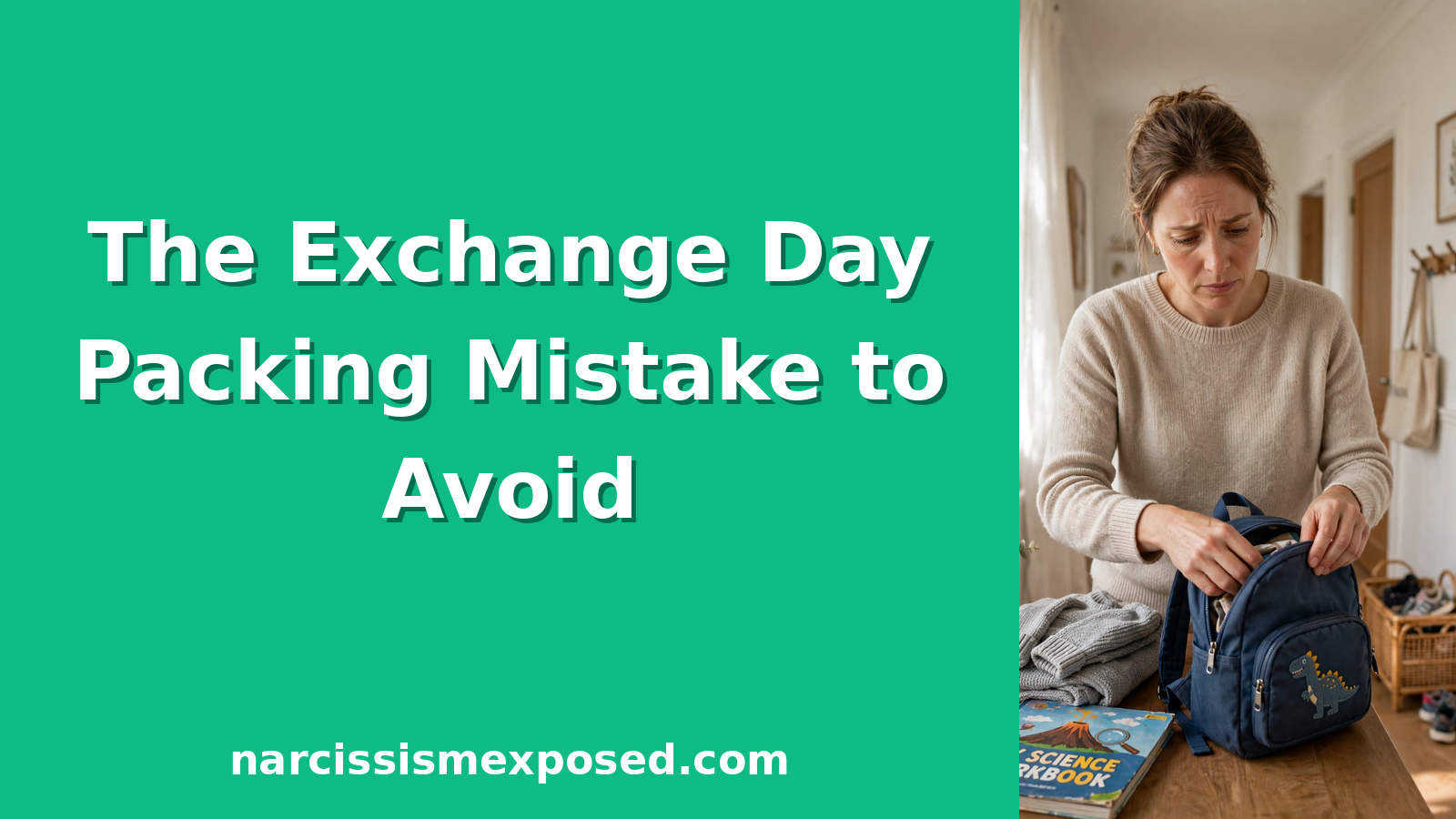
It is 5.40 pm, the exchange is at 6 pm, and you are standing in the hallway with your child’s bag half packed, trying to remember whether the inhaler is in the bathroom cabinet or already in the bag, whether the permission slip got signed, and whether you ever told your ex about the dentist on Wednesday. That is the exchange day packing mistake in action, and it is not forgetting a jumper. The exchange day packing mistake is packing only the things you can see and forgetting the information that has to travel with them, the dosing plan, the appointments, the homework due on Monday, and the small facts about how your child is doing this week.
- What Is the Exchange Day Packing Mistake
- What the Exchange Day Packing Mistake Costs Your Child
- What Should Go in the Exchange Day Bag Every Time
- The Printable Exchange Day Packing Checklist
- How Does Packing Change as Children Get Older
- What Should You Duplicate and What Must Always Travel
- How Do You Pack Medication Safely on Exchange Day
- What Information Must Travel With the Bag
- How Do You Pack for Different Stays
- What Do You Say at the Door on Exchange Day
- How Do You Pack When You Cannot Talk to Your Ex
- What If the Other Parent Keeps Forgetting or Keeping Items
- How Do You Involve Your Child Without Making Them Responsible
- Your Exchange Day Log
- Frequently Asked Questions
- Protect Your Schedule, Your Kids, and Your Peace
This guide names that mistake plainly, shows you what it costs, and gives you a system that stops it happening again. You will get a full printable packing checklist, an age by age guide to who packs what, a clear rule for what to duplicate and what must always travel, a safe way to pack medication, a one page handover note that carries the information, scripts for the doorstep, and a plan for when the other parent forgets things or keeps them. Every step uses behaviour first language, which means we describe what people do, not who they are as people, because observable behaviour is what a parenting plan, a mediator, and a court can actually work with.
If your ex turns every exchange into a fight, the Coparenting Protected Parent Bundle was made for exactly that. It gives you a parallel parenting framework, ready to use scripts for hard messages, and a simple log for keeping track of what was agreed and what actually happened. You can see everything it includes here: Coparenting Protected Parent Bundle.
The short answer is this. The exchange day packing mistake to avoid is treating the bag as the whole job, when the bag is only half of it. Every exchange carries two things, stuff and information, and the information is the part that gets lost. Pack the bag the night before with your child, write the dosing plan, the appointments, and the school deadlines on a short handover note, send that note in writing before the exchange, and keep the goodbye at the door under two minutes.
Key Takeaways
- The exchange day packing mistake is packing the bag and forgetting the information, the medication plan, the appointments, the permission slips, and the schedule changes.
- A forgotten jumper gets solved with another jumper. A forgotten dose, a missed appointment, or a lost permission slip cannot be solved at the door.
- Pack the night before, with your child, using one written checklist that lives in both homes. Memory fails exactly when you are tired, which is always on exchange day.
- Duplicate the cheap and replaceable items in both homes, and let only the irreplaceable things travel, medication, school devices, the comfort object, and started homework.
- Never make your child the messenger or the logistics manager. Adults coordinate between adults, in writing, and the child carries a bag, not the plan.
- Log every exchange factually, date, agreed time, actual time, what travelled, and what did not. Patterns move courts, single incidents do not.
What Is the Exchange Day Packing Mistake
The exchange day packing mistake is believing the job is finished when the bag is full. The direct answer is that the bag is only the visible half of the exchange, and the invisible half, the information, is the half that causes the real damage when it goes missing. A custody exchange, also called a handover, is the scheduled moment when your child moves from one parent’s care to the other parent’s care. A parenting plan is the written agreement that sets out the schedule, the exchange place and time, and the rules for decisions, communication, and costs. Packing is the practical work of getting your child and everything they need from one home to the other, on time, without a scene.
Think of every exchange as carrying two loads. The first load is the stuff, the school bag, the clothes, the medication packet, the sports kit, the comfort object, the charger. The second load is the information, the exact dose and timing of the medicine, the dentist appointment on Wednesday at 5.30 pm, the school trip permission slip that must be back by Monday, the fact that your child has slept badly for three nights, and the change to Friday pickup because of a work meeting. The stuff fits in a bag. The information does not, and when there is no agreed system for getting it across, it ends up travelling in the memory of a tired adult, or worse, in the head of your child.
That is why the mistake is so common and so invisible. The bag looks done, so you feel done, and the missing information only shows up hours later, when the other parent texts to ask what dose the medicine is, or when the teacher emails about a form nobody returned. The parents who get this right are not the parents with the best memories. They are the parents with a written list and a written note, because a list catches what memory drops, and a note carries what a bag cannot.
What the Exchange Day Packing Mistake Costs Your Child
A packing mistake costs your child far more than a missing item. The direct answer is that it costs them calm, routine, and the feeling that the adults have this under control, and those three things are exactly what a child needs most during a move between homes. Children experience transitions between homes as stressful even when both parents are kind and the exchange itself takes ninety seconds. Predictability is what steadies them, the same bag, the same routine, the same calm goodbye, and a packing mistake breaks that predictability in front of them.
Consider a real, ordinary example. Maya is nine, and she takes an inhaler every morning and evening for asthma. Her mother packs the inhaler but forgets to write down that the dose changed last week, that the last dose was given at 7 am, and that the next dose is due at 7 pm. Her father gives the old dose at the old time, because that is what he remembers from last month, and Maya has a wheezy night. Nobody meant any harm. The packet travelled, and the plan did not, and the child paid for the gap. That is the pattern to watch for. The item travels, the information stays behind, and the consequence lands on the child.
The costs stack up in smaller ways too. A forgotten homework folder means a child hands in work late and feels embarrassed at school. A forgotten sports kit means a child sits out of practice and feels singled out. A forgotten comfort object means a child cannot settle at bedtime in the other home. A permission slip left on the fridge means a child misses a school trip their friends all went on. None of these is a crisis on its own, and that is the trap. Each one is small, each one is fixable, and each one tells your child, in a language they understand perfectly, that the move between homes is chaotic and that they are the one who has to keep track of it. Over a school term, that message sinks in, and the child starts checking the bag themselves, reminding the adults, and carrying the logistics in their own head. That weight is not theirs to carry, and this guide exists to take it off them.
What Should Go in the Exchange Day Bag Every Time
The bag itself is simple once you stop relying on memory. The direct answer is that every exchange day bag needs five categories, school, health, clothes, comfort, and documents, and the exact items inside each category depend on your child’s age, the length of the stay, and what happens during those days. Use the categories below as your master list, and drop whatever does not apply to your family this week.
School comes first, because school deadlines do not wait for the exchange. Pack the school bag with the next day’s books and folders, finished homework or the materials needed to complete it, the reading record and library books, any school device with its charger, and signed permission slips and school letters that need returning. Check the school calendar the night before, not the morning of the exchange, because a form due on Monday is easy to forget on a Friday evening.
Health comes second, because it cannot be improvised. Pack medication in its original packaging, never loose in a pocket or a sandwich bag, plus a written dosing plan, which is covered in full later in this guide. Add glasses, a dental retainer, hearing aids, an inhaler, or any other device your child uses, plus allergy medication such as an EpiPen if one is prescribed, and a short note about any illness, symptoms, or treatment this week. If your child has an appointment during the other parent’s time, the appointment details travel in writing too.
Clothes come third, and the rule is simple, pack for the days ahead plus one spare. Pack complete outfits for the length of the stay, with one extra outfit per three days, weather appropriate outerwear for the forecast, pyjamas, underwear and socks with extras, shoes for school and for play, and any special outfit needed for an event during the stay. Check the forecast the night before, because a child in a thin jacket on a cold day is a packing failure, not a weather problem.
Comfort comes fourth, and it is not optional. Pack the comfort object, the cuddly toy, blanket, or book your child sleeps with, a familiar bedtime book, and a small keepsake such as a family photo if your child likes one. A comfort object is a transition object, an item that travels between homes and tells your child that some things stay the same even when the house changes. Never treat it as clutter, and never leave it behind to teach a lesson about responsibility. A child who cannot settle at bedtime is not being difficult, they are missing the thing that helps them settle.
Documents and electronics come fifth. Pack a phone and charger if your child has one, a bus pass, house keys if they carry them, any borrowed item that belongs to the other home and needs returning, and a birthday gift if a party falls during this stay. If your child is travelling abroad with one parent, the passport and a written travel letter travel too, and that arrangement should be agreed in writing well before the trip, not at the door.
The Printable Exchange Day Packing Checklist
Here is the full checklist, built to print and stick by the door. The direct answer is that one identical list in both homes, reviewed the night before with your child present, beats two different lists in two different heads every single time. Tick each item off as it goes into the bag, and leave the bag by the door when you finish.
Your printable exchange day packing checklist.
School and homework:
– School bag with the next day’s books and folders
– Homework finished, or the materials needed to complete it
– Reading record, library books, and school device with charger
– Signed permission slips and school letters due back
Health and medication:
– Medication in original packaging, with the written dosing plan
– Glasses, retainer, hearing aids, inhaler, or other device
– Allergy medication, such as an EpiPen, if prescribed
– Note about illness, symptoms, or treatment this week
Clothes and weather:
– Complete outfits for the stay, plus one spare per three days
– Pyjamas, underwear, and socks with extras
– Weather appropriate coat, hat, or sunscreen as needed
– Shoes for school and for play, plus sports footwear
Activities and sport:
– Clean sports kit and activity specific footwear
– Swimming bag, protective gear, or musical instrument
– Any equipment that exists in only one home
Comfort and personal:
– Comfort object, cuddly toy, blanket, or current book
– Phone and charger, bus pass, and house keys if carried
– Any borrowed item from the other home, returned clean
Information, sent in writing before the exchange:
– Exchange time and place confirmed
– Health update, illness, symptoms, medicine given and when
– Appointments during the other parent’s time, with exact days and times
– School news, tests, trips, letters, and deadlines this week
– Schedule changes, confirmed in writing by both parents
Five minutes before you leave, do the three item scan, the three things most often forgotten. Medication, charger, and whatever is needed for school tomorrow. If those three are in the bag, most exchange day disasters are already prevented. If something was forgotten last time, add it to the list before the next exchange, rather than raising it as a complaint. The list is a tool, not a scorecard, and every family forgets things. The goal is not perfection, it is predictability, and a child who knows the list is checked every time handles the move with far more ease.
How Does Packing Change as Children Get Older
Packing changes a lot as children grow, and the biggest change is who does the packing. The direct answer is that adults pack for young children, children pack with an adult beside them in the middle years, and teenagers pack for themselves with a light prompt, but the coordination between adults never becomes the child’s job at any age. That distinction is the whole point, and it is where most families go wrong.
| Age | What dominates the list | Who packs the bag | Common pitfall |
|---|---|---|---|
| 0 to 3 | Nappies, food, comfort object, sleep routine | Adults only | Each home running a different routine |
| 3 to 6 | Spare clothes, nursery kit, cuddly toy, some school items | Adults, with the child watching | The comfort toy getting left behind |
| 6 to 9 | School bag, homework, activity kit | Adult and child together | The child feeling responsible for remembering everything |
| 10 to 12 | School books, devices and chargers | Child, with an adult check | Books stranded at the other home |
| 13 to 17 | Phone, charger, bus pass, their own diary | Teenager, with a gentle prompt | Delegating information coordination to them, not just the packing |
For toddlers, the routine matters more than the bag. Two homes running different sleep and meal routines will exhaust a small child faster than any forgotten item, so write the routine down, bedtime, wake time, meals, and naps, and share it in writing. For children aged three to six, let them watch you pack and choose one small thing themselves, a book or a toy, because choice gives them a sense of control over a day they otherwise have no say in. For children aged six to nine, pack together, and let them tick items off the list, but you hold the list and you do the final check. For children aged ten to twelve, let them pack, then check the bag together, because a child this age can pack a bag and still forget the charger, the homework folder, or the kit for Tuesday practice. For teenagers, a gentle prompt is enough, and the prompt should be about the bag, never about carrying messages or information between homes. A teenager who is asked to tell one parent what the other parent said is being put in the middle, and that is a different problem from a forgotten charger.
What Should You Duplicate and What Must Always Travel
Duplicating is the single best way to shrink the packing list, and most families underuse it. The direct answer is to duplicate everything cheap and replaceable in both homes, let only the irreplaceable things travel, and agree in writing what comes back and by when. Fewer travelling items means fewer failures at the door, fewer trips back, and fewer arguments about whose jumper is in whose house.
| Category | Keep in both homes | Must always travel | Needs a written return rule |
|---|---|---|---|
| Daily basics | Toothbrush, toothpaste, pyjamas, underwear, everyday clothes, phone charger, basic stationery | Ongoing medication, school device | None, these stay put |
| School | Homework folder, reading books, spare pens | Started homework, library books, permission slips | Library books, within one week |
| Comfort | A spare blanket, a bedtime book | The irreplaceable comfort object | The comfort object, every exchange |
| Activities | Basic sports kit, a second water bottle | Musical instrument, specialist protective gear | Specialist gear, next exchange |
| Valuables | Nothing expensive duplicated | Games console, expensive trainers, smart shoes | Console and trainers, agreed return day |
Start with the cheap duplicates, because they pay for themselves in the first month. A toothbrush, toothpaste, pyjamas, underwear, a phone charger, and basic stationery in both homes removes six items from every single exchange. Add everyday clothes next, so that a school night stay needs little more than a school bag. Keep one set of toiletries and one set of night clothes permanently in each home, and stop packing them at all. The bag gets lighter, the list gets shorter, and the morning of the exchange gets calmer.
What must always travel is a short list, and it is worth memorising. Any ongoing medication, any school device, a musical instrument, the irreplaceable comfort object, and any homework already started. These are the items that cannot be replaced by a trip to a shop, and they are the items that cause the most damage when they are forgotten. Everything else is negotiable, and the middle ground, the smart shoes, the expensive trainers, the handheld games console, is where most low level friction lives. The only thing that works here is an explicit agreement about whether the item comes back and within what timeframe. Without that agreement, every item that does not return becomes a small grievance that accumulates quietly, and after a few months the grievances are doing more damage than the items ever did. If you are setting boundaries with your ex around belongings, write the return rule down in the same message as the exchange confirmation, so it is part of the plan, not a separate argument.
How Do You Pack Medication Safely on Exchange Day
Medication is the highest stakes item in the bag, and it is the item most often packed wrong. The direct answer is that the packet alone is not enough. The packet must travel in its original packaging with a written dosing plan that says what your child is taking, what dose, how often, since when, until when, and who gave the last dose. Without that note, the other parent is guessing, and guessing with medicine is not acceptable.
Write the dosing plan on a small card that stays with the medicine, and send the same words in your written handover message. A good dosing plan looks like this: ‘Amoxicillin, 250 mg, three times a day with food, started Tuesday evening, four days left, last dose given today at 7 am by Mum, next dose due 3 pm.’ That is six facts, and each one matters. The name stops a mix up with a sibling’s medicine. The dose stops an underdose or an overdose. The timing stops a missed dose. The start and end dates stop a course being stopped early. The last dose stops an accidental double dose. Keep the medicine in its original packaging with the pharmacy label visible, never loose in a pocket, a sandwich bag, or the bottom of a school bag, because a loose pill or a loose inhaler with no label is a risk nobody should take.
The same rule applies to everything health related. An inhaler travels with a note about when it was last used and what triggers a flare up. Allergy medication travels with a note about the allergy, the symptoms to watch for, and when to use the EpiPen. A new prescription travels with the GP or specialist letter, or a copy of it, so both parents hold the same instructions. If your child has an appointment during the other parent’s time, the appointment details travel in writing, with the exact day, time, place, and what to bring. For long term treatment, both parents should hold a copy of any GP or specialist letter, so neither home is working from memory. Psychology Today explains why clear, written routines matter so much in high conflict co-parenting, and you can read their guidance on co-parenting with a narcissist and parallel parenting.
What Information Must Travel With the Bag
Information is the second load, and it needs its own vehicle. The direct answer is a short written handover note, sent before the exchange, that covers health, school, appointments, schedule changes, and how your child is doing, in five short lines. Anything raised at the door gets remembered wrong by one of you, so the note goes in writing, before you meet, and the doorstep stays for a hello and a goodbye.
A good handover note looks like this, and you can copy the shape for every exchange:
‘Hi, exchange today 6 pm at school pickup. Leo had a sore throat yesterday, no fever, gave paracetamol at 8 am, next dose due 2 pm if needed. Dentist Wednesday 5.30 pm, address in the app. School trip form signed and in his bag, due back Monday. He slept badly last night, so he may be tired this evening. Bag packed, inhaler inside with the dosing card.’
That is five lines, and it covers everything the other parent needs to know. Health first, because it is the most urgent. Appointments second, because they are the most likely to be missed. School third, because deadlines are unforgiving. How your child is doing fourth, because context stops a rough evening being read as a problem with the other home. And a confirmation that the bag is packed fifth, because it closes the loop. Two sentences about how your child is doing are enough, and they matter more than parents think. If your child has slept badly for three nights, or has been a bit off all week, that context helps the other parent understand what they are walking into, and it stops a tired child being misread as a difficult child.
The note also protects you. If a disagreement comes up later about what was agreed, what was given, or what was said, the written note is a record, and a dated written record is worth more than two competing memories. Send it through one channel only, your co-parenting app or one dedicated email thread, so there is a single place to look. Do not send it by text, by phone call, and by app all at once, because three channels means nobody knows which version is current. And keep the note factual and short. This is not the place for feelings about the relationship, for old arguments, or for character judgments. It is a logistics note about a child, and the shorter it is, the more likely it is to be read.
How Do You Pack for Different Stays
Not every stay is the same, and packing the same bag for a school night and a two week holiday is a mistake in itself. The direct answer is to pack by the stay, using three different lists, a school night list, a weekend list, and a holiday list, and to check the calendar for the days ahead before you pack a single item.
| Stay | Pack | Information to send | Common mistake |
|---|---|---|---|
| School night | School bag, homework, device and charger, pyjamas, next day clothes | Tomorrow’s timetable, any test or deadline | Packing a full suitcase for one night |
| Weekend | School night items plus sports kit, comfort object, weather clothes, one spare outfit | Weekend activities, party or match times, return time | Forgetting the Monday school bag |
| School break | Weekend items plus holiday clothes, medication supply, travel documents | Full itinerary, appointments, return date and time | No written plan for the whole break |
| Long holiday | Break items plus passport, travel letter, insurance card, extra medication | Travel dates, flight or drive times, emergency contacts | Packing everything and duplicating nothing |
For a school night, the bag should be light, because the child is coming back tomorrow. School bag, homework, device and charger, pyjamas, and the next day’s clothes are enough, and overpacking for one night teaches your child that every move is a big production. For a weekend, add the sports kit, the comfort object, weather clothes, and one spare outfit, and check what happens on Monday morning, because the most common weekend mistake is sending a child back on Sunday evening without the Monday school bag. For a school break, add holiday clothes, a full medication supply, and travel documents, and send the full itinerary in writing, because a break has more moving parts and more chances for something to be missed. For a long holiday, pack the passport, a written travel letter if one parent is travelling alone with the child, the insurance card, and extra medication, and agree the travel dates, times, and emergency contacts in writing well before the trip. Your parenting plan should say how holiday packing works, and you can read a clear state by state explanation of what a parenting plan must include on WomensLaw.org.
What Do You Say at the Door on Exchange Day
The doorstep is the most delicate two minutes of the week, and what you say there matters as much as what you packed. The direct answer is to keep it to thirty seconds, one prepared line, the bag, and a warm goodbye to your child, and to save every other conversation for writing. A long, emotional farewell tells a child this is something to grieve. A brief, warm one tells them it is normal, and normal is what they need.
Prepare one line before you arrive, and use it word for word. Try this: ‘Hi, here is his bag, he has had lunch, inhaler and dosing card inside, dentist Wednesday 5.30 pm as I messaged.’ That is it. No discussion, no negotiation, no character feedback, no money talk, no schedule dispute. If your ex raises something contentious at the door, try this: ‘I will send that in the app, our priority is keeping things smooth for our child.’ Then stop talking. Say it twice if you need to, and then leave. A prepared line removes the pause where something else can start, and the pause is where most doorstep arguments begin.
When something has been forgotten, the script changes, but the rule does not. If you forgot an item, say so plainly and fix it fast: ‘I forgot the football kit, I will drop it off at school tomorrow morning before practice, sorry about that.’ No excuses, no blame, no long explanation. If the other parent forgot an item, say so once, in writing, after the exchange: ‘Pickup was Friday 6 pm, the homework folder was not in the bag, please send it by Monday morning as it is due then.’ Then stop. Do not send three follow ups, and do not raise it in front of your child. One clear message is enough, and the log does the rest. If you are parallel parenting because cooperation is not possible right now, the doorstep script is even simpler, because parallel parenting means minimal contact, written messages only, and a clear plan that decides the details in advance. A short handover is not cold, it is protective, and it works.
How Do You Pack When You Cannot Talk to Your Ex
Some co-parents cannot talk calmly, and packing has to work without a conversation. The direct answer is to switch the whole system to writing, one channel, one checklist, one handover note, and no discussion at the door, because a system that needs goodwill will fail the week goodwill runs out. This is parallel parenting, and it is a reasonable structure, not a failure.
Start by moving all communication into one written channel, a co-parenting app or one dedicated email thread, and stop taking phone calls about logistics. Written messages create a record, give you time to think, and take the heat out of the exchange. Send the handover note through that channel the night before, and send the exchange confirmation, time and place, through the same channel. If your ex sends long, angry, or confusing messages, do not answer the feelings. Answer the logistics, in one short reply, and then stop. A message that says ‘Bag packed, inhaler inside with dosing card, dentist Wednesday 5.30 pm’ needs no reply beyond an acknowledgement, and if none comes, the record still shows you sent it.
Second, make the checklist identical in both homes. Print two copies, one for your door and one for theirs, or keep one shared digital list that both of you can see. When both homes run the same list, the bag is packed the same way whoever packs it, and there is nothing left to argue about at the door. Third, use school as the exchange point whenever you can. One parent drops the child at school in the morning, the other picks them up in the afternoon, and the child moves between homes inside a normal school day, with no kerbside goodbye and no face to face exchange between parents. If school is not possible, use a neutral public place, a library, a supermarket car park, or a supervised exchange centre if your order requires one. If you are divorcing with kids and every conversation becomes a fight, this structure is your best protection, because the plan does the deciding, so the two of you do not have to.
What If the Other Parent Keeps Forgetting or Keeping Items
A single forgotten item is an accident. A pattern is a problem, and patterns need a different response. The direct answer is to log it factually, raise it once in writing, propose a specific fix, and escalate through mediation or a lawyer only if the pattern continues, because courts act on dated patterns, not on single incidents and not on feelings.
Worked scenario 1, the forgotten homework. Your child’s homework folder is missing for the third Friday in a row, and the work is due on Monday. Do not argue by text. Send one short written message: ‘The homework folder was not in the bag on Friday, this is the third week. Please pack it on Thursday evening and check it against the list, as it is due Monday.’ Then log it, with the date, what was agreed, and what happened. Bring the log to your next mediation session or to your lawyer. A pattern of forgotten schoolwork is far more persuasive than a single angry message, because it shows a behaviour, not a feeling.
Worked scenario 2, the kept trainers. Your child’s expensive trainers go to the other home and do not come back, twice in a month, with no explanation. Raise it once, in writing, calmly: ‘The trainers went to your home on the 3rd and the 17th and have not been returned. Please return them at the next exchange, or agree a return day in writing.’ Then stop. Do not send three follow ups, and do not withhold something of theirs in return, because tit for tat packing turns your child into a courier for adult grievances. If the pattern continues, ask for mediation to add a written return rule to the parenting plan, with a named return day for shared items.
Worked scenario 3, the withheld comfort object. Your child’s comfort toy stays at the other home, and your child cannot settle at bedtime without it. This one matters most, because it affects your child’s sleep, not just their wardrobe. Raise it the same evening, in writing, plainly: ‘The comfort toy stayed at your home today, please bring it to the next exchange, as Leo needs it to settle at night.’ If it keeps happening, name it in mediation as a specific issue, with dates, and ask for the comfort object to be named in the parenting plan as an item that always travels. A comfort object is not a bargaining chip, and a pattern of withholding it is something a mediator and a court will want to hear about.
First, separate carelessness from a gap in your agreement. If you have never clearly agreed what travels and what stays, there is no breach, there is an ambiguity worth closing in writing. Write the rule down, agree it in writing, and give it a month. Second, if there is an agreement in place and it is consistently not being followed, keep a neutral record and discuss it with a qualified family lawyer in your state. Third, never use your child’s belongings as leverage, and never hold back an item to punish the other parent, because the child is the one who goes without, and the pattern will be visible to anyone who reads the log. For a step by step look at building a case that protects your child, read our guide on how to get child custody, which covers evidence, records, and the moves that matter in court. This article gives general information only, not legal advice, and custody law varies by state, so talk to a qualified family lawyer in your state before you act on any of this.
How Do You Involve Your Child Without Making Them Responsible
Children want to help, and helping gives them a sense of control, but there is a line between helping and carrying the logistics, and that line matters. The direct answer is to let your child choose and tick, never to let them remember and remind, because the moment your child is the one who remembers the inhaler, the permission slip, or the dentist appointment, the adults have handed them a job that is not theirs.
Let your child choose one thing for the bag, a book, a toy, or a snack for the drive, and let them tick items off the checklist while you pack. That is involvement, and it helps, because a child who helped pack feels some ownership over a day they otherwise have no say in. Do not ask your child to remember what to pack, to remind the other parent about an appointment, or to carry a message between homes. Do not ask them what the other parent said about the schedule, what the other house is like, or whether the other parent packed the right things. Those questions put your child in the middle, and a child in the middle learns to manage adult feelings instead of their own.
Keep the goodbye short and warm. A hug, a simple sentence about when you will see them next, and then let them go. Try this: ‘Have a good weekend, I will see you Sunday at 6 pm, I love you.’ That is enough. Do not make a big fuss over saying goodbye or over how much you will miss them, because that can make a child feel guilty for leaving, or provoke emotions they might not otherwise have felt. Do not ask them to report back on the other home, and do not quiz them when they return. When they come back, take time to reconnect and notice any changes in behaviour or mood. Some children need space to decompress, while others want to talk about their time away. Listen without judgment, let your child guide the conversation, and watch for ongoing signs of anxiety, sadness, or acting out, which may signal that they need extra support. A family therapist who understands high conflict separation can help, and your state court self help pages will explain the local rules for your area. The California Courts self help guide on child custody and parenting time is a good example of how official state sources explain the process, and your own state will have its own version.
Your Exchange Day Log
A simple log is the most useful tool in this entire guide, and it takes five minutes a week. The direct answer is to keep one row per exchange, in the shared app or a notebook you control, and to fill it in the same evening as each exchange, while the details are fresh. This log protects your memory, shows the pattern if you ever need mediation or a lawyer, and keeps small problems from becoming big ones.
| Date | Exchange time | Planned | What happened | Bag check | Notes |
|---|---|---|---|---|---|
| Fri, Nov 14 | 6 pm pickup | On time | On time, calm | Complete | Checklist used, inhaler inside |
| Sun, Nov 16 | 6 pm return | On time | 25 min late, no message | Homework folder missing | Logged, raised in writing |
| Wed, Nov 19 | School pickup | Other parent picks up | As planned | Complete | Dosing card sent in app |
| Fri, Nov 21 | 6 pm pickup | On time | As planned | Complete | Medicine in bag, note sent |
Copy this table into a notebook or a spreadsheet, and fill it in the same evening as each exchange. Note late arrivals, missed days, changes made without notice, forgotten items, and any message that proves what was agreed. If nothing went wrong, write that too. A log that only records problems looks one sided. A log that records every exchange, good and bad, is a record anyone can trust. If the pattern in the log shows repeated forgotten medication, repeated late pickups, or repeated kept items, take the log to mediation or to your lawyer, and propose a specific change, not a general complaint. A specific change sounds like this: ‘Add a written return rule for shared items, with a named return day.’ A general complaint sounds like this: ‘They never pack properly.’ Only one of those can be fixed, and the log is what turns the first into the second. If you want a fuller framework for keeping records that protect your child, the Co-Parenting Protection Protocol covers documentation, communication, and the structure that holds when cooperation does not.
Frequently Asked Questions
What should I pack for my child custody exchange?
Pack five categories, school, health, clothes, comfort, and documents. School bag and homework, medication in original packaging with a written dosing plan, weather appropriate clothes plus one spare, the comfort object, and any permission slips, devices, and chargers. Send the appointments, schedule changes, and health updates in writing before the exchange, because the information matters as much as the bag.
How do I pack for a custody exchange?
Pack the night before, with your child, using one written checklist that lives in both homes. Check the school calendar and the forecast, pack by the stay, school night, weekend, or holiday, and leave the bag by the door. Five minutes before you leave, do the three item scan, medication, charger, and whatever is needed for school tomorrow.
What is the biggest exchange day packing mistake?
The biggest exchange day packing mistake is packing only the things you can see and forgetting the information that has to travel with them. The bag looks done, so you feel done, and the dosing plan, the appointments, and the school deadlines stay behind. A forgotten jumper gets solved with another jumper, but a forgotten dose or a missed appointment cannot be solved at the door.
Who should pack the bag, the parent or the child?
It depends on age. Under six, adults pack. Between six and twelve, packing together works well, with the child choosing and ticking while the adult holds the list and does the final check. In the teenage years the young person can take the lead with a light prompt. What you never delegate, at any age, is the coordination between parents.
What happens with medication when the child moves home mid-treatment?
The original packaging should travel, along with a written dosing plan, what it is, what dose, how often, when the course started, and when it ends. Noting who gave the last dose prevents accidental doubles. For long term treatment, it is sensible for both parents to hold a copy of any GP or specialist letter.
How do I stop the same things being forgotten every time?
Two measures work well together, duplicate the cheap and replaceable items in both homes, such as toiletries, pyjamas, underwear, and a charger, and use an identical written list in both homes, reviewed the night before. Duplicating shrinks the list, and the list catches what is left. If something was forgotten, add it to the list before the next exchange.
What do I do if the other parent keeps items and does not send them back?
First, check whether you ever clearly agreed what travels and what stays, because if there is no agreement, there is an ambiguity worth closing in writing. If there is an agreement and it is consistently not being followed, raise it once in writing, log each incident with the date, and discuss it with a qualified family lawyer or in mediation. Never withhold an item in return.
Can a parenting plan cover what goes in the bag?
Yes, a parenting plan can set out the exchange arrangements, the packing responsibilities, what travels and what stays, and the return rule for shared items. The right level of detail depends on your situation, so take advice from a qualified family lawyer in your state if you want particular provisions included. Many families handle the day to day detail through a written agreement, which is easier to adjust as children grow.
How early should I pack for a custody exchange?
Pack the night before the exchange, and send the written handover note the night before too. Two days before, review the following week and write down anything the other parent needs to know, appointments, school trips, parties, and schedule changes. Packing the morning of the exchange, or at the door, is how the important things get forgotten.
Should my child pack their own bag for custody exchange?
Teenagers can pack their own bag with a gentle prompt, and children aged ten to twelve can pack with an adult check. Younger children should pack with an adult, choosing one small thing themselves. No child, at any age, should be responsible for remembering the medication plan, the appointments, or the messages between parents, because that coordination belongs to the adults.
Protect Your Schedule, Your Kids, and Your Peace
A good checklist is only half the battle. If your ex fights every swap, rewrites the plan by text, or uses the kids to get to you, you need more than a bag packed the night before. The Coparenting Protected Parent Bundle gives you the Parallel Parenting Framework, Kid Safe Communication Scripts with 30 ready to use BIFF scripts, Documenting for Custody and The Parent Log, Countering Alienation Tactics, What to Tell the Kids with age wise scripts, Protecting Your Kids’ Emotional Safety, School, Medical, and Third Party Coordination, Your Calm Parent Self Regulation, and a 60 Day Protected Parenting Journal.
$47 (was $97, Save $50)
Get the Coparenting Protected Parent Bundle
Instant download, 30-Day Money-Back Guarantee.
And for the day to day running of the plan, try Co-Parenting Guard free for 5 days. Its Message Shield reads your coparent’s messages before you reply, ToneMeter keeps your replies calm, and the Custody Calendar keeps every handover, school day, and holiday in one place. Start your free trial at Co-Parenting Guard.
You do not need a perfect co-parenting relationship, and you do not need to pack a perfect bag. You need one written checklist that lives in both homes, a short handover note sent the night before, a calm thirty second goodbye at the door, and a log that records what actually happened. Start tonight, with the checklist, and pack the next exchange the way your child deserves it to be packed, with the stuff and the information, together. Your child does not need you to get every exchange right. They need to know where they will be, what is in the bag, and that the adults have the rest under control.