
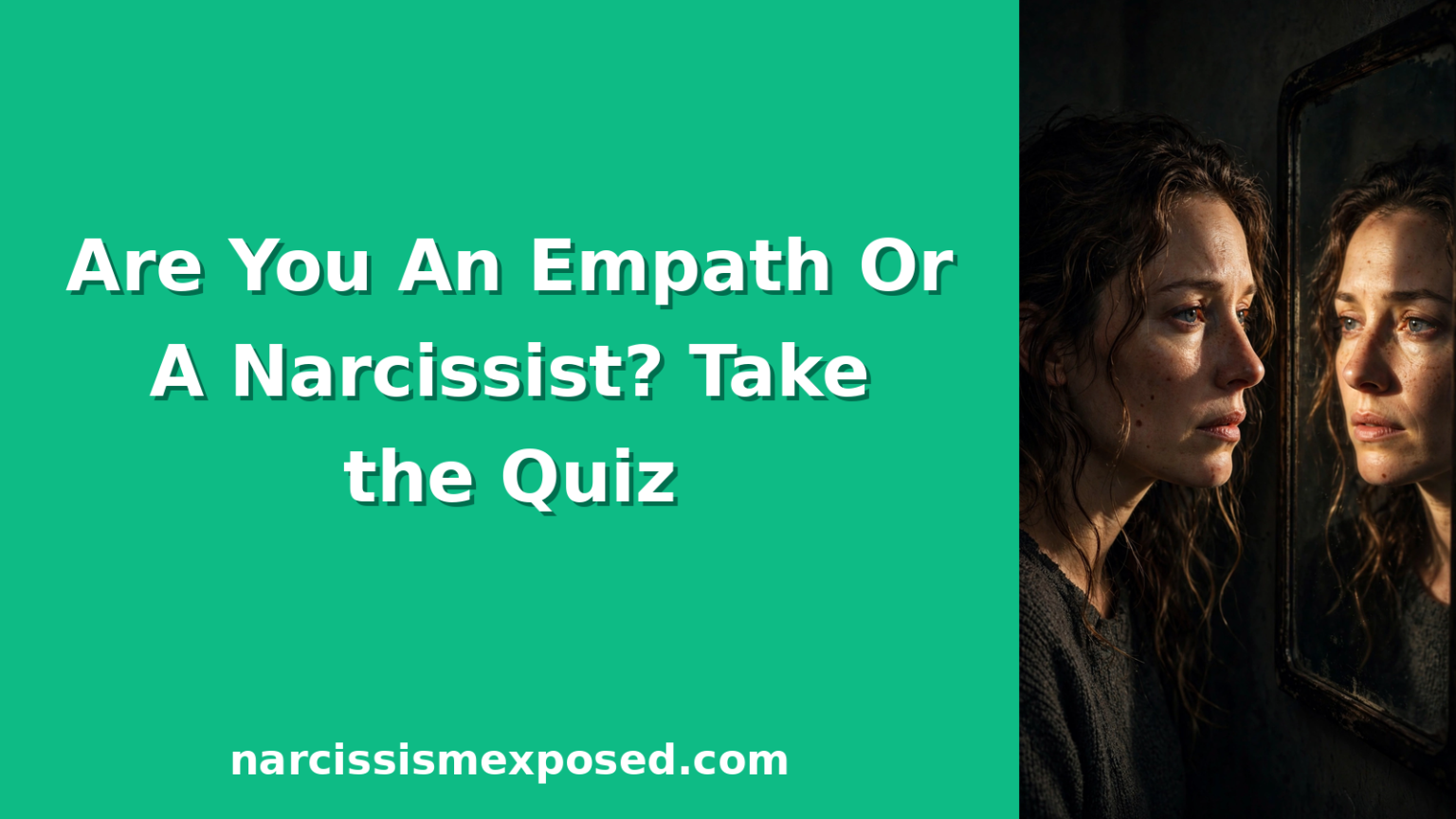
If you searched for an “am i an empath or a narcissist quiz,” you are asking one of the most honest questions a person can ask about themselves. It takes real courage to look in the mirror and wonder which side of the line you fall on. Most people never ask. The fact that you are asking says something good about you already.
Here is what you need to know upfront: empathy and narcissism exist on a spectrum, and they are not opposites in the way most people think. A person can be deeply sensitive to other people’s pain and still carry narcissistic traits like entitlement or a hunger for admiration. Likewise, someone who worries they might be a narcissist is very often an empath who has absorbed so much blame from the narcissists around them that they have started to question their own character.
This free quiz will not diagnose you with anything, and it will not label you. What it does is measure, through ten honest self-reflection questions, where your patterns currently lean: toward empathic traits or toward narcissistic ones. You get a score out of 30 and a clear explanation of what it means. It takes about three minutes, and the clarity is worth it.
What This Quiz Measures
This quiz measures where you land on the empathy to narcissism spectrum, based on ten specific questions about how you relate to other people. Each question asks how often a particular pattern shows up in your life, from Never to Often. Your answers add up to a score between 0 and 30.
Lower scores point toward empathic patterns: feeling other people’s emotions deeply, caring about impact, and struggling more with boundaries than with entitlement. Higher scores point toward narcissistic patterns: grandiosity, entitlement, low empathy, and difficulty with accountability. Middle scores are the most common and the most human, a mix of both, which usually means you have empathic instincts with some defensive or self-protective patterns layered on top.
An important disclaimer: this quiz is not a medical or psychological diagnosis. Narcissistic personality disorder can only be diagnosed by a qualified professional working directly with a person, and “empath” is not a clinical diagnosis at all, though research does support the existence of people with exceptionally high empathy. Treat your result as a mirror for self-reflection, not a verdict on who you are.
If you want to understand the empath side of the spectrum more deeply, the guide to the super empath meaning and traits is a thoughtful companion read.
The Sibling Survival Workbook
The Empath and the Narcissist: Why the Confusion Is So Common
It surprises many people to learn that empaths and narcissists are drawn to each other, and that they can look alike from the outside. Both can be intense, both can be charismatic, and both can struggle with boundaries. The confusion you feel has real roots.
Here is the core difference. An empath absorbs other people’s emotions and often puts others first to the point of self-neglect. A narcissist centers their own emotions and expects others to orbit around them. But life is messier than definitions. An empath who has spent years being devalued by a narcissist can develop protective shells that look narcissistic from the outside: emotional numbness, irritability, self-focus as a survival strategy. And a narcissist can perform empathy beautifully when it serves them, which is why so many people ask, can a narcissist be an empath? The short answer is that they can imitate empathy, but they do not feel it the way an empath does.
There is another twist that brings many people to this quiz. If you grew up with or partnered a narcissist, you were probably blamed for everything. Years of hearing “you are the selfish one” can plant a seed of doubt that grows into a genuine fear: what if I am the narcissist? Psychologists see this constantly. The people most terrified of being narcissists are very often the empaths, because true narcissists rarely worry about it at all. Your worry is, paradoxically, evidence in your favor.
That said, honest self-reflection still matters. Everyone carries some narcissistic traits. Healthy self-esteem, ambition, and the ability to advocate for yourself all live on the same spectrum. The question is never whether you have zero narcissistic traits. It is whether those traits run the show.
One more distinction worth making: empathy without boundaries is not a virtue, it is a vulnerability. Many empaths pride themselves on feeling everything, but absorbing everyone’s pain without protection leads to burnout, resentment, and eventually the very self-focus they judge in others. If that cycle sounds familiar, the complete guide to an empath leaving a narcissist maps the way out.
10 Signs to Check: Are You an Empath or a Narcissist?
Read through these signs before you take the quiz. They capture the two poles the quiz questions are built around.
- You feel other people’s emotions as if they were your own, even when you try not to.
- You believe you deserve special treatment that others do not get.
- Crowds, conflict, and other people’s moods drain you quickly.
- You steer conversations back to yourself without noticing.
- You struggle to say no, even when saying yes hurts you.
- You expect praise or admiration without having truly earned it.
- You notice subtle shifts in someone’s mood before they say a word.
- You find it genuinely hard to understand why someone is upset.
- Your feelings get hurt easily because you notice everything.
- You use charm or flattery to get what you want from people.
If the odd-numbered signs describe you far more than the even-numbered ones, you are likely looking at an empathic profile. If the even-numbered ones sting with recognition, the quiz below will help you measure how strong that lean really is.
A Note Before You Start
Answer for who you actually are, not who you wish you were or who you fear you are. There are no trick questions and no score that makes you a bad person. The quiz is a mirror, and mirrors only help when you let them show the truth.
Think about your general patterns over the past year, not your behavior on your best day or your worst one. If a question makes you uncomfortable, sit with the discomfort instead of rushing past it. That discomfort is usually where the most useful insight lives.
Your answers are private. The result is for your eyes only, and it exists to give you clarity, not to judge you.
The 30 Day Trauma Bond Recovery Workbook
Interpreting Your Results: What Your Score Means
Your score is a number between 0 and 30. Here is what each range means in plain language.
0 to 10: The Empath Profile. Your patterns lean strongly empathic. You feel deeply, you care about your impact on others, and you probably struggle more with boundaries than with entitlement. If you came to this quiz worried you might be a narcissist, this score is reassuring: people with strong narcissistic traits do not typically score down here. Your growth edge is not becoming less selfish. It is learning to protect your sensitivity instead of apologizing for it.
11 to 20: The Mixed Profile. You carry meaningful traits from both sides, which is the most common and most human result. You likely have genuine empathy alongside some self-protective patterns: moments of entitlement, difficulty with criticism, or self-focus that developed as armor. A mixed score often reflects life experience rather than character. People who have survived narcissistic relationships frequently land here, because surviving required them to toughen up in ways that can look narcissistic from the outside.
21 to 30: Strong Narcissistic Leanings. Your patterns lean significantly toward narcissistic traits: grandiosity, entitlement, low empathy, or chronic difficulty with accountability. Hearing that is uncomfortable, but the fact that you took this quiz and are reading this result is genuinely meaningful. Self-awareness is the one thing that separates a person with narcissistic traits from a person who will never change. This score is not a life sentence. It is an invitation to do the deep work, ideally with a therapist who understands personality patterns, because these traits are changeable when a person is willing to face them.
Whatever your score, remember that a number cannot capture your full humanity. Use it as a starting point for honest reflection, not as a label you wear.
What to Do With Your Result
Clarity only matters if it changes something. Here is how to use your result well.
If you scored 0 to 10: Believe the result, and stop interrogating your own character. If the fear of being a narcissist was planted by someone else, name that. The person who benefits from your self-doubt is rarely you. Redirect the energy you spent worrying into building boundaries, because empaths without boundaries burn out. Your sensitivity is a strength. Protect it like one.
If you scored 11 to 20: Get curious about the specific questions where you scored highest. Those are your growth edges, not your identity. Ask yourself where each pattern came from. Did you learn self-focus as protection? Do you struggle with criticism because it was weaponized against you? Understanding the origin of a pattern is the fastest way to loosen its grip. Consider journaling through your answers, or talking them over with a therapist who can help you sort survival strategies from character traits.
If you scored 21 to 30: Be honest with yourself, and then be kind to yourself about the honesty. Recognizing narcissistic patterns in yourself is rare and brave. The next step is professional support, because these patterns are deep and self-help alone rarely unwinds them. Look for a therapist experienced with narcissistic traits who will challenge you without shaming you. Change is absolutely possible, but it requires sustained, uncomfortable work. Starting that work is the strongest evidence that you are more than your patterns.
Whatever your range, the goal is the same: to relate to other people, and to yourself, with more honesty than yesterday.
Get Your Narcissistic Abuse Clarity Report
Frequently Asked Questions
If I worry I am a narcissist, does that mean I am not one?
Not automatically, but it is a meaningful signal. Genuine, persistent worry about being a narcissist is far more common in empaths than in narcissists. People with strong narcissistic traits rarely lose sleep over the question, because self-reflection threatens the grandiose self-image. That said, worry alone is not proof of anything. The quiz measures actual behavioral patterns, which is more reliable than anxiety as a guide.
Can an empath have narcissistic traits too?
Yes, and most do to some degree. Narcissistic traits exist on a spectrum in everyone. An empath under chronic stress, or one who survived narcissistic abuse, can develop entitlement, irritability, emotional numbness, or self-focus as protective adaptations. These are usually situational and soften with healing, which is very different from the stable, pervasive pattern seen in narcissistic personality. Context matters enormously.
What is the real difference between an empath and a narcissist?
The core difference is the direction of emotional attention. An empath’s attention flows outward: they feel others’ emotions, often at cost to themselves. A narcissist’s attention flows inward: others exist primarily as sources of admiration, validation, or control. Both can be intense and both can struggle with boundaries, but the empath struggles to keep others out while the narcissist struggles to let others in. For a deeper look at the empathy deficit specifically, the article on lack of empathy and what it reveals breaks it down clearly.
Can this quiz diagnose narcissistic personality disorder?
No, and no honest online quiz can. Narcissistic personality disorder is a clinical diagnosis that requires a qualified mental health professional evaluating a person directly against established criteria. This quiz measures self-reported behavioral patterns and places them on a spectrum. It is a tool for self-reflection and a starting point for deeper work, not a medical instrument. If your result concerns you, a therapist is the right next step.
I scored in the middle and feel more confused than before. Is that normal?
Completely normal, and actually a good sign. A mixed result means you are a complex human being, not a caricature. Most people land in the middle because most people contain multitudes: genuine care alongside self-protective armor, empathy alongside the occasional entitled moment. Instead of asking “which one am I,” try asking “which patterns do I want to grow, and which do I want to release?” That question will take you much further.
If this quiz gave you useful insight, the 12 traits of a narcissist checklist is a strong next read. It will help you recognize these patterns in the people around you, not just in yourself.