You raise one calm, clear concern. Ten minutes later you are apologising, defending your character, and comforting the person who hurt you. You walk out of the room unsure what just happened, only that the thing you came to talk about never got talked about at all. If that scene feels familiar, you have probably met DARVO, and this guide explains what does DARVO stand for, what it looks like in real life, and what to say back.
- What Does DARVO Stand For
- What Does DARVO Look Like in a Real Conversation
- What Are the Exact Phrases People Use in DARVO
- Is DARVO the Same as Gaslighting
- How Is DARVO Different From Blame Shifting, Projection, and Whataboutism
- What Does a Fair Defence Look Like
- Where Does DARVO Show Up
- What Happens With DARVO After Separation
- Why Does DARVO Work So Well
- What Does DARVO Do to You Over Time
- How Do You Know If DARVO Is Happening to You
- What Do You Say When DARVO Is Happening
- Can Someone Who Uses DARVO Change
- Your 7 Day First Steps Plan
- Frequently Asked Questions
What does DARVO stand for? DARVO stands for Deny, Attack, Reverse Victim and Offender. It is a three step pattern that some people use when they are confronted about harmful behaviour. First they deny it happened, then they attack the person who raised it, then they reverse the roles so the person who was hurt looks like the aggressor and the person who caused the harm looks like the victim. It is closely related to gaslighting and to blame shifting, and it shows up again and again in narcissistic relationships, in families, in co-parenting, and at work. This guide explains what DARVO means letter by letter, shows you a full conversation so you can watch it happen in real time, gives you the exact phrases to listen for, and gives you word for word scripts for what to say back.
If every attempt to raise a concern ends with you apologising for bringing it up, the Gaslighting Recovery Bundle was made for exactly that. It gives you a clear map of the tactics, scripts for holding your ground without a fight, and a step by step plan for rebuilding trust in your own perception. You can see everything it includes here: Gaslighting Recovery Bundle.
The short answer is this. DARVO stands for Deny, Attack, Reverse Victim and Offender. It is a pattern in which a person who is confronted about harmful behaviour denies it happened, attacks the credibility or character of the person who raised it, and then claims to be the real victim, so the person who was hurt ends up defending themselves instead of getting an answer.
Key Takeaways
- DARVO stands for Deny, Attack, Reverse Victim and Offender. It was named by psychologist Jennifer Freyd in 1997, from her work on betrayal trauma.
- The pattern only starts when someone is confronted. Denial alone is not DARVO. The reversal at the end is the signature move.
- Each step is designed to pull you off the original point. Denial invites evidence, attack invites self defence, reversal invites reassurance. Answering any of them moves you further from what happened.
- Research shows DARVO works on bystanders too. Observers who watch a DARVO sequence rate the person who caused harm as more believable and the person who was hurt as less believable.
- The strongest response is simple. Name the structure, return to the original point once, in writing where possible, and stop engaging when the reversal starts.
What Does DARVO Stand For
DARVO stands for Deny, Attack, Reverse Victim and Offender. The direct answer is that each letter names one move in a three step sequence, and the sequence runs in order, fast, usually inside a single conversation. The term was coined by psychologist Jennifer Freyd, Professor Emerita of Psychology at the University of Oregon, in a 1997 paper on betrayal trauma. Betrayal trauma is the name Freyd gave to the harm caused by someone you depend on and trust, such as a partner, a parent, or an institution. Her original description, published on her University of Oregon page, is still the clearest one available. She wrote that the perpetrator or offender may deny the behaviour, attack the individual doing the confronting, and reverse the roles of victim and offender, so that the perpetrator assumes the victim role and turns the true victim, or the whistleblower, into an alleged offender.
D Stands for Deny
The first move is denial, and it comes in several strengths. The direct answer is that denial erases the event so the conversation becomes about whether anything happened at all, instead of about what to do about it.
Flat denial sounds like this. That never happened. I never said that. You are making that up. Minimising sounds like this. It was not that bad. You are turning a small thing into a huge drama. Reframing sounds like this. That is not what I meant, you are taking it completely out of context. Memory disputing sounds like this. I have no idea what you are talking about. You have got this completely confused.
Denial works because of timing. You have just raised something difficult, and you are usually a little uncertain and hoping to be heard. The other person answers with total certainty. Confidence is persuasive to listeners whether or not it is accurate, and a flat denial delivered with moral outrage lands hard. It also works because most harmful behaviour happens in private, with no witnesses. Now it is one person’s word against another’s, and the person denying it sounds sure while you sound unsure.
Denial alone is not DARVO. Most people deny things at first, including people who go on to acknowledge them. What matters is what follows the denial.
A Stands for Attack
The second move is the attack, and the subject shifts. The direct answer is that the attack moves the conversation off the behaviour and onto the person who raised it, so instead of defending what they did, you are defending who you are.
The attack usually targets one of five things. Your credibility: you are not exactly a reliable narrator. Your memory: you always twist things, you remember everything wrong. Your mental state: you are clearly not well right now, you need help. Your motives: you have been looking for a reason to do this, you just want a fight. Your character: this is who you are, you destroy everything, you always find something to complain about.
The attack often brings up something unrelated from the past. Oh, so we are doing this? Let us talk about what you did last month. That is not an accident. It widens the argument until the original point is buried under a pile of older grievances, and you are now explaining yourself on five fronts at once.
The function of the attack is to make your account unusable rather than to disprove it. If you can be established as unreliable, hostile, or unwell, then what you said stops needing an answer. Nobody has to deal with the behaviour, because the witness has been discredited.
R Stands for Reverse Victim and Offender
The third move is the reversal, and it is the step that gives DARVO its name. The direct answer is that the person who caused the harm now claims to be the real victim, and the person who was hurt is now framed as the aggressor who owes them an apology.
The reversal sounds like this. I am the one who has been suffering here. Do you have any idea what these accusations are doing to me? After everything I do for you, this is what I get. You have been abusing me and calling it holding me accountable. Sometimes it is quieter. A long silence, a wounded look, a retreat into hurt that makes you feel guilty for bringing anything up at all. Sometimes it is louder. Tears, threats to end the relationship, or telling mutual friends that you attacked them out of nowhere.
The positions have now swapped completely. The person who raised the harm is the source of harm. The person who was confronted is owed something, usually an apology, sometimes reassurance, sometimes comfort. And the original concern, the thing that actually happened, has disappeared from the conversation entirely.
V and O Stand for Victim and Offender
The V and the O are the two roles being swapped. The direct answer is that the victim is the person who was harmed, the offender is the person who caused the harm, and DARVO reverses them so the offender wears the victim’s role and the victim wears the offender’s role.
This matters because the reversal is not just a feeling. It changes what everyone in the room is expected to do next. The offender is now owed care, sympathy, and an apology. The victim is now expected to explain, apologise, and make amends. If you accept that framing, even a little, you have agreed to a version of events in which you are the problem. That is why the reversal is the most damaging step, and why simply noticing it, in the moment, takes away much of its power.
What Does DARVO Look Like in a Real Conversation
Reading the three steps is one thing. Watching them run in a real conversation is another, because the whole sequence can take less than five minutes. The direct answer is that a DARVO conversation follows the same shape every time: a clear concern is raised, it is denied, the person raising it is attacked, the roles reverse, and the concern is never addressed.
Here is a full example, annotated move by move, so you can see the turn happen.
You: Last night you called me selfish in front of my family. I felt humiliated, and I would like to talk about it.
Partner: I did not call you selfish. I was joking. You always take everything so seriously. (Deny, plus minimising.)
You: You said it in front of everyone. My sister heard it too.
Partner: Oh, so now you are getting your sister involved? This is exactly what you do. You collect people to gang up on me. (Attack, on your motives and your character.)
You: I am not ganging up on anyone. I am just telling you how it felt.
Partner: You know what, I cannot believe this. I work all week, I do everything around here, and I come home to accusations. I am the one being attacked right now. (Reverse victim and offender.)
You: I did not mean to attack you. I am sorry, I should not have brought it up like that.
Notice what happened. You raised one specific thing. You ended up apologising for raising it. The word selfish was never discussed. Your sister was never asked. The conversation is over, and the only person who got an apology is the person who caused the hurt.
Now the same shape in a text message, because DARVO runs just as well in writing.
You: Hey, you said you would pick up the kids at 4. You did not come and did not message. They waited at the gate for an hour.
Ex: I never agreed to 4. (Deny.)
You: You did, it is in our messages from Tuesday.
Ex: You are obsessed with catching me out. You keep screenshots like a detective. Normal people do not do that. (Attack.)
You: I just want the kids picked up on time.
Ex: You are using the kids to control me. I am the one being harassed here, and everyone can see it. (Reverse victim and offender.)
The pattern is identical. The only difference is the medium. In text, the sequence is even easier to spot afterwards, because you can read it back and watch the topic change line by line.
What Are the Exact Phrases People Use in DARVO
Once you know the phrases, you start hearing them the moment they arrive. The direct answer is that DARVO phrases fall into three groups, one per step, and each group has a job: erase the event, discredit you, or claim victimhood.
| What they said | Which step | What it really does | What to say back |
|---|---|---|---|
| That never happened | Deny | Erases the event | I remember it clearly, and I am going to stay on that point |
| You are exaggerating | Deny | Shrinks the harm so it needs no answer | The size of it is not the issue. What happened is the issue |
| You have got it completely confused | Deny | Attacks your memory | My memory of this is clear |
| You are too sensitive | Attack | Makes your reaction the problem | My feelings are not the subject here |
| You always do this | Attack | Turns one concern into a character flaw | I am talking about this one thing |
| You are crazy, you need help | Attack | Discredits you as a witness | I am not going to argue about my mental health |
| You are just trying to start a fight | Attack | Gives you a bad motive | My motive is to resolve what happened |
| I am the one suffering here | Reverse | Claims the victim role | I hear that you are upset. I still need to talk about what happened |
| After everything I have done for you | Reverse | Uses past good deeds as a shield | What you have done before does not change what happened |
| You are abusing me by accusing me | Reverse | Turns accountability into an attack | Raising a concern is not abuse |
| I cannot believe you would do this to me | Reverse | Makes your complaint the real harm | I am asking about one specific thing |
You do not need to memorise the table. You need to notice the moment the conversation stops being about what happened and starts being about you. That moment is the turn. Once you see it, you can choose not to follow it.
Is DARVO the Same as Gaslighting
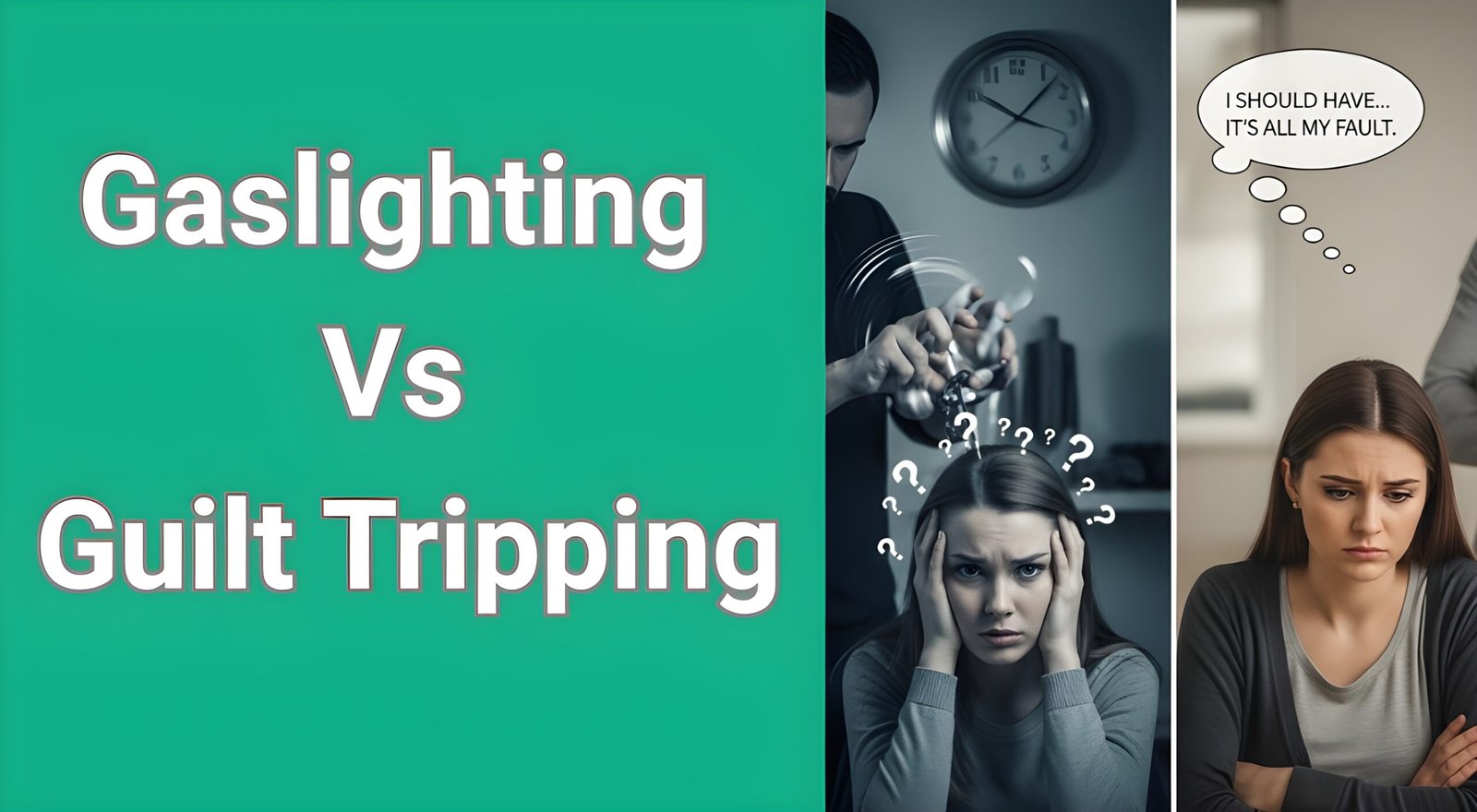
No, DARVO is not the same as gaslighting, though the two often appear together and the first step of DARVO usually involves gaslighting. The direct answer is that gaslighting is a long, ongoing campaign to make you doubt your own perception, while DARVO is a specific three step response to being confronted. Gaslighting can happen at any time. DARVO is triggered by accountability.
| DARVO | Gaslighting | |
|---|---|---|
| What it is | A three step response to being confronted | A broader pattern of making someone doubt their reality |
| When it happens | Triggered by confrontation or accountability | Ongoing, in everyday conversations, over months or years |
| Primary goal | Escape accountability for a specific thing | Undermine trust in your own perception |
| Who it targets | You and the people watching | Mainly you, inside your own mind |
| How it feels | Sudden confusion and role reversal in one conversation | Slow, chronic self doubt that builds over time |
| How it ends | You apologise for raising the concern | You stop trusting your memory at all |
Gaslighting is often one of the tools used inside a DARVO response, especially in the denial step, where your memory or your reading of events is actively undermined. But gaslighting can also happen on its own, in ordinary conversations, without the full three step structure. Think of it this way. Gaslighting prepares the ground. DARVO exploits it. A person whose perception has already been eroded by months of gaslighting is far more vulnerable to DARVO, because the self doubt that gaslighting installed makes the denial, the attack, and the reversal all more effective. The guide on what gaslighting is in relationships explains the longer pattern in full, and it is worth reading alongside this one if the denial you face is not a one off but a daily feature of the relationship.
How Is DARVO Different From Blame Shifting, Projection, and Whataboutism
DARVO gets confused with three nearby tactics, and the differences matter, because each one needs a different response. The direct answer is that blame shifting, projection, and whataboutism are single moves, while DARVO is a full three step sequence that ends in role reversal.
| Tactic | What it does | How it differs from DARVO |
|---|---|---|
| Blame shifting | Moves responsibility for a behaviour onto you | One move only. DARVO adds denial first and role reversal last |
| Projection | Accuses you of the very thing the other person did | One accusation only. DARVO is a sequence, and the reversal is the final step, not the whole pattern |
| Whataboutism | Answers your concern with an unrelated accusation about you | A deflection inside the attack step. DARVO contains it, but DARVO is the whole three step arc |
| DARVO | Denies, attacks, then reverses victim and offender | The full sequence, triggered by confrontation, ending with the offender as victim |
An example makes the difference clear. Blame shifting on its own sounds like this. You forgot the appointment. Well, you never remind me about anything. That is one move, and you can answer it. Projection on its own sounds like this. You are the one lying. That is one accusation, and you can answer it. Whataboutism on its own sounds like this. You are upset about the money? What about the time you spent too much? That is one deflection, and you can answer it. DARVO runs all three ideas in order, and by the end you are not answering one move, you are comforting the person who hurt you. If you want the deeper picture of the single move, the guide on blame shifting sets out its ten signs in detail.
What Does a Fair Defence Look Like
This is the section most explainers skip, and it matters, because not every denial is DARVO. The direct answer is that a fair defence stays on the facts, while DARVO moves the subject onto you and then claims victimhood. Innocent people deny accusations, sometimes angrily. A strong defence is not DARVO. The reversal step is the signature.
| A fair defence | DARVO | |
|---|---|---|
| The subject | Stays on what happened | Moves onto your character, memory, and motives |
| The evidence | Offers facts, times, messages, witnesses | Offers no facts, only attacks on your credibility |
| Your role | You are a person raising a concern | You become the accused |
| The ending | The facts get discussed, even if you disagree | You end up apologising and comforting the other person |
| The feeling afterwards | Frustration, but clarity about what was said | Confusion, guilt, and doubt about your own memory |
Here is a fair defence in practice. You: You called me selfish in front of my family. Partner: I did not use that word. I said I thought the plan was selfish, not you, and I should not have said it in front of everyone. I am sorry about that part. Notice the difference. The facts are disputed, but the subject stays on the facts, and there is an acknowledgement of the part that was wrong. Compare that with the DARVO version, where the word is denied, your sensitivity is attacked, and you end up apologising. The first conversation can be resolved. The second one cannot, because the second one was never about the facts at all.
DARVO is also not proof of anything on its own. A defensive reaction does not settle whether the original concern was true. DARVO describes a shape a response takes. It does not decide the underlying question. That honesty matters. If you use the word DARVO as a verdict instead of a description, you lose the clarity it gives you.
Where Does DARVO Show Up
DARVO shows up wherever someone wants to avoid accountability and has enough standing to make their version stick. The direct answer is that it appears in romantic relationships, families, co-parenting, workplaces, and friendships, and the shape is the same in every setting, only the stakes change.
In a Romantic Relationship
This is the setting most people recognise first. You raise a concern about something that hurt you, perhaps a cruel comment, a broken promise, or money spent without telling you. The response denies it, attacks your sensitivity or your memory, and ends with the partner claiming to be the one who is attacked and unappreciated. Over time, the cost of raising anything becomes so high that you stop raising things at all. That silence is the goal. A relationship in which one person cannot raise a concern without being reversed is a relationship in which accountability has been switched off.
In a Family
In families, the third step does most of the damage, because it recruits everyone else. An adult child raises something that happened. The parent denies it, questions the child’s memory or stability, and then presents the raising of it as an attack on a parent who did their best. Other relatives, who would rather not decide, receive a version in which someone is being cruel to an elderly parent. Pressure then arrives from people who were not there. This is how a two person disagreement becomes a family position, and it overlaps closely with flying monkeys, where third parties are brought in to carry pressure rather than to establish facts. If this pattern is coming from a parent, the family system matters as much as the single conversation, because the whole family may be organised around the parent’s version of events.
In Co-Parenting and Family Court
In co-parenting, DARVO runs through messages, emails, and court filings. You raise a missed pickup, an unanswered message about a medical appointment, or a pattern of hostile texts. The response denies the agreement existed, attacks your parenting or your motives, and reframes you as the parent who is harassing, controlling, or alienating the children. In family court this becomes a formal strategy. A parent seeking protection can find themselves defending their own character, while the other parent is positioned as the victim of false allegations. The legal setting makes DARVO especially dangerous, because its effects carry real, enforceable consequences for you and your children.
There is one practical protection that matters more than any other in co-parenting. Keep everything in writing, in one place, with dates. A written record resists reinterpretation. When a message says one thing on Tuesday and the opposite on Friday, the record shows it, and no amount of denial can erase a timestamp. If your co-parent’s messages regularly turn hostile or go unanswered, a tool that reads the tone before you reply and keeps a clean timeline of what was said and when can change the whole dynamic. Co-Parenting Guard does exactly that for this problem. Its Message Analyser reads an incoming message and shows you the tone and the traps in it before you answer, ToneMeter keeps your own replies calm and child focused, and Chat Import and Timeline builds a dated record of every exchange, so a denied agreement is one tap away from the proof. You can try it free for 5 days at Co-Parenting Guard. It costs $9 a month or $79 a year after the trial.
In the Workplace
At work, DARVO runs through HR complaints, performance reviews, and team meetings. An employee raises a concern about a manager making demeaning comments. The manager says it was clearly a joke, accuses the employee of being too sensitive to work in a fast paced environment, and then reports to HR that the employee is creating a hostile dynamic. The complaint is now under the shadow of a counter allegation, and the manager is positioned as the victim of a campaign. Institutions do this too. A complaint is made, the organisation denies wrongdoing, questions the complainant’s motives or performance, and then frames the complaint as damaging to colleagues and to the institution’s reputation. Psychologist Jennifer Freyd called this institutional DARVO, and her research team found that the opposite, institutional courage, measurably protects employee health after workplace harassment. The 2023 study by Smidt, Adams-Clark, and Freyd, published in PLOS ONE, found that institutional courage buffers against institutional betrayal, protects employee health, and fosters organisational commitment following workplace sexual harassment. Psychology Today has also covered DARVO at work, noting that it can be deliberate and calculated, or reflexive and emotion driven. If this is happening at your work, document every interaction in writing, keep copies outside the workplace system, and get advice from a specialist employment adviser or union representative before raising a formal complaint.
In Friendships and Text Messages
In friendships, DARVO is often quieter, and that makes it harder to spot. You tell a friend that a comment at a gathering hurt you. They say it was completely misinterpreted, ask whether you have been looking for reasons to be offended lately, and then tell mutual friends they were blindsided by a sudden attack on their character. The group now has two stories, and the friend’s version is calmer, simpler, and easier to believe. In text messages the pattern is the same, only faster, because each message is short and the topic can flip in three lines. Save the thread. Read it back the next day, when the emotion has cooled, and watch where the subject changed. That is the moment DARVO ran.
What Happens With DARVO After Separation
DARVO does not end when the relationship ends. It intensifies. The direct answer is that after separation, DARVO moves into new channels: smear campaigns, family court, and mutual friends and family, all running at once.
The smear campaign is DARVO at social scale. The same denial, attack, and role reversal is deployed across mutual social networks, family systems, and legal proceedings simultaneously. The story told to the group is simple and calm. I did nothing wrong, I am being falsely accused, and the person accusing me is unstable, vindictive, or trying to destroy my life. Because the story is simple and the person telling it is calm, it is easy for others to accept. The survivor’s story is longer, more emotional, and harder to tell, and that works against them.
Flying monkeys are the people who carry the reversed story for the person using DARVO. They are usually not malicious. They are friends, family members, or colleagues who heard one calm version first and now repeat it, often with genuine concern. They call you and say, you should really apologise, or, you are hurting them, have you thought about how this looks? They believe they are helping. What they are doing is delivering the attack and the reversal on someone else’s behalf.
If this is happening to you, do not try to win the group back with a longer version of your story. Groups do not decide by evidence, they decide by comfort. Say your piece once, in writing, to the people who matter, and then stop. The people who know you will come back. The people who needed the simple story were never going to hold the complicated one. Your energy belongs with the record, the legal advice, and the people who stayed.
Why Does DARVO Work So Well
DARVO works because it exploits five real weaknesses in how people handle conflict. The direct answer is that it is not magic and it is not your fault for falling for it. It is a sequence built to use ordinary human habits against you.
First, it exploits a real asymmetry. You are raising a difficult issue, and you are usually uncertain and hoping to be heard. The person using DARVO is certain and playing offence. Confidence is persuasive to observers regardless of accuracy, and certainty beats hesitation in front of an audience every time.
Second, each step invites a reply. Denial invites evidence. Attack invites self defence. Reversal invites reassurance. Answer any of them and you are working inside the frame the other person chose, several steps from the original point. The exchange ends with you having said a great deal about yourself and nothing further about what happened.
Third, it creates symmetry where there was none. Once both parties are making accusations, an outside observer sees a messy dispute between two people rather than an allegation and a response. For anyone who would rather not adjudicate, that symmetry is a relief, which is why it is so readily accepted.
Fourth, it is emotionally cheaper for bystanders to believe. Believing an allegation usually requires doing something. Concluding that it is complicated does not. DARVO supplies the second option, gift wrapped.
Fifth, it uses betrayal blindness. Freyd’s term describes what happens when awareness of a betrayal would threaten a relationship the witness depends on or values. A bystander who is socially, professionally, or emotionally invested in the person using DARVO cannot afford, psychologically, to fully believe you. The mind protects the relationship by finding reasons to doubt the account that threatens it. Your presentation, distressed, perhaps inconsistent, perhaps unable to produce documentation of events that happened in private, provides sufficient grounds for that doubt. The other person’s presentation, calm, morally aggrieved, consistent, does not. The bystanders who did not believe you were not simply reading the situation incorrectly. They were responding to a tactic designed to produce exactly that result.
What Does DARVO Do to You Over Time
The effects of repeated DARVO are real, and they accumulate. The direct answer is that DARVO does not just win one argument. It changes how you see yourself, how you speak, and whether you speak at all.
Chronic self doubt is the first effect. After enough conversations where your memory and perception are challenged, it becomes difficult to trust your own version of events, even when you know what happened. You start rehearsing concerns carefully before raising them, anticipating the attack, softening the accusation, pre-emptively conceding ground. Often, by the time you speak, the concern has been diluted to the point where it carries no accountability at all.
Self blame follows. A 2017 study by Harsey, Zurbriggen, and Freyd found that the more a person was exposed to DARVO, the more likely they were to blame themselves for the abuse they experienced. That finding is the heart of the pattern. If every confrontation ends with you positioned as the problem, you eventually internalise that position. The other person’s narrative becomes your own internal narrative.
Anticipatory anxiety comes next. You start dreading conversations before they happen, knowing from experience how they tend to end. Some people begin avoiding bringing up concerns entirely, because the aftermath feels too exhausting. Over time, many people in relationships with consistent DARVO stop raising concerns at all. That silence is what makes the pattern especially dangerous, because it creates an environment where harmful behaviour can continue unchecked.
Isolation is the fourth effect. If the person using DARVO has spoken to others with a reversed narrative, you may find yourself socially isolated, or feeling like you have to prove your experience to mutual friends. And guilt and confusion are the fifth. The reversal step introduces real guilt. They looked so hurt. Maybe you were too harsh. Maybe the whole thing really was your fault. That confusion makes it very hard to assess any situation involving the other person clearly.
The effect on observers is just as well documented. A 2020 study by Harsey and Freyd found that observers exposed to a DARVO sequence rated the perpetrator as less abusive, less responsible, and more credible, while rating the survivor as more abusive, more responsible, and less credible. A 2023 study with undergraduate students found the same shape of result. Participants rated perpetrators who used DARVO as less abusive, less responsible, and more believable than perpetrators who did not use DARVO, and rated survivors as less believable and more abusive. One DARVO sequence was enough to shift third party perception in the perpetrator’s favour. And a 2022 study of 89 women who had experienced sexual assault while at college found that almost half had experienced DARVO tactics from the person who abused them when they had further contact with them.
There is one piece of good news in the research. The same 2020 study found that people who had been educated in DARVO methods found perpetrators less believable and survivors more believable. Simply learning what DARVO is makes it less effective. Reading this article has already changed how the pattern will land on you next time.
DARVO also feeds the trauma bond. When the same person who hurts you is also the person who comforts you after the reversal, the cycle of harm and relief binds you tighter to them. Each DARVO exchange ends with you soothing the person who hurt you, and that soothing feels like closeness. It is not closeness. It is the pattern completing itself. If that cycle sounds familiar, the guide on how to break a trauma bond with a narcissist explains why the bond forms and how to loosen it.
How Do You Know If DARVO Is Happening to You
DARVO is designed to disorient, so it can be hard to identify while it is happening. The direct answer is that three features together are the clearest test, and a short self-check can confirm what you are feeling.
Answer these ten questions honestly. Count how many you answer yes to.
- Do you regularly end up apologising after bringing up something that bothered you?
- Do you walk away from difficult conversations unsure of what was even said?
- Do you spend hours or days afterwards replaying the conversation and questioning your own memory?
- Does the other person’s response to your concerns consistently focus on your flaws, not their behaviour?
- Do you feel like you can never raise anything without it becoming a whole thing?
- Have you started self censoring, anticipating how things will be turned back on you?
- Have mutual friends or family heard a version of events in which you were the problem?
- Do conversations about what the other person did somehow always end with you comforting them?
- Do you feel more confused and more self doubting after the confrontation than before it?
- Is the person you confronted now positioned as the one who has been harmed by the exchange?
If you answered yes to 0 to 2, you are probably dealing with ordinary defensiveness or a bad argument, not DARVO. If you answered yes to 3 to 5, the pattern is present and worth watching, especially if the same shape repeats. If you answered yes to 6 or more, you are very likely experiencing DARVO as a regular pattern, and the steps in the next two sections are the ones to use. This check is an educational guide, not a diagnosis of anyone. It describes a pattern of behaviour, and it does not diagnose the other person or you.
What Do You Say When DARVO Is Happening
You cannot force someone else to take accountability. But you can change how you respond in the moment, and that shift matters. The direct answer is that the strongest response is to name the structure, return to the original point once, and disengage from the reversal. Here are seven scripts, including text message versions, that do exactly that.
1. Name the structure, not the steps. I notice we have moved from what I raised to what is wrong with me. I am going back to the original point. This is the one move the pattern does not have a ready answer for, because it addresses the conversation rather than its content. Use it out loud only if it feels safe. In many situations the internal version, this is DARVO, I know this shape, is the safer and more powerful use.
2. Say the thing once, plainly, in writing where possible. A short written account resists reinterpretation better than a conversation, and it stops the record depending on anyone’s memory. Text version: I am writing this down so we both have the same record. On Tuesday you agreed to pick the kids up at 4. They waited until 5. I need that to be addressed.
3. Refuse the symmetry. Do not accept a framing in which both sides made accusations and everyone should apologise, if that is not what happened. Script: I am not going to apologise for raising this. We can talk about what happened, or we can stop here.
4. Do not chase the attack. If someone attacks your character or memory, you do not have to defend yourself. Defending yourself only takes you further from the original point. Script: I am not interested in arguing about that right now. I want to talk about this specific thing.
5. Disengage from the reversal. The reversal needs an audience. Removing yourself removes it. Script: I can see you are upset. I am not going to be able to continue this conversation right now. Ending the conversation is not defeat. It is the removal of the audience the reversal requires. Text version: I am stepping away from this conversation now. I will come back to the original point tomorrow.
6. Expect the reversal in advance. Deciding beforehand what you will do when you are told you are the real aggressor removes most of its force. It lands hardest when it is a surprise. Before a difficult conversation, write down the one sentence you will return to, and the line you will use to leave. Then use them, exactly as written, even if your voice shakes.
7. Keep at least one person outside it. The reversal works by isolating your account. One person who has the whole thing, consistently, is the most effective countermeasure available. Tell a trusted friend, a family member, or a therapist the full version, with dates, and keep telling them. If you want more scripts for the exact words, the guide on how to respond to DARVO gives nine exact scripts that shut down the blame flip.
What never to do: do not present more evidence after the denial, because the denial was never about evidence. Do not defend your character after the attack, because the attack was never about your character. Do not comfort the reversal, because the distress is the mechanism, not a side effect. Do not accuse the person of doing DARVO in the middle of the conversation, because that usually escalates the attack and gives them a new thing to deny. And do not keep arguing in the hope of an admission. The purpose of the pattern is to make the admission unnecessary, so going in for acknowledgement means going in for the one outcome it is built to prevent.
Can Someone Who Uses DARVO Change
The honest answer is that it depends, and it is usually not quick. The direct answer is that change is possible, but only if the person using DARVO develops awareness of the pattern and becomes willing to sit with the discomfort of accountability instead of deflecting it.
DARVO often functions as an automatic defensive response, which means the person using it may not even fully realise they are doing it. Some people use it deliberately and strategically. Others run it as a reflex they learned in childhood, in a home where blame was always deflected outward. The effect on you is the same either way, and intent does not change what you should do next.
For change to happen, three things are needed. Awareness of the pattern, willingness to feel shame without converting it into attack, and professional support, usually individual therapy focused on accountability, shame, and communication. Some people do this work. But they have to want to, and that wanting has to come from within, not from you working harder to explain yourself or finding the right way to raise concerns.
If you are in a relationship where DARVO is a consistent pattern and the other person has shown no interest in examining their own behaviour, that is important information about what you can reasonably expect going forward. You cannot change them by being clearer, calmer, or kinder. You can only change what you accept, what you document, and when you leave the room.
Your 7 Day First Steps Plan
Knowing what DARVO is changes how it lands. The next step is to turn that knowledge into a habit. The direct answer is that seven small days of practice will do more than one long argument ever will.
Day 1. Write down the last DARVO conversation from memory, with dates and exact words where you can recall them. Label the three steps in the margin. Seeing it on paper is the moment it stops feeling like fog.
Day 2. Choose your one return sentence and your one exit line, and write them on your phone. Your return sentence is: I hear that you are upset. I want to come back to what I raised. Your exit line is: I am stepping away from this conversation now.
Day 3. Tell one trusted person the whole story, with dates. Ask them to hold it with you, and to tell you plainly if the shape repeats.
Day 4. Start the DARVO log below. One line per incident, filled in the same day, every time.
Day 5. Practise saying your return sentence out loud, three times, in a calm voice. It will feel strange. That is normal. You are building a reflex to replace the old one, which was to defend yourself.
Day 6. Move one recurring conversation into writing. If the pattern usually runs by phone or face to face, send the concern by text or email instead, and keep the reply thread.
Day 7. Read your log back. Count how many times the three steps ran in the same order. That count is your evidence, for yourself first, and for any professional you speak to later.
A Printable DARVO Log
Copy this table into a notebook or a notes app. Fill it in the same day, every time, in your own words.
| Date and time | What I raised, in one sentence | What they denied | What they attacked | How the roles reversed | What I did next |
|---|---|---|---|---|---|
Three rows are enough to see the shape. Ten rows are enough to stop doubting yourself. If the situation involves monitoring, financial control, isolation, or fear of someone’s reaction, this is no longer a difficult conversation, it is coercive control, and you should speak to a qualified local professional promptly and make a safety plan before confronting anything.
Frequently Asked Questions
What does DARVO stand for?
DARVO stands for Deny, Attack, Reverse Victim and Offender. It describes a pattern in which someone confronted about harmful behaviour denies it, attacks the credibility of the person raising it, and then presents themselves as the real victim of an unfair accusation.
What is DARVO in simple terms?
DARVO is what happens when you raise a concern and end up apologising for it. The other person says it never happened, then says something is wrong with you for bringing it up, then claims they are the one being hurt. The original concern is never addressed.
What is an example of DARVO?
You tell your partner they called you selfish in front of your family. They say they never said it, then say you always exaggerate and collect people to gang up on them, then say they are the one being attacked after everything they do for you. You end up apologising. The word selfish is never discussed.
What does the O in DARVO stand for?
The O stands for Offender. The full phrase is Reverse Victim and Offender, meaning the roles of victim and offender are swapped, so the person who caused the harm is treated as the victim and the person who was hurt is treated as the offender.
Is DARVO the same as gaslighting?
No, though they often appear together. Gaslighting is a long, ongoing pattern of making you doubt your perception. DARVO is a specific three step response to being confronted, and its distinguishing feature is the role reversal at the end. Gaslighting often appears inside the denial step of DARVO.
Is DARVO a form of narcissistic abuse?
DARVO is strongly associated with narcissistic abuse, but the two are not interchangeable. Narcissistic abuse is a broader pattern that can include love bombing, devaluation, stonewalling, and smear campaigns. DARVO is one specific tactic that frequently appears inside that pattern, especially during conflict. DARVO can also be used by people who do not have narcissistic traits at all.
Is DARVO emotional abuse?
Yes, when it is used repeatedly as a way to avoid accountability, DARVO is a form of emotional abuse. It works by denying your experience, attacking your credibility, and reversing blame onto you, which over time produces self doubt, self blame, and silence. A single defensive argument is not emotional abuse. A repeated pattern is.
Can DARVO happen unintentionally?
Yes. Many people use DARVO automatically, without a plan, because it works and because accepting responsibility for harm feels intolerable. It is often a reflex learned in childhood, in a home where blame was always deflected outward. Unintentional does not mean harmless. The effect on the person confronting them is the same.
Is DARVO a mental health disorder?
No. DARVO is a behavioural pattern, not a clinical diagnosis. It does not appear in the DSM-5 as a condition. It is a framework used by psychologists, therapists, and researchers to describe a specific type of response to confrontation.
How do you respond to DARVO?
Name the structure rather than answering each step, return to the original point once, in writing where possible, and disengage from the reversal. A useful line is: I notice we have moved from what I raised to what is wrong with me. I am going back to the original point. Do not defend your character, do not present more evidence, and do not comfort the reversal.
Can someone who uses DARVO change?
Change is possible, but it is not quick and it cannot be forced from the outside. The person has to develop awareness of the pattern, become willing to sit with the discomfort of accountability, and usually work with a therapist on shame and communication. If they show no interest in examining their behaviour, that tells you what to expect going forward.
What is institutional DARVO?
Institutional DARVO is the same three step pattern used by an organisation instead of a person. A university, a company, a church, or a police force denies wrongdoing, attacks the credibility of the person raising the concern, and positions itself as the victim of unfair criticism or a malicious allegation. Psychologist Jennifer Freyd described it as a particularly aggressive form of institutional betrayal. The opposite is institutional courage, which research links to better health outcomes for the people who raise concerns.
If you are tired of raising a concern and ending up apologising for it, the Gaslighting Recovery Bundle will help you hold your ground. It gives you the full map of gaslighting and DARVO, word for word scripts for the moments that flip, and a step by step plan for trusting your own perception again, for $47 (was $97). You can get it here: Gaslighting Recovery Bundle. Instant download, 30-Day Money-Back Guarantee.
You are not too sensitive. Your memory is not faulty. And noticing this pattern is not an attack on anyone, it is an act of clarity. The next time a conversation flips and you find yourself apologising for the thing you came to raise, you will know the shape. Deny, attack, reverse. Name it silently, return to the original point once, and step away when the reversal starts. The pattern only works while it stays invisible. Now you can see it, and seeing it is the beginning of the end of it.